
Part VII History and the Chef's Mindset
Chapter 26
Standing at the Counter — Customer Service, Omotenashi, and the Chef's Responsibility
A sushi chef handles raw fish with bare hands, right in front of the guests, and serves it to be eaten on the spot. In this chapter, you will learn three things as one connected "responsibility of the chef": the greetings and omotenashi (wholehearted hospitality) that build trust, the movements that let guests enjoy sushi at its best, and the rules that protect guests' lives.
In this chapter you will learn
- Explain why greetings, smiles, and the way you answer the phone decide how much a restaurant is trusted
- Practice good conduct at the counter, and the omotenashi that senses each guest's preferences
- Plan an omakase (chef's choice) meal, and ask about allergies and disliked foods before you start. Name the 9 specified allergenic ingredients
- Explain the temperature and time rules for takeout, the first steps after an incident, and how a chef returns to work after norovirus
- Explain what labels mean, how allergens differ from country to country, and the records and ethics to keep when working outside Japan (Grade 1)
26.1 Trust Begins with the First Word — Greetings, Smiles, and the Phone
Imagine you walk into a restaurant and no one notices you. You are left standing there. You would regret coming. Look guests in the eye and greet them with a smile. That alone makes guests feel welcome.
A loud shout without eye contact is a show of energy. It is not a greeting. What you need to convey is gratitude, "Thank you for coming," and a feeling, "Today I will take care of you as well as I can."
A smile is the foundation of trust
The Association sees a smile as a signal that says, "I am on your side. Please trust me." In the distant past, before people had language, living with other families was dangerous. In this view, people were able to live together once they could send this signal with a smile.
People have sharpened their ability to tell a real smile from a false one. So we instinctively avoid people who do not smile. Even in an age when advertising can build a reputation, what matters most is a heartfelt smile from the people who do the work. A smile is the first step to earning trust. Stand at the counter as if you were telling each guest, with a smile, "These ingredients are safe. Please enjoy them with peace of mind."
Answering the phone builds the restaurant's reputation
First-time guests make reservations based on borrowed, "temporary trust": a referral, or reviews online. Their first conversation with the restaurant is the phone call. Because they cannot see your face, they listen to your voice with all their attention. If you sound annoyed, they will imagine they will be treated carelessly on the day as well. Restaurants with many last-minute cancellations are usually restaurants that answer the phone poorly.
On the phone, speak more slowly than usual, a little louder, and brightly. When you speak slowly, callers feel the restaurant is attentive. A quiet voice makes callers think the restaurant is gloomy. Everyone in the restaurant practices this.
The word "brand" is said to come from "burned," as in a mark burned in with a hot iron. A brand is a sign of trust. For a small restaurant, the greeting and the phone call are the first chances to burn that mark into a guest's heart. The link between cleanliness and a restaurant's trust is covered in Chapter 31.
26.2 Conduct at the Counter
A chef's appearance is the first thing guests see of "this restaurant's hygiene." Change into clean chef's whites every day, and cover your hair with a cap or a headband. Keep your nails short. Do not wear rings, watches, or nail polish. Under the nails and under rings are the places most often missed when washing. Where soap cannot reach, Staphylococcus aureus (Chapter 3) stays behind.
Do your handwashing (double handwashing; see Chapter 4) where guests can see it. Guests outside Japan who are seeing a chef shape sushi with bare hands for the first time are the most reassured when they can check with their own eyes. When guests are watching, you cannot skip handwashing. It is a silent explanation to the guests, and also a promise to yourself.
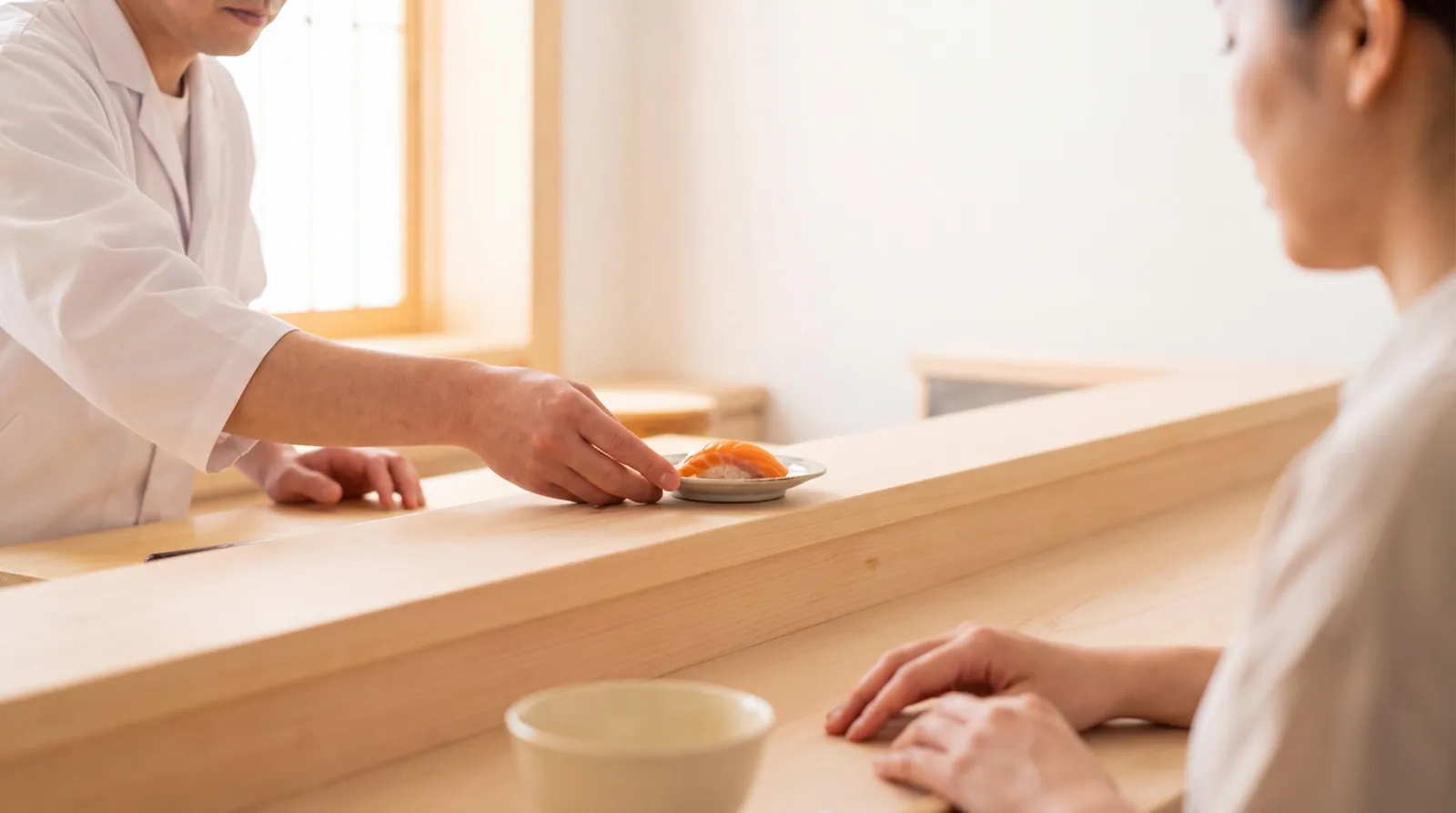
Each time a group of guests leaves, wipe the tsukedai (the ledge in front of the guests where nigiri is placed) with a clean cloth, and finish with a dry cloth. Use separate cloths for separate jobs. The refrigerated topping case is a refrigerator, not a display shelf. Open and close it as little as possible. Do not line it with pre-cut neta (toppings) just to make it look good (Chapter 5). Serve gari (pickled ginger) with tongs or chopsticks kept for that use. Never put gari that has come back from a guest's place into the container again.
Watching how fast each guest eats is the core skill of serving. From the moment a piece of nigiri is set down, its temperature and moisture begin to change. Wait until you see the previous piece go into the guest's mouth, then shape the next one (Chapter 24).
Timing, voice, and agari
The shorter the time from shaping to eating, the better. The ideal is within 10 seconds (Chapter 24). Aim to keep the inside of the topping case at 5°C or below. Speak loudly enough to be heard at the next seat, but not at the far end of the restaurant. Serve agari (green tea) hot and a little at a time, and replace it when it cools. The catechins in tea dissolve better the hotter the water used to brew it (Chapter 21).
26.3 Omotenashi — As If You Were Inviting Guests into Your Home
When you are unsure what good service is, imagine inviting someone important to your home and treating them to your best dish.
You would meet them at the door and thank them for coming. You would show them to their seat and tell them where the restroom is. If the food were not ready yet, you would serve drinks or a starter first.
A bad restaurant does the opposite. No eye contact, a silent walk to the table, and then the guests are left alone. If the host you visited shut themselves in the kitchen, absorbed in cooking, how would you feel as a guest?
A common mistake for cooks is this: they want so badly to serve delicious food that they neglect hospitality. Omotenashi means paying attention to whether a guest's glass is empty, watching their expression, reading what they want, and responding to it.
Sense each guest's preferences
Chefs tend to serve the same food to everyone. But at the counter, it is important to discover each guest's favorite flavors. At the start, ask about their favorite toppings, their taste preferences, and how much they can eat.
With sushi, preferences for saltiness and sourness differ especially clearly. At first, brush on a little extra nikiri and watch the guest's face. Squeeze on a little extra sudachi citrus and watch their reaction. In this way, you learn whether they like strong flavors, and whether they like or dislike sour things.
Understand what sourness does, and adjust it
Of the five basic tastes, sweetness and umami are said to be liked from birth. Bitterness, saltiness, and sourness are said to be tastes whose liking we learn through experience. Most spoiled foods turn sour. So in the past, avoiding sourness helped protect people from food poisoning. On the other hand, sourness increases appetite and sharpens the outline of other flavors.
Some people cannot finish a bowl of rice, about 150 g. Yet with sushi, they can sometimes eat 10 pieces or more. This is because vinegar increases appetite. Vinegar is also why fish tastes better with shari than as sashimi alone. The Association believes that the balance of sourness is the most important factor in whether a sushi restaurant is popular.
You can change the sourness for each guest. For guests who like sourness, prepare a separate nikiri with vinegar added and use it for them. You can also use a little more tezu (vinegared hand water), or squeeze on citrus (vinegar is covered in Chapter 8, and nikiri in Chapter 20).
Omotenashi lasts until you see guests off
When you invite guests to your home, you see them off outside your front door. The same goes for a restaurant. Starting to wash dishes, clean, or take a break while guests are still eating is the same as saying, "Please leave soon." The spirit of omotenashi shows all the way to seeing guests off.
26.4 Omakase and Okonomi
When guests order one piece at a time, it is called okonomi (ordering piece by piece). When the chef decides the order and serves the pieces, it is called omakase. Okonomi was the original style. Starting with high-end restaurants, omakase became the main style.
The basic flow of omakase is this. Start with mild white-fleshed fish and move on to rich, fatty fish. Refresh the palate with hikarimono (silver-skinned fish) cured in vinegar. Change the temperature and sweetness with simmered toppings (nimono). Finish with rolls (makimono) and tamagoyaki (Japanese omelet). This order suits the way the tongue works. After a strong flavor, the tongue has trouble sensing a weaker one. If you serve olive flounder (hirame) after toro (fatty tuna), the hirame's flavor will not stand out. Layer the season's peak ingredients onto this framework. Aim for about 10 to 15 pieces, and adjust the amount while watching the guest.
The Association does not think of omakase as a fixed set course. Guests believe that leaving it to the chef will bring them something more delicious, and they literally leave it to you. Approach the meal with this feeling: "Today, this guest has trusted me with everything." Otherwise, the chef becomes self-centered.
If a guest who loves tuna says they want to eat a lot of it, do so. Place cured sushi in between so the tuna's flavor stands out. Also ask early how much nigiri and how many small dishes they want, and tailor the meal to each person. When you have served everything, check whether the guest is full. If not, serve more. If guests leave unsatisfied, they will say, "Too little for the price."
Adapting to each guest tends to raise the bill. So tell guests at the start the price of the course, whether additions are possible, and the expected total.
With okonomi, repeat the order back to the guest and add a word about how that topping is today. Being able to say, "Today's mackerel is lightly cured," shows you understand your own prep work. If something is sold out, say so honestly and suggest an alternative. Quietly substituting a different fish is false labeling, and it can lead directly to an allergy incident.
The reasons behind the flow, and adjusting the amount
Sourness cuts through fat, so place the cured toppings after the fatty ones. Simmered toppings with sweet tsume (sweet reduced sauce) create a feeling of satisfaction near the end. In Edomae (Edo-style) sushi, tamagoyaki is considered the summary of all the restaurant's preparation work. Serving it last leaves a lingering impression. For women and older guests, make the rice ball for nigiri (shari-dama) a little smaller. "Market price" alone makes guests uneasy. If a guest says they are avoiding raw food, do not ask why. Rebuild the meal around cooked toppings.
26.5 Allergies and Guests with Dietary Restrictions
Whether you serve omakase or okonomi, before you start, ask every guest in the same words: "Are there any foods you are allergic to, or any foods you do not like?" A restaurant that skips this one question leaves its guests' lives to luck. If a guest answers, confirm whether it is a dislike or an allergy. For an allergy, you must not serve the food, and you must also use separate tools.
Under Japan's food labeling rules, 9 items are set as specified allergenic ingredients (allergens that must be labeled). They are foods that cause severe symptoms or affect many people. They are shrimp, crab, walnuts, wheat, buckwheat (soba), egg, milk, peanuts, and cashew nuts. Cashew nuts were added in April 2026. In addition, there are 20 items for which labeling is recommended in the same way. Many of them are familiar in sushi restaurants, such as abalone, squid, ikura (salmon roe), salmon, mackerel, sesame, and soybeans. Whether or not labeling is required, a chef has the responsibility to answer when asked.
| Item | Main examples in a sushi restaurant |
|---|---|
| Shrimp and crab | Kuruma prawns, crab, dashi made from shrimp shells |
| Egg | Tamagoyaki, oboro (sweet fish or shrimp floss), rolls made with mayonnaise |
| Wheat | Soy sauce, tsume, tempura batter |
| Buckwheat (soba) | Green-tea soba noodles, batter made with buckwheat flour |
| Milk, walnuts, peanuts, and cashew nuts | Cheese and nuts in creative rolls |
| Soybeans and sesame (recommended items) | Soy sauce, miso, yuba (tofu skin), rolls made with sesame |
Soy sauce and tsume contain wheat. Tamagoyaki and mayonnaise contain egg. Allergy incidents happen less when the problem food is "served" and more when it gets "mixed in." Even an invisible amount can cause a severe reaction. It can transfer from a cutting board used to cut shrimp, or from a hand that touched crab. For a guest who has told you about an allergy, do not use tools that have only been washed. Use a dedicated, clean cutting board and knife. Wash your hands again, and take seasonings out separately. Washing does not bring the food's proteins down to zero. And the most important rule is this: when in doubt, do not serve it. Never serve something whose ingredients you cannot check yourself, thinking it is "probably fine."
Muslim guests ask for halal food, meaning food permitted by Islamic teachings. Here, the sake and mirin in nikiri, tsume, and sushi vinegar (awasezu) are the problem. If you cannot accommodate the request, say so honestly. A restaurant without certification must not call itself "halal-friendly." For vegetarian guests, dashi made with katsuobushi (dried bonito) and tamagoyaki are the hidden traps. For pregnant guests, do not recommend raw food, because of Listeria, which can grow even in the refrigerator. Also pay attention to methylmercury, which is high in large fish (Chapter 14). For young children and older people, too, let them know you can build a meal from cooked toppings.
The labeling rules, and the 20 recommended items
The 20 recommended items are almonds, abalone, squid, ikura, oranges, kiwifruit, beef, sesame, salmon, mackerel, soybeans, chicken, bananas, pistachios, pork, macadamia nuts, peaches, yamaimo (Japanese yam), apples, and gelatin. Under the law, the labeling requirement applies to processed foods in containers or packaging. Even so, write the allergens on your menu and on takeout items.
Allergens differ by country
The EU's 14 items are set by Regulation (EU) No 1169/2011. In the United States, sesame was added in 2023. Table 26-2 shows that fish, soybeans, and sesame are not mandatory in Japan, but they are covered in the EU and the United States.
| Category | Japan (9 mandatory items) | EU (14 items) | United States (9 items) | Main examples in a sushi restaurant |
|---|---|---|---|---|
| Crustaceans | Shrimp and crab | Covered | Covered | Kuruma prawns, crab, dashi from shrimp shells |
| Fish | Not covered (salmon and mackerel are recommended) | Covered | Covered | Almost all toppings, dashi from katsuobushi |
| Mollusks | Not covered (squid and abalone are recommended) | Covered | Not covered | Squid, octopus, akagai (ark shell), scallops, abalone |
| Egg | Covered | Covered | Covered | Tamagoyaki, oboro |
| Wheat and gluten | Wheat | Cereals containing gluten | Wheat | Soy sauce, tsume |
| Soybeans | Recommended | Covered | Covered | Soy sauce, miso, yuba |
| Sesame | Recommended | Covered | Covered (since 2023) | Sesame sauce |
| Milk, peanuts, and tree nuts | Milk, peanuts, walnuts, and cashew nuts (the 3 other tree nuts are recommended) | Covered | Covered | Cheese and nuts in creative rolls |
| Buckwheat | Covered | Not covered | Not covered | Green-tea soba noodles |
| Celery, mustard, sulfites, and lupin | Not covered | Covered | Not covered | Wine, imported processed foods, dishes dressed with mustard |
More on religious needs and on caring for vulnerable guests
Under halal rules, fish itself is generally considered permitted. But schools of Islamic law differ on shellfish and crustaceans, so ask the guest directly. For vegetarian guests, you can make kanpyo (dried gourd strip) rolls and kappamaki (cucumber rolls) with dashi made from kombu. Listeria can seriously harm an unborn baby. So be especially careful to avoid items that are not cooked and are refrigerated for a long time, such as smoked salmon (Chapter 3). On methylmercury, Japan's Ministry of Health, Labour and Welfare advises caution with large fish such as Pacific bluefin tuna, bigeye tuna, splendid alfonsino (kinmedai), and swordfish. For pregnant women, the guideline is about once a week, at 80 g per serving. Guests with weakened immune systems are also likely to become seriously ill.
26.6 Temperature and Time for Takeout
Once takeout sushi is handed over, temperature control leaves the restaurant's hands. But the responsibility stays with the restaurant. Before handing it over, always do these four things (Chapter 5).
- Keep it at 10°C or below Chill the toppings and the containers before packing, and keep the sushi at 10°C or below with ice packs. Cold air sinks, so place the ice packs on top. Put everything in an insulated bag. The acid in the vinegared rice slows the growth of bacteria, but it does not stop it.
- Write the time and the limit Write on the container the time it was made and "Please eat within X hours," and also tell the guest out loud. This corresponds to a use-by date (the limit for eating safely). Tell the guest not to eat it after that time.
- Shorten the time for the season and conditions A common guideline in the United States is within 2 hours if the food cannot be refrigerated, and within 1 hour if the air temperature is above 32°C (90°F). In summer, shorten the time. You may also refuse takeout orders for raw items.
- Write down what is inside Attach a note listing the toppings, seasonings, and allergens used. At the very least, list the 9 specified allergenic ingredients. You do not know who will eat it.
For delivery, make an insulated bag a condition, and set an upper limit on delivery time. Even if someone else does the delivery, the responsibility lies with the restaurant.
Why 10°C, and keeping delivery records
Vibrio parahaemolyticus grows much more slowly at 10°C or below (Chapter 3). Seal the containers tightly to prevent drying and condensation. In summer, the inside of a car can go above 50°C. Record the times from the order to the completed delivery.
26.7 Explaining Labels Correctly to Guests
A use-by date is "the limit for eating safely." It is put on foods that spoil easily and may be dangerous after the date, such as sashimi and sushi. A best-before date is "the limit for eating at best quality." It is put on foods that keep well, such as canned foods, dried foods, vinegar, and soy sauce. Food a little past its best-before date is not immediately dangerous. But a use-by date is the limit of safety, so throw away anything even 1 day past it.
The date is set by taking the number of days found through tests such as microbial tests, and multiplying it by a safety factor smaller than 1. The national guidelines ask that this factor be kept close to 1, so the margin is not large. Explain to guests: "The date is a guide for when the package is unopened and stored as labeled. If you take it home and leave it at room temperature, the date no longer applies from that point."
In Japan, seafood eaten raw is subject to standards and specifications under Japan's Food Sanitation Act. Fresh seafood for raw consumption must have 100 or fewer Vibrio parahaemolyticus per 1 g. The rules also require, for example, that it be processed with drinkable water or sterilized seawater, and stored at 10°C or below. Only products that meet these standards can be labeled "for raw consumption." Serving shellfish labeled "for cooking" raw is against the law, and it is a cause of food poisoning (Chapter 18). For fresh seafood, it is mandatory to label thawed products "thawed" and farmed products "farmed." You do not have to write "wild." But if you do, it must be true.
There is no need to hide "thawed" or "farmed." Tuna frozen at a very low temperature carries practically no risk from parasites (Chapter 12). Farmed fish raised on controlled feed have a consistent fat content. If you can explain this, writing it honestly will not cost you trust.
26.8 When an Incident Happens
Someday you will get a call that says, "I got sick after eating at your restaurant." How you act first decides how far the harm spreads and what becomes of the restaurant. There is one principle: do not hide anything.
- Listen and write it down Do not deny anything or make excuses. Ask for and record the date and time of the visit, the number of people, what they ate, when they started feeling sick, their symptoms, whether they saw a doctor, and their contact details. Never say, "That's impossible here," before the facts are known.
- Urge them to see a doctor, and contact the public health center yourself If the symptoms are severe, urge them to see a doctor right away. If a doctor diagnoses food poisoning, the doctor reports it to the public health center (hokenjo). But do not wait for that. Contact the center from the restaurant, and cooperate with the investigation.
- Gather the retained samples and records Retained food samples are small portions of the dishes and ingredients you served, set aside and frozen for testing. Gather the retained samples, purchase slips, refrigerator temperature records, and staff health records. Also find out which other guests ate the same items.
- Decide whether to stop business While the cause is unknown, stop business on your own. There is no need to wait for an order from the authorities.
- Apologize and prevent it from happening again Accept that the restaurant may be the cause, and apologize sincerely. Check purchasing, temperatures, processes, and staff health one by one to find the cause. Share what you fixed with everyone.
Under Japan's rules for large-scale cooking facilities, about 50 g of each dish and each ingredient is sealed and stored at −20°C or below for at least 2 weeks as a retained sample. A small restaurant can also freeze samples on days with banquets or catering. They can help find the cause, and they can also prove that the restaurant was not the cause.
Reports, official orders, insurance, and handling complaints
A doctor who diagnoses food poisoning is required to report it to the public health center within 24 hours. A restaurant that contacted the center itself is trusted differently afterward from one that was reported. An order to suspend business is issued by a prefectural governor or a similar authority. But it is the restaurant's responsibility to stop without waiting for that. Work with your insurance company on medical costs and sympathy payments. Before opening, check whether you have product liability insurance (PL insurance), insurance for sympathy payments after food poisoning, and coverage for lost business. There are four basics for handling complaints. Listen to the end. Separate facts from feelings. Have the person in charge respond. Keep a record.
26.9 Managing the Chef's Own Health
The biggest possible source of contamination in a restaurant is the chef's own body. Every morning, check for diarrhea, vomiting, or fever. If you have symptoms, do not touch raw food.
Be especially careful about norovirus (Chapter 3). Just 10 to 100 virus particles can cause infection, and alcohol sanitizer does not work well against it. In Japan, it is the cause of food poisoning with the largest number of patients, and most cases pass through the hands of the people preparing food. What makes it frightening is that even after the symptoms stop, the virus keeps coming out in the stool for about 1 week, and sometimes for as long as about 1 month. So a chef who has had norovirus does not do any work that involves touching food directly until a stool test confirms the virus is gone. This approach follows the rules for large-scale cooking facilities.
As a guideline, take a stool test at least once a month. From October through March, adding a norovirus test is recommended. If a family member you live with is vomiting or has diarrhea, report it too, because you may be carrying the virus. If you have a cut or infection on your hand, assume Staphylococcus aureus is multiplying there. Cover it with a waterproof bandage and a glove, and also step away from any job that involves touching food with bare hands.
26.10 Running a Restaurant Outside Japan
Outside Japan, what is common sense in Japan is not the local law. The order of priority is first, local law; second, science; and third, the Japanese way. Restaurants that serve raw fish are often asked for freezing records for parasite control and for proof of their suppliers. In the United States, there is a rule that menus must carry a notice about raw foods. Many states also generally prohibit touching ready-to-eat food with bare hands. How to obtain permits and file notifications is covered in Chapter 29.
Arguing back that "this is how we do it in Japan" will not work. What works is explaining the reasons. If you want to shape sushi with bare hands, one way is to document your handwashing, tezu, and control of acidity and time for the vinegared rice, and have the authorities approve it (Chapter 6). HACCP is a hygiene management method. You think ahead about hazards such as food poisoning, set standards for the key steps, and check them with records. In Japan too, since June 2021, it has been required in principle for all food business operators. Record temperatures, freezing times, sanitizer concentrations, and staff health every day. When you make sushi with local fish, do not pretend it replaces Japanese toppings. Present it honestly as "the sushi of that place."
Inspections, training, and the ethics of local fish
In many countries, health authorities inspect restaurants both before opening and during operation, and HACCP is a condition for opening. Freezing standards are covered in Chapters 1 and 12. Train staff in the local language, using written documents that give both the procedures and the reasons. Never serve raw freshwater fish, which often carry parasites, or tropical coral-reef fish that may carry ciguatera toxin (Appendix B), while claiming they are the same as Japanese sushi. Choose safe local fish, and apply freezing and shigoto (preparation work) when needed. Claiming that something different is the same disgraces the name of the chef.
26.11 "The Customer Is God," and Trust as Savings
Some people take "the customer is god" to mean that the customer is the most important person, so you must obey even unreasonable demands. For that reason, some people cannot agree with this saying.
The Association supports this idea, but understands it differently. If you listen to guests, notice their hints, and work in the direction they show you, guests will one day make your wishes come true. Guests are god not because they are the most important people, but because they are the ones who make your wishes and dreams come true.
For example, suppose you earn a salary of 300,000 yen a month and do work worth 1,000,000 yen. You receive 300,000 yen in money. But the remaining 700,000 yen is something you save every month in the form of trust.
How these savings come back differs from person to person. Your salary may rise. A senior colleague who opened their own restaurant may invite you to join. You may be put in charge as head chef. If you keep offering omotenashi at the counter, you will gain more fans among your guests. When you open your own restaurant, people may appear who help with funding or design, or who send you guests.
If you work only 300,000 yen's worth because your salary is 300,000 yen, your own value also stops at 300,000 yen. If you give your all for your guests, the best companions will gather around you, and your life will become richer. In this sense, the Association says it once again: "The customer is god."
The mindset the Association asks of chefs
The Japan Sushi Association asks chefs to keep three things in mind. First, be aware that this is work that holds people's lives in your hands, where a single mistake can take a guest's life. Second, do not serve what you do not know. Saying no is a sign of sincerity. Third, keep learning. Hygiene standards, labeling systems, and even the numbers in this book are revised year by year. Wherever in the world you shape sushi, it is the chef's responsibility to protect guests to the same standard.
Chapter summary
- Look guests in the eye and greet them with a smile. Answer the phone slowly, a little louder, and brightly. Smiles and phone manners build a small restaurant's trust and reputation.
- Your appearance, handwashing that guests can see, wiping the tsukedai, handling the topping case, and watching how fast guests eat are all movements for one purpose: having guests eat safely and enjoy the food.
- Omotenashi is the same as inviting guests into your home. Do not get lost in cooking. Sense each guest's preferences, check the amount, and pay attention all the way to seeing guests off. You can change the sourness for each guest with nikiri, tezu, and citrus (Grade 1).
- Omakase goes from mild toppings to fatty ones, then cured toppings, simmered toppings, and finally rolls and tamagoyaki. Before you start, ask every guest about allergies and dislikes, and state the price clearly.
- There are 9 specified allergenic ingredients. For a guest who has reported an allergy, use a dedicated, clean cutting board and knife. When in doubt, do not serve it. For takeout, keep to 10°C or below and label it "within X hours."
- When you get a report of an incident, act without hiding anything. A chef who has had norovirus does not touch food directly until a stool test confirms the virus is gone. Throw away anything even 1 day past its use-by date, and label "thawed" and "farmed" honestly (Grade 1).
- "The customer is god" means guests are the ones who make your wishes come true. Work beyond your salary becomes savings in the form of trust.
Review questions
Q1 Which is the most appropriate way to serve sushi to a guest who has reported an allergy?
a Rinse the cutting board used to cut shrimp with water, then use the same board to cut white-fleshed fish and serve it
b If you do not use the problem food, it is fine to share tools
c Use a dedicated, clean cutting board and knife, wash your hands again, take seasonings out separately, and do not serve anything whose ingredients are unknown
d If the guest says "a little is fine," you may serve as usual
e If the menu carries a warning notice, the restaurant is no longer responsible
Answer: c
Allergy incidents also happen when an invisible amount gets "mixed in." Washing does not completely remove the food's proteins, so use dedicated, clean tools, and keep your hands and seasonings separate too. Do not serve anything whose ingredients you cannot check. Choices a and b cannot prevent mixing. Choice d leaves the danger to the guest's words, and the warning notice in choice e does not prevent mixing.
Q2 Which way of taking reservation calls does the Association recommend?
a At busy times, talk fast, take only the essentials, and hang up
b Speak more slowly than usual, a little louder, and brightly
c Speak quietly so the restaurant seems calm
d The phone is only for confirming reservations, so no practice is needed no matter who answers
e If the online reviews are good, you do not need to worry about phone manners
Answer: b
For first-time guests, the reservation call is their first contact with the restaurant. Because they cannot see your face, they focus on your voice. Speaking slowly makes callers feel the restaurant is attentive, and a quiet voice makes them think the restaurant is gloomy. Phone manners build the restaurant's reputation, so everyone in the restaurant practices.
Q3 Which statement about use-by dates and best-before dates is correct?
a A use-by date is "the limit for eating at best quality," so it is fine to eat food a little past it
b Best-before dates are put on foods that spoil easily, such as sushi and sashimi
c A use-by date is the limit for eating safely, so throw away anything even 1 day past it
d The date stays valid in the same way even after the package is opened and left at room temperature
e The national guidelines ask that the safety factor used to set the date be made as small as possible
Answer: c
A use-by date is the limit of safety. It is put on foods that spoil easily, such as sushi and sashimi. A best-before date is a guide to quality. It is put on foods that keep well, such as canned foods and soy sauce. The date applies when the package is unopened and stored as labeled. The national guidelines ask that the safety factor be kept close to 1, so the margin is not large.