
Part VII History and the Chef's Mindset
Chapter 25
The History of Sushi: From Street Stalls to the World
Sushi did not always look the way it does today. It began as a preserved food, a way to eat fish without letting it spoil. It became a quick meal at the street stalls of Edo, and today it is made all over the world. This chapter is meant to be read as a story. It follows sushi's journey of more than a thousand years. The goal is for you to be able to talk about it accurately, and enjoyably, when a guest at the counter asks.
In this chapter you will learn
- To explain the differences between nare-zushi, namanare, haya-zushi, and nigiri, linking each to how it protects the fish
- To talk about the birth of nigiri sushi while separating the period we know for certain from the inventors, about whom there are several theories
- To explain how the Great Kanto Earthquake, postwar contract processing, the refrigerator, and conveyor-belt sushi changed sushi
- To name the main events in the spread of sushi outside Japan, with their dates
- To explain the changes in the forms of sushi from the principles of preservation: acid, moisture, and temperature (Grade 1)
25.1 The Beginning: Sushi Whose Rice Was Not Eaten
Sushi is thought to have originated outside Japan. The leading theory is that it was born in a region stretching from southwestern China to Laos and northeastern Thailand. This is rice-growing country, with rivers and paddy fields, far from the sea. Sushi was a way to keep the fish caught in paddies and rivers for a long time. It is believed to have spread through East Asia along with rice farming and reached Japan as well.
Its first form was nare-zushi (fermented sushi). The basic method is simple. Fish is gutted and packed in salt to draw out the water. Then it is packed into a wooden tub with cooked rice, weighed down with a stone, and left for several months to years.
Inside the tub, lactic acid bacteria multiply, feeding on the starch in the rice. They produce lactic acid, and the inside of the tub turns sour. The bacteria that spoil fish are weak against acid, so they cannot multiply. Slowly, the fish turns into a preserved food with a distinctive sourness and umami.
The surprising part is that the rice was not eaten. The rice was "feed" for the fermentation, and the broken-down rice was thrown away. Today, the shari (sushi rice) is one of the stars of sushi. At first, it was not even food.
Nare-zushi still survives in Japan. The best-known example is funa-zushi (fermented crucian carp sushi) from Lake Biwa in Shiga Prefecture. Nigorobuna, a crucian carp of Lake Biwa, is salted in spring, repacked in rice in summer, and eaten after the new year. In an age without refrigerators, people could keep fish for a year or more.
What protects nare-zushi is acid. In funa-zushi, the pH falls below 4 about 1 month after the fish is packed. Once the pH drops to around 4, most food poisoning bacteria cannot multiply. The salt, which has drawn out the water, also helps. For more than a thousand years, sushi has been a food that keeps itself safe with acid.
25.2 Sushi Carried to the Capital, and Namanare, Whose Rice Was Eaten
Sushi first appears in Japanese records in the Nara period. The Yoro Code, an 8th-century legal code, lists sushi, written with the old character 鮓, made from abalone and other shellfish, among the goods that provinces paid as tax to the capital. The Engishiki, a 10th-century code of procedures, also records that sushi of ayu (sweetfish), crucian carp, abalone, and other seafood was sent to the capital from many regions. Nare-zushi kept for a long time, so it could be carried to the capital from distant provinces.
In the Muromachi period, from the 14th to the 16th centuries, a big change took place. People shortened fermentation to a few days or a few weeks and began to eat the rice together with the fish while the rice still kept its shape. This is called namanare.
Because the fermentation is short, the fish tastes closer to raw. The lightly sour rice is also good to eat. On the other hand, the acid is weak, so it does not keep long. People chose "flavor" over "preservation." This was a major turning point that changed the character of sushi.
Sushi at the Imperial Court
The sushi sent to the capital was also served at banquets of the imperial court and the nobility. However, it was regarded less as a luxurious dish than as a high-grade preserved food protected by acid. From nare-zushi, whose rice was thrown away, sushi moved toward a dish in which rice and fish were eaten together. Namanare can be called the first form in which people chose to give up keeping quality in exchange for flavor.
25.3 The Arrival of Vinegar: Haya-zushi and Kasuzu
In the Edo period, a new method spread. Instead of waiting for fermentation, people made the rice sour from the start by mixing vinegar into it. This is haya-zushi (quick sushi). There was no longer any need to wait for months. Because it could be made in one night, it was also called ichiya-zushi (overnight sushi).
Hako-zushi (box sushi), or oshi-zushi (pressed sushi), in which vinegared rice and fish are packed into a wooden box and pressed, developed mainly in Osaka. It is still a pillar of sushi in the Kansai region today. Scattering toppings over vinegared rice, rolling, and pressing: many forms were born in this period. Without the spread of vinegar, there would be no sushi as we know it today.
Vinegar had long been made from rice. But for ordinary people to use it freely, they needed cheap vinegar. That is where kasuzu, a vinegar made from sake lees, came in. In 1804 (Bunka 1), Nakano Matazaemon, a sake brewer in Handa on the Chita Peninsula in Owari Province, began making kasuzu. This was the beginning of today's Mizkan.
Kasuzu could be made more cheaply than rice vinegar. It has strong umami and a reddish-brown color. Kasuzu from Handa was shipped to Edo and used in the vinegared rice for the nigiri sushi that was born soon after. This is the origin of reddish shari, known as akashari (red shari).
The Umami and Color of Kasuzu
The deep umami and brown color of kasuzu come from the sake lees it is made from. The amino acids and sugars in the sake lees produce umami and color during aging. You learned the chemistry of akazu (red vinegar) in Chapter 8. Access to a vinegar that could be mass-produced cheaply laid the foundation for the spread of sushi through the city of Edo.
25.4 The Street Stalls of Edo and the Birth of Nigiri Sushi
When, and Who Started It
The accepted view is that nigiri sushi, made by shaping vinegared rice by hand and placing fish on top, was born in Edo during the Bunsei era, around 1818 to 1830. The person best known as its creator is Hanaya Yohei. He was born in 1799 and died in 1858, and he opened Yohei-zushi in Ryogoku.
On the other hand, some see Sakaiya Matsugoro, who opened Matsu-ga-zushi in Atake, in the Fukagawa district, as the pioneer. Several restaurants in Edo at around the same time competed to perfect the form of nigiri. This view seems closest to what really happened.
So when you talk to guests, do not say flatly that "Yohei invented it." It is accurate to say this: "It was born in Edo around the Bunsei era, and it is said that the restaurants of Yohei, Matsugoro, and others made it popular. There are several theories about who created it."
Street-Stall Nigiri Was Large
Nigiri sushi spread as a quick food that the people of Edo ate standing up at street stalls (yatai). Today we would call it fast food. Each piece is said to have been 2 to 3 times the size of today's, about as big as a small onigiri (rice ball). People would eat one or two to fill a small hunger, then quickly move on. That was how it was eaten.
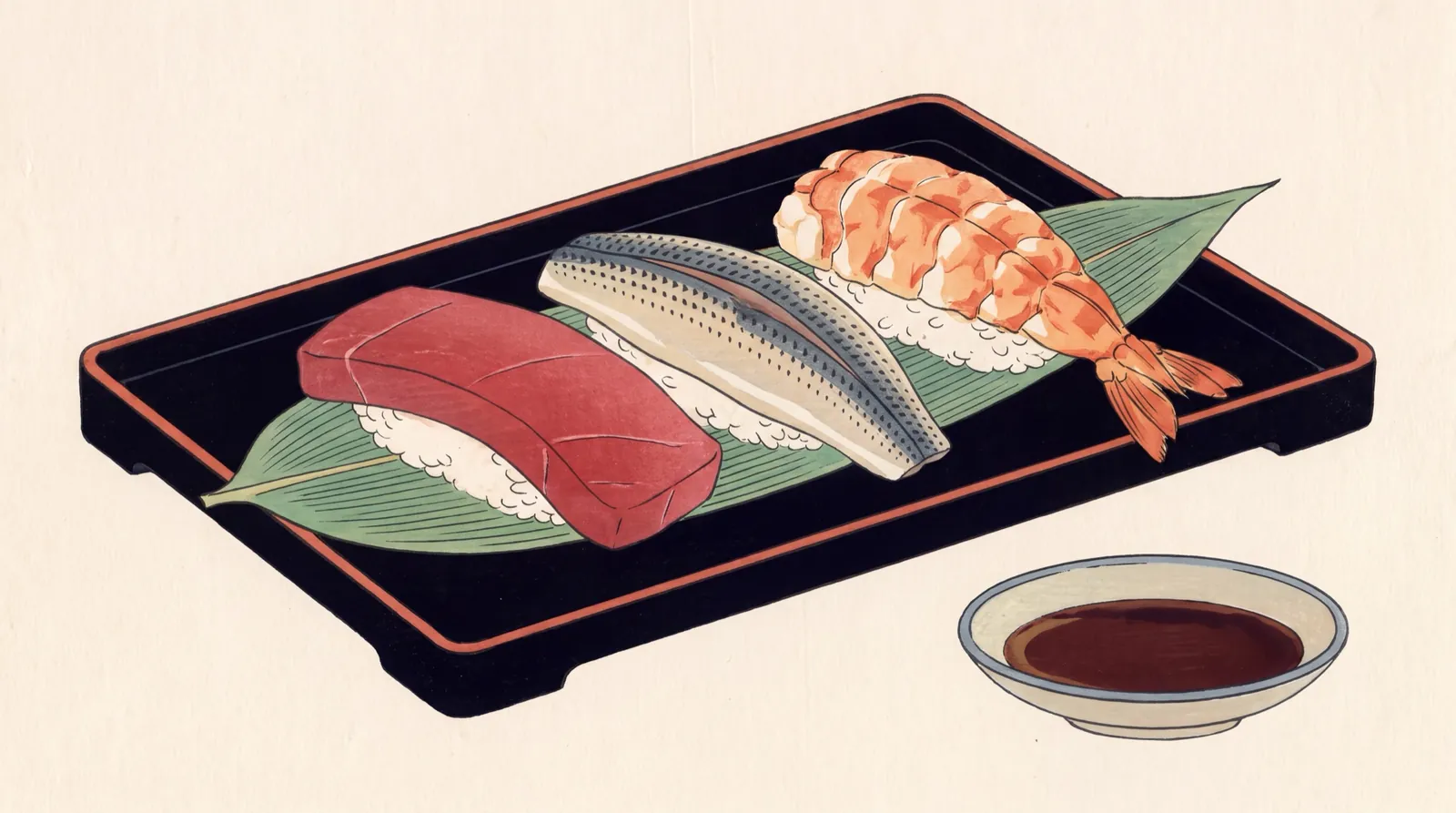
The neta (toppings) were fish and shellfish from Edo Bay, which spread out in front of Edo Castle and is today's Tokyo Bay. Kohada (gizzard shad), anago (conger eel), kuruma prawn, hamaguri (Japanese hard clam), abalone, and shirauo (icefish) were at the center. Tuna was considered a low-grade fish and was used as zuke (marinated in soy sauce). Toro (fatty tuna), rich in fat, did not keep, and it is said that most of it was thrown away.
Shigoto Was a Preservation Technique
Edomae (Edo style) nigiri was not "a dish of raw fish on rice." Kohada was cured with salt and vinegar. Anago and hamaguri were simmered. Tuna was marinated in soy sauce, shrimp were boiled, and white-fleshed fish was cured in kombu. At sushi restaurants, this kind of preparation is called shigoto (preparation work).
Shigoto was not only for flavor. It was a preservation technique for making fish last through the day in an age without refrigerators. Salt draws out water. Vinegar slows the growth of bacteria with acid. Heat kills bacteria, and soy sauce protects with its salt. Much of the prep work you learned in Chapter 13 is technique that was refined so that sushi could survive at the street stalls of Edo.
The Word "Edomae"
"Edomae" originally meant the sea in front of Edo, that is, Edo Bay. In the Edo period, it described where fish came from, as in "Edomae eel."
But the catch from Tokyo Bay declined, and neta began to arrive from all over Japan and the world. Then "Edomae" changed into a word for a style of shigoto, not a place of origin. It means the techniques that add an extra step, such as curing, simmering, and marinating.
In 2005, a committee of the Fisheries Agency set out a definition of "Edomae" as a name for fish. It defined Edomae as "fresh fish and shellfish caught anywhere in Tokyo Bay." When you talk with guests, make clear whether you mean the place of origin or the style. That way there is no misunderstanding.
25.5 From the Meiji Period to the Great Kanto Earthquake
In the Meiji period, three things changed around sushi.
The first was ice. After natural ice, machine-made ice came into use. Fish could now be chilled with ice for shipping and storage.
The second was the railroad. Starting with the line between Shinbashi and Yokohama, which opened in 1872, railroads spread. Fish, people, and skills began to move to the provinces.
The third was the form of the restaurant. Nigiri had been eaten standing at street stalls. The center of gravity then shifted toward uchimise, indoor restaurants where guests came inside and ate sitting down. Sushi moved up in status, becoming a dish eaten seated. Even so, sushi stalls remained in the streets until the early Showa period.
The great turning point was the Great Kanto Earthquake on September 1, 1923 (Taisho 12). Sushi restaurants in Tokyo were hit hard. Many chefs who lost their shops in the fires moved to their hometowns or to provincial towns and opened restaurants there. Until then, sushi in the provinces had mainly meant pressed sushi or chirashi (scattered sushi). Edomae nigiri took root in those places too. It is said that this movement of people after a great disaster was what made nigiri a dish of the whole country.
25.6 After the War: Contract Processing and the Refrigerator
Right after the war ended, Japan faced a severe food shortage. In 1947, the Emergency Measures Ordinance for the Restaurant Business was issued, and restaurants were, in principle, banned from operating.
So the sushi restaurants of Tokyo won approval for a certain arrangement and kept operating. Guests brought their own rice, and the restaurant turned it into nigiri and gave it back. This arrangement was called contract processing. The standard exchange was 10 pieces of nigiri for 1 go (180 mL) of rice. Guests went to sushi restaurants carrying their rationed rice. This arrangement spread from Tokyo to other regions. Sushi restaurants survived not as "places that sell food" but as "places that provide a skill."
From the late 1950s, electric refrigerators became common. In the 1960s, it is said, restaurants increasingly used glass refrigerated topping cases to chill the fish while displaying it.
Distant-water fishing, which catches fish in far-off seas, and ultra-low-temperature freezing, which freezes fish at very low temperatures (Chapter 12), also advanced. As a result, toro, which used to be thrown away, could now be kept, and it rose to become the most prized topping. Raw toppings that Edomae sushi never had, such as uni (sea urchin) and ikura (salmon roe), also became established. The refrigerator made it possible to "serve fish raw, just as it is."
This change had a downside too. Once fish would keep without shigoto, more restaurants skipped the extra work. They simply placed sliced fish on vinegared rice. For a time, Edomae shigoto was seen as "old-fashioned" and "a hassle," and fewer people carried it on.
On the other hand, the refrigerator was clearly a step forward for hygiene. Cold control, keeping food at 10°C or below (Chapter 5), became standard in restaurants. The risk of food poisoning went down. The main protection for fish shifted from acid and heat to cold. This is the biggest change in postwar sushi.
25.7 Conveyor-Belt Sushi: An Idea from a Beer Factory
In 1958, Shiraishi Yoshiaki opened Genroku Sushi in Fuse City, Osaka Prefecture, which is now Higashiosaka. Inspired by the conveyor belts in a beer factory, he created a system that carried plates of sushi along a lane past the guests' seats. This was the beginning of conveyor-belt sushi (kaiten-zushi).
Genroku Sushi set up a restaurant at Expo '70 in Osaka in 1970 and became known throughout Japan. When Shiraishi's rights expired in 1978, many other companies entered the business one after another. In this way, sushi changed from "a dish at expensive restaurants with chefs" to a meal that families could enjoy casually. At the same time, a new hygiene challenge arose: keeping large amounts of shari and fish circulating safely at low temperatures, without a break.
25.8 Sushi Crosses the Sea
Sushi first went abroad in earnest in the United States in the 1960s. Sushi counters opened in the Japanese district of Los Angeles. Sushi spread from employees posted there by Japanese companies to local guests.
Around this time, the California roll was born for guests who were not used to raw fish or black nori. The nori was rolled on the inside, and avocado and crab were used in place of fatty fish. It was created in the 1960s or 1970s. Who created it is not settled. One theory names a chef in Los Angeles, and another names a chef in Vancouver, Canada. This idea of the inside-out roll (Chapter 24) became the gateway to the later worldwide sushi boom.
Another turning point was salmon. In Japan, it was known that wild salmon carries parasites. So there was no custom of eating it raw. In the mid-1980s, Norway made a plan to market farmed Atlantic salmon as a sushi topping in Japan. After long negotiations, salmon for raw consumption became established in the Japanese market in the 1990s. Today it is one of the most popular toppings in the world, but it is not "a traditional Edomae topping."
In December 2013, "Washoku; traditional dietary cultures of the Japanese" was inscribed on UNESCO's list of Intangible Cultural Heritage. As the face of washoku, sushi drew even more attention.
Japanese restaurants outside Japan have also increased. According to surveys by Japan's Ministry of Agriculture, Forestry and Fisheries, there were about 24,000 in 2006 and about 181,000 in 2025. Most of them are said to be run by people who are not Japanese. Many of the chefs who make sushi have never trained in Japan.
25.9 Today, and Tomorrow
Sushi today is moving in two directions.
One is toward high-end dining. In 2007, the Tokyo edition of the Michelin Guide was first published. Since then, omakase (chef's choice), in which the chef plans the flow of the meal, has become the standard at high-end restaurants. Guests from all over the world now visit counters in Japan. In this setting, Edomae shigoto, which had dwindled after the war, is being reappraised. Examples include akashari made with kasuzu, aging fish by letting it rest (Chapter 10), and techniques such as kobujime (curing between kombu sheets) and zuke.
The other is toward everyday dining. Conveyor-belt sushi and takeout sushi have become part of daily meals.
And in some parts of the world, sushi is sold at street stalls and night markets in hot countries without proper refrigeration. Raw fish and rice are the most dangerous combination if temperature control goes wrong. If they are handled without the knowledge of acid, shigoto, and cold, food poisoning cannot be avoided.
| Form | Main period | Source of acid | How the rice is treated | How the fish is protected |
|---|---|---|---|---|
| Nare-zushi | Ancient times onward (still made today, as funa-zushi and others) | Lactic acid fermentation | Feed for fermentation. Thrown away | Acid and salt, for months to years |
| Namanare | Muromachi period | Short lactic acid fermentation | Eaten while it keeps its shape | Mild acid and salt, for days to weeks |
| Haya-zushi | Early Edo period onward | Mixed-in vinegar | Eaten as vinegared rice | Acid of the vinegared rice. Pressing to remove moisture |
| Edomae nigiri | Bunsei era onward | Vinegar (kasuzu, rice vinegar) | Vinegared rice shaped by hand | Vinegared rice plus shigoto: curing, simmering, and marinating |
| Today's nigiri | Postwar onward | Vinegar | Vinegared rice shaped by hand | Refrigeration, freezing, and hygiene management. Shigoto chosen for flavor |
Here is what Table 25-1 shows, put into words. Nare-zushi and namanare were protected by acid made through fermentation, and by salt. Haya-zushi and Edomae nigiri were protected by the acid of vinegar, with shigoto added on top. Today's nigiri is protected by refrigeration, freezing, and hygiene management.
Sushi has always changed its form as an answer to one question: "How can we eat fish safely?" Lactic acid in nare-zushi, vinegar in haya-zushi, shigoto in Edomae sushi, refrigeration after the war. Each was a way to keep sushi safe with the technology of its time. Now that sushi has spread around the world, what chefs should inherit is not so much the shape of nigiri as this way of thinking: "designing for safety." The Japan Sushi Association makes hygiene the first pillar of this book because hygiene is the history of sushi itself.
25.10 Rereading History Through the Principles of Preservation
Let us reread the history so far, following a single thread: the principles of preservation.
A Scientific Look at Edomae Shigoto
Each kind of Edomae shigoto protects fish by a different principle. Salt draws water out of the fish by osmotic pressure. Vinegar lowers the pH and slows the growth of bacteria. Heating kills the bacteria themselves. Soy sauce protects with its salt.
Neta that has been given shigoto has lower water activity and lower pH. That is why it keeps longer than raw neta and has a deeper flavor. Even now that we have refrigerators, shigoto works as "one more defense on top of cold."
| Form | Main principle that protects the fish | Typical keeping time |
|---|---|---|
| Nare-zushi | Low pH and dehydration by salt | Months to years |
| Namanare | Mild acid and salt | Days to weeks |
| Haya-zushi (box, pressed, chirashi) | Low pH of the vinegared rice, pressing to remove moisture | The same day to the next day |
| Edomae nigiri | Vinegared rice plus shigoto: curing, simmering, and marinating | Within the same day |
| Modern nigiri | Refrigeration, freezing, and hygiene management | A short time at 10°C or below (Chapter 5) |
The keeping time has grown steadily shorter: from years for nare-zushi, to the next day for haya-zushi, to within the same day for Edomae nigiri. In exchange, the fish has come closer to raw, and the flavor has improved. And today's nigiri is a dish that is protected by cold and eaten within a short time.
Conveyor-Belt Sushi and Chefs Around the World
Conveyor-belt sushi replaced the chef's skill with machines and a division of labor. In exchange, it took on the challenge of keeping large amounts of cooked rice and fish circulating safely at low temperatures.
Around the world, the number of chefs who make sushi is thought to have far surpassed the number of chefs in Japan. This estimate is based on the roughly 180,000 Japanese restaurants outside Japan. Many of those chefs work in tropical or subtropical countries. Handling raw fish and cooked rice without the knowledge of acid, shigoto, and cold can even lead to life-threatening incidents.
Do Not Dress Up the Numbers
When you talk about history with guests from abroad, there is one more thing to keep in mind. Do not dress up the numbers. Use only dates and restaurant counts that have a reliable source. If you do not know, answer, "Let me look that up and get back to you." Telling history accurately is the same quality in a chef as keeping hygiene numbers accurately.
Chapter summary
- Sushi began as nare-zushi. It was a preserved food in which fish was packed with rice and fermented by lactic acid bacteria, protected by acid, and the rice was thrown away. In the Muromachi period, namanare made the rice edible too. In the Edo period, haya-zushi replaced fermentation with vinegar.
- In 1804, kasuzu production began in Handa in Owari, and cheap vinegar supported the sushi of Edo. This is the origin of akashari.
- Nigiri sushi was born in Edo during the Bunsei era, around 1818 to 1830, as a quick food at street stalls. The names of Hanaya Yohei, Sakaiya Matsugoro, and others have been handed down, but there are several theories about who created it. Each piece is said to have been 2 to 3 times the size of today's.
- Edomae shigoto, such as curing, simmering, and marinating, was a preservation technique from the days before refrigerators. The meaning of "Edomae" changed from a place of origin to a style of shigoto.
- After the Great Kanto Earthquake of 1923, chefs scattered across Japan and nigiri spread. After the war, sushi restaurants survived through contract processing, and the refrigerator opened the era of raw toppings.
- There are four milestones in the spread of sushi around the world. Genroku Sushi in 1958. The United States and the California roll in the 1960s. Norwegian salmon in the 1990s. And the inscription of washoku as Intangible Cultural Heritage in 2013.
- A pH of 4.6 is the boundary for Clostridium botulinum, and most food poisoning bacteria stop multiplying only at around pH 4. Nare-zushi is protected by the double defense of acid and dehydration by salt. The main means of preservation has shifted from fermentation acid, to vinegar and shigoto, to cold. (Grade 1)
Review questions
Q1 Which of the following best describes the birth of nigiri sushi?
a It was born in the Nara period as goods paid as tax to the capital
b It spread as a street-stall food in Edo around the Bunsei era (1818 to 1830), and there are theories naming Hanaya Yohei, Sakaiya Matsugoro, and others as its creator
c It was created by chefs who moved to the provinces after the Great Kanto Earthquake of 1923
d Records clearly confirm that Hanaya Yohei invented it alone
e It was born after the war, once electric refrigerators became common
Answer: b
The accepted view is that nigiri sushi was born in Edo around the Bunsei era. Besides Hanaya Yohei, some see Sakaiya Matsugoro as the pioneer, and there are several theories about who created it. In option a, what was sent to the capital in the Nara period was nare-zushi. In option c, the Great Kanto Earthquake was the event that helped nigiri spread across Japan. Declaring it the invention of one person, as in option d, is not accurate. In option e, the refrigerator spread raw toppings, long after nigiri was born.
Q2 Which of the following best describes the difference between nare-zushi and namanare?
a Nare-zushi makes the rice sour with vinegar, and namanare makes acid through lactic acid fermentation
b Nare-zushi is fermented for a long time and the rice is thrown away uneaten, while namanare is fermented for a short time and the rice is eaten together with the fish
c Nare-zushi was born in the Edo period, and namanare is an older form from the Nara period
d Nare-zushi places raw fish on rice, and namanare simmers the fish before packing it
e There is no difference between the two; they are just regional names
Answer: b
Nare-zushi preserves fish through lactic acid fermentation lasting months to years, and the broken-down rice is thrown away. Namanare, which spread in the Muromachi period, shortens fermentation to days or weeks, and the rice, still in shape, is eaten together with the fish. Option a has the sources of acid reversed. Vinegar was first used with haya-zushi in the Edo period. Option c has the periods reversed.
Q3 Which of the following best explains why nare-zushi can be kept without spoiling?
a Because below pH 4.6, almost all food poisoning bacteria stop multiplying
b Because lactic acid bacteria kill all the bacteria in the fish
c Because lactic acid lowers the pH to around 4, and salt also draws out water, so bacteria have a hard time multiplying
d Because the rice absorbs all the water from the fish, turning the fish into a dried food
e Because there is no oxygen in the tub, so no bacteria can survive
Answer: c
In funa-zushi, the pH falls below 4 about 1 month after packing. Most food poisoning bacteria cannot multiply at around pH 4. Salt draws out water and lowers the water activity, so the fish is protected by the double defense of acid and low moisture. Option a is wrong: pH 4.6 is considered the boundary for Clostridium botulinum. Some bacteria, such as Staphylococcus aureus and Salmonella, can multiply even below 4.6. In option b, acid does not kill bacteria. It makes them slower to multiply.