

Part V Seasonings and Condiments
Chapter 21
Wasabi, Nori, Gari, and Tea
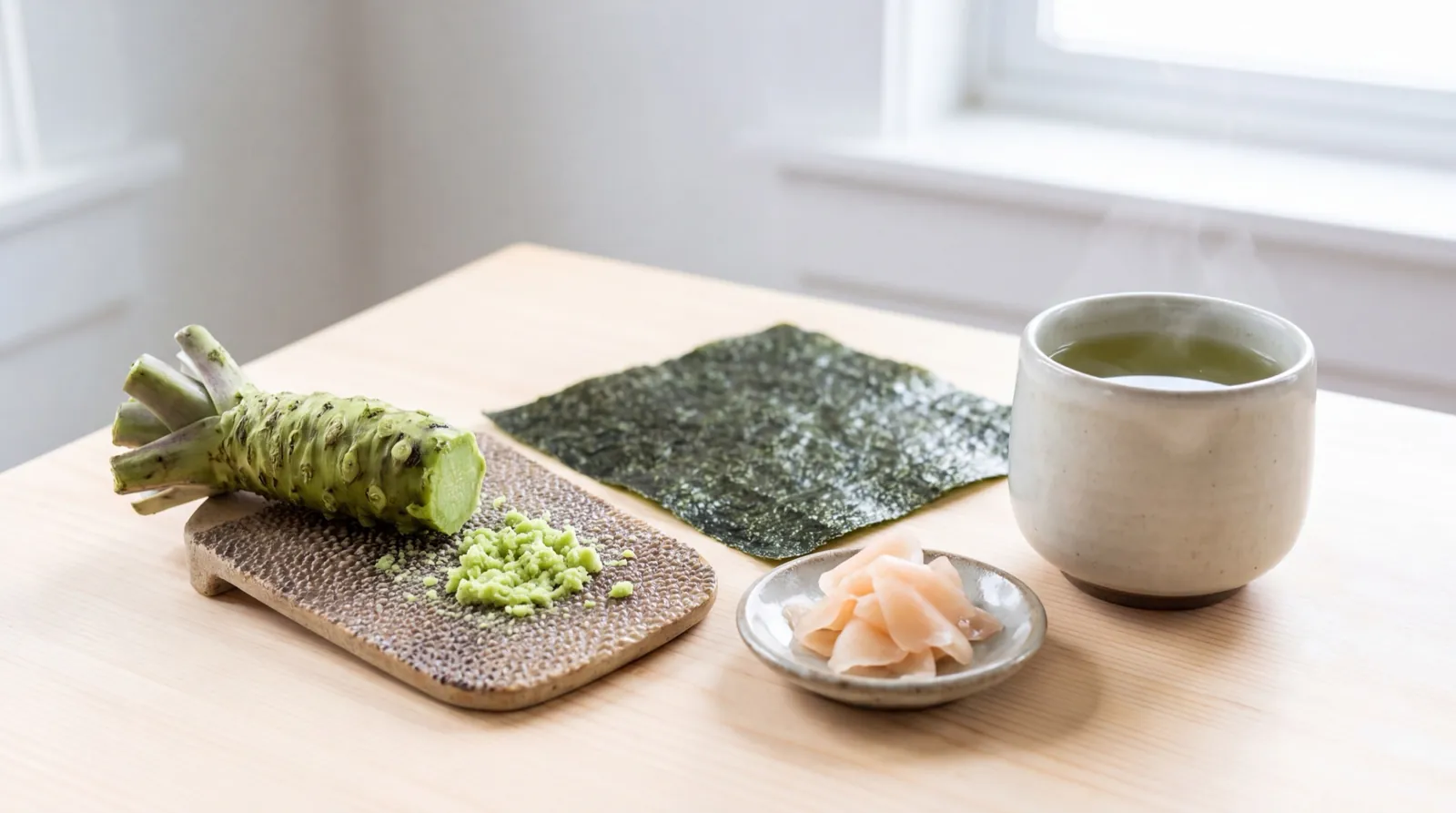
Wasabi, nori, gari (pickled ginger), and tea may look like supporting players in sushi, but they greatly affect the flavor of each piece. Why is freshly grated wasabi best? Why does nori turn green when it is toasted? Why is gari squeezed before it is pickled? In this chapter you will learn how to handle all four, along with the reasons. You will also confirm that their antibacterial action is only a "supplement."
In this chapter you will learn
- To explain the difference between real wasabi (hon-wasabi) and horseradish, and why wasabi is grated just before serving
- To explain why wasabi is placed between the neta (topping) and the shari (sushi rice), and the limits of its antibacterial action
- To use the front and back of nori correctly, and to explain why it turns green when toasted and how to store it
- To explain the steps for preparing gari, and why agari (green tea) is brewed hot
- To organize the roles of condiments in terms of masking and the contrast effect, and to choose them to suit each topping (Grade 1)
21.1 Wasabi — real wasabi and horseradish
Real wasabi (hon-wasabi) is a plant native to Japan, in the mustard family. The part used for sushi is the rhizome, which is a thick underground stem. Wasabi grown in mountain streams fed by cold spring water at around 10 to 15°C all year round is called stream-grown wasabi. It produces thick, firm rhizomes. The main producing areas are Shizuoka and Nagano.
Horseradish is called "Western wasabi" in Japanese. It is a different plant in the same mustard family. Its root is white, and its pungent compound belongs to the same group as that of real wasabi. However, it has little aroma, and only its heat is strong.
Most commercial powdered wasabi and wasabi paste in tubes is made mainly from horseradish and colored green. In Japan, the labeling is set by the industry's voluntary standards. If real wasabi makes up 50% or more, the label says "made with real wasabi." If it makes up less than 50%, the label says "contains real wasabi." If a sushi restaurant serves something it calls "real wasabi," it is expected to grate the rhizome on the spot.
Choose rhizomes that are bright green, firm, and heavy. The bumps on the surface are scars where leaves were attached. When these are close together, it shows the plant grew slowly. Such rhizomes are said to be dense, with strong heat and aroma. To store them, wrap them in damp paper, refrigerate them, and change the paper every day.
Producing areas, varieties, and judging rhizomes
The main producing areas are Amagi on the Izu Peninsula and Gotemba in Shizuoka, and Azumino in Nagano. Among the varieties, Mazuma, which grows slowly and has strong aroma and heat, is considered the finest. Field-grown wasabi, grown in shady fields, does not develop thick rhizomes. Its leaves and stems are used to make wasabi-zuke pickles and wasabi paste. In Hokkaido, horseradish is a familiar food known as yama-wasabi, or "mountain wasabi."
Also check rhizomes for dark spots and for hollow spaces inside. Such a hollow is called su. Another way to store rhizomes is to keep them in water and change the water every day. If the grated end dries out and darkens, shave off a thin layer before use.
21.2 Heat is created by grating
The wasabi rhizome itself is not hot. Inside its cells, the substance that becomes the heat and the enzyme that breaks it down are stored in separate places. The source of the heat is called sinigrin, and the enzyme is called myrosinase.
When grating breaks the cells, the two meet in the water inside the cells. Then the pungent compound is formed. This compound is called allyl isothiocyanate. From here on, we will call it "the pungent compound." It is like two-part glue, which sets only once the two parts are mixed. What this reaction needs is water. It does not need air, that is, oxygen. The heat of wasabi is created by grating itself. The finer you break the cells, and the more cells you break, the stronger the heat and aroma.
Grating with sharkskin
This is why chefs use a sharkskin grater. It is a grater made of sharkskin attached to a board. The tiny bumps on sharkskin are much finer than the teeth of a metal grater. They crush the cells finely. With a coarse grater, the fibers are only cut, and many cells remain uncrushed. The result is watery wasabi with weak heat.
Grate from the stem end, the end where the leaves were attached. The stem end has a better aroma and milder heat. The closer you get to the tip, the stronger the heat and the more stringy the texture. Much of the aroma lies just under the skin, so either do not peel it, or peel it very thinly. Hold the rhizome upright against the sharkskin. Without pressing, move it slowly in small circles, as if writing the Japanese letter "no."
The heat is said to peak after a few minutes
The pungent compound escapes into the air as soon as it forms. This is called volatilization. The compound also breaks down. The heat is explained as being strongest not right after grating, but a few minutes later. Generally, this is said to be 3 to 5 minutes after grating. After that, the heat and aroma fade. If the wasabi is left exposed to air for as long as 15 to 20 minutes, bitterness and a grassy smell are said to become noticeable.
That is why you grate only as much as you will use, just before serving. If you grate a large batch before opening and refrigerate it, the heat and aroma decrease over time, even in a sealed container. It never returns to its freshly grated state. Either grate only what you need and use it up within a few minutes, or put it in a small container and turn the container upside down so the wasabi does not touch the air.
Amount to suit the topping
The pungent compound dissolves poorly in water and easily in oil. With fatty toppings such as toro (fatty tuna), salmon, and Japanese amberjack (buri, yellowtail), the pungent compound dissolves into the fat. The bite softens, so even a larger amount does not taste very hot. White-fleshed fish has a delicate aroma, so use less. Use only a very small amount on shellfish, which have no fat, because wasabi would wipe out their sweetness. For hikarimono (silver-skinned fish), switch to ginger or use only a little wasabi (Chapter 16). Do not use wasabi with anago (conger eel), tamagoyaki (Japanese omelet), or kanpyo rolls, which are filled with dried gourd strips. Putting the same amount in every piece shows that you are not looking at the toppings.
Details of grating, and how the heat works
Before grating, shave the bumps off the stem end with the back of the knife. If you rub with force, the fibers tear, and the texture becomes unpleasant. The cells are not crushed, either. The slower the circles, the more finely the cells are crushed. The enzyme reaction takes place in more cells, and the wasabi becomes fine-textured with a lively heat.
In kitchens, people say that adding a pinch of sugar when grating brings out the heat. One explanation is that the contrast with sweetness makes the heat stronger. Another is that sugar helps the enzyme reaction. However, the theory has not been confirmed. It is passed down as chefs' wisdom.
21.3 Why place wasabi between the topping and the shari?
In nigiri, wasabi goes not on top of the topping but between the topping and the shari. There are two reasons.
The first is to trap the aroma. The pungent compound escapes easily into the air, so on top of the topping it would fade within minutes. Sandwiched between the topping and the shari, it stays trapped. The aroma rises only at the moment the guest bites, and it reaches them at its most vivid.
The second is to support hygiene. Where the topping and the shari meet, the cold topping touches shari at body temperature, and moisture moves back and forth. This boundary has moisture, nutrients, and an in-between temperature. It is thought to be a place where the conditions for bacterial growth come together. Experiments have reported that the pungent compound in wasabi suppresses the growth of bacteria. These include Vibrio parahaemolyticus, Staphylococcus aureus, E. coli, and Salmonella. Placing wasabi at the boundary lets you expect some of this effect.
However, in the amount placed in one piece, the effect is only supplementary. It does not "kill" bacteria. It only makes it "harder for them to multiply." Bacteria and toxins that have already increased do not disappear. The safety of sushi shaped by bare hands rests on handwashing, tezu (vinegared hand water), the acid in the vinegared rice, and control of temperature and time (Chapter 6). Wasabi, gari, and tea are supplementary layers added on top of that.
21.4 Nori
The nori used for sushi is a farmed seaweed called Pyropia yezoensis (susabi-nori), one of the laver seaweeds. The main producing areas are three sea areas. They are the Ariake Sea, off Fukuoka, Saga, and Kumamoto; the Seto Inland Sea, off Hyogo and Kagawa; and Mikawa Bay and Ise Bay, off Aichi and Mie.
In autumn, when the sea temperature drops, seeds are attached to nets. The nori picked first, from late November to December, is called the first harvest, or ichiban-tsumi. The shoots are young and tender, so it melts nicely in the mouth and has strong sweetness and umami. The picked nori is washed and chopped. It is then spread thinly on a bamboo screen and dried, the same way paper is made. This is dried nori, that is, sheet nori. A full sheet measures about 21 cm by 19 cm.
Front and back
Nori has a smooth, shiny front and a rough back that dried against the screen. In rolls, put the back on the shari side, that is, on the inside. The rough back quickly absorbs moisture from the shari and grips the rice grains, so the roll keeps its shape. With the front on the outside, its shine shows and the roll looks better. If you reverse them, the shari slides on the smooth front and the roll loosens. Rolling technique is covered in Chapter 24.
Why nori turns green when toasted
Dried nori is a purple so dark it is almost black. Nori contains green, red, blue, and yellow pigments together. Like paints mixed together, they look blackish. When nori is toasted over a flame, the red pigment, which is sensitive to heat, breaks down and disappears. This pigment is called phycoerythrin. What mainly remains is the heat-resistant green pigment, chlorophyll, so the nori turns bright green. At the same time, a toasty aroma forms.
If you toast it too long, even the green pigment breaks down and the nori turns brown. The aroma is lost, and only a burnt smell remains. One method is to put 2 sheets together, back to back, and toast the fronts a few seconds at a time, held far from the flame. Stop when they turn green. Besides glutamic acid, nori also contains inosinic acid and guanylic acid. In nori alone, umami synergy (Chapter 20) is already taking place.
Keeping out moisture
The enemies of nori are moisture, light, and heat. When nori absorbs moisture, it loses its shine, its color fades, its aroma escapes, and it no longer melts nicely in the mouth. Keep it in a sealed container with a desiccant, in a cool place out of the light. For long-term storage, freezing is the best method.
However, if you open the bag right after taking it out of the freezer, water droplets form on the surface of the nori. It is the same as droplets forming on a cold glass. Nori absorbs moisture in an instant. Let it come to room temperature in the bag before you open it. When cutting it, use a dry knife and a dry cutting board.
Grades, the chemistry of color, and cutting
The more times nori is picked from the same net, the harder and thicker the leaves become. The grade of nori is decided at cooperative sales, which are joint sales held in the producing areas. Nori is graded by how black and shiny it is, its thickness, any holes or tears, and its aroma. Dried nori that has been toasted is called toasted nori. Some sushi restaurants buy dried nori and toast it themselves just before serving. Others buy toasted nori.
The four pigments of nori are green chlorophyll, red phycoerythrin, blue phycocyanin, and yellow carotenoids. When nori is toasted, the red phycoerythrin changes along with its protein and breaks down. The toasty aroma comes from pyrazines, aroma compounds formed by the Maillard reaction between amino acids and sugars. These overlap with dimethyl sulfide, the core of the smell of the sea.
Putting the front on the outside is not only for shine. It also makes the nori less likely to come apart after rolling. If nori has absorbed moisture, toasting it over low heat or warming it in a microwave for a few seconds will drive off the water. However, the aroma that was lost will not come back. Use such nori for the inside of rolls or for seasoning. After cutting nori, keep it sealed.
| Cut | Approximate size | Use |
|---|---|---|
| Full sheet | About 21 × 19 cm | Futomaki (thick rolls) |
| Half sheet | About 19 × 10.5 cm | Hosomaki (thin rolls), temaki |
| Quarter sheet | About 10.5 × 9.5 cm | Small temaki |
| Strip (sheet cut into 6) | About 19 × 3.5 cm | Gunkan. Adjust the width to the height of the rice ball |
There are four main ways to cut nori. A full sheet is used for futomaki. A half sheet, cut in half from a full sheet, is used for hosomaki and temaki. A quarter sheet is used for small temaki, and a thin strip, made by cutting a sheet into 6, is used for gunkan.
21.5 Gari
Gari is ginger pickled in sweet vinegar. The best raw material is young ginger, which is on the market from June to August. Its fibers are tender, its heat is mild, and the base of its stems is red. Stored mature root ginger is also called hine shoga. Its fibers are tough and its heat is strong, so if you use it, slice it thin and blanch it a little longer. The preparation steps are as follows.
- Scrape off the skin Much of the aroma lies just under the skin, so do not peel it thickly. Scrape it thinly with a spoon or similar tool.
- Slice thinly Slice along the fibers to about 1 mm. If the slices are too thick, the sweet vinegar does not reach the center. If they are too thin, they lose their crunch.
- Salt Sprinkle lightly with salt and leave for 10 to 15 minutes to draw out excess water.
- Blanch Dip the slices in plenty of boiling water for 10 to 30 seconds. This removes some of the heat, kills bacteria, and softens the fibers. Boiling too long drives off the aroma too.
- Squeeze while hot Drain in a colander. While the ginger is still hot, squeeze out the water firmly with both hands.
- Into the sweet vinegar while hot Right after squeezing, submerge the ginger in sweet vinegar, and let it soak in the refrigerator overnight or longer.
Why squeeze before pickling?
When you squeeze blanched ginger hard, water is pushed out of the tissue and spaces open up. It is the same as squeezing a wet sponge. If you put it into sweet vinegar right away, the compressed tissue springs back and draws in the sweet vinegar. From there, the sweet vinegar spreads little by little to the center. This is called diffusion. It is the natural spreading of substances from where they are concentrated to where they are dilute.
Blanching has already broken the cell membranes of the ginger. So what is at work here is not osmotic pressure. It is absorption and diffusion. If you pickle the ginger without squeezing it, the remaining water dilutes the sweet vinegar, and the flavor has trouble getting in. You pickle it while hot because diffusion is faster at higher temperatures.
Color, roles, and hygiene
Gari made from young ginger turns pale pink, but not because of coloring. It is because a pigment in the ginger called anthocyanin takes on color from the acid in the sweet vinegar. Anthocyanin is a pigment that turns red in acid. Commercial gari with a bright red color is often colored with additives.
The first role of gari is to cleanse the palate. Its heat and sourness clear away the fat and aroma of the previous piece. This lets the guest taste the next piece with a fresh palate. The components of ginger and the acid of the vinegar also suppress the growth of bacteria. However, this too is only supplementary.
Gari goes directly into guests' mouths. When serving it, use dedicated chopsticks or tongs, and never pick it up with your hands. Never return gari cleared from a guest's place to the container. Never serve it again to another guest. Put only one serving's worth at a time into the gari holder on the counter. Do not serve gari to guests directly from the preparation container.
The sweet vinegar recipe, and other roles of gari
One guideline for the sweet vinegar is 60 to 80 g of sugar and just under 1 teaspoon of salt to 200 mL of rice vinegar. Use vinegar with an acidity of 4 to 5%. The pigment that turns pink is found mostly in the buds and under the skin. Mature root ginger has little of this pigment, so it stays pale yellow.
The antibacterial action of gari comes from compounds in ginger called gingerol and shogaol, and from the acid in the vinegar. As a third role, gari stimulates saliva and gastric juice and helps digestion.
Sweet vinegar is strongly acidic, so bacteria do not grow easily in it. Even so, each time gari is taken out and put back, dirt gets in from chopsticks or fingers. Wash the gari holder on the counter after service. Replace gari that has sat for a long time, faded in color, and lost its sourness.
21.6 Tea (agari)
Tea in a sushi restaurant is called agari. Mostly, konacha is used. Konacha is the fine tea leaves sifted out while sencha or gyokuro is being finished. It is inexpensive, but because the leaves are fine, their components come out quickly and strongly, and the taste stands out more than the aroma.
Why tea refreshes the mouth
The source of the astringent taste of tea is catechins. They belong to a group of compounds called polyphenols. Catechins bind strongly to proteins. This action is called astringency, which means a tightening action. Catechins bind to fish proteins and saliva proteins left in the mouth and wash them away. The puckery feeling you notice is this tightening action itself.
On the other hand, what washes away fat like that of toro is the heat of the tea. Tuna fat is said to melt at about 24 to 30°C. This is a guideline (Chapter 14). Hot tea melts the fat, so it flows away more easily. Catechins do not bind to fat. Heat and catechins together reset the mouth. Then the guest can taste the next piece properly. Antibacterial action has also been reported for catechins, but this too is supplementary.
Water temperature and teacups
Catechins dissolve better at higher temperatures. Brew agari quickly with water at 80 to 90°C, and serve it hot. In lukewarm tea, the fat does not melt, and not enough catechins come out. However, if the tea is too strong, its astringency gets in the way of the topping's flavor. Make it deep in color, but not so strong that astringency lingers.
There is also a reason why sushi restaurant teacups are thick and large. Thick pottery does not lose heat easily, so it keeps the tea hot for a long time. It is easy to hold even when the tea is hot, and it does not tip over easily on the counter. When a guest's tea runs low, refill it before they ask.
Mecha, and when to serve tea
Mecha, made from the curled tips of new buds, also gives a strong taste and suits agari. The antibacterial action of catechins has been reported against Vibrio parahaemolyticus, Staphylococcus aureus, and other bacteria. However, these are laboratory findings, and the effect when you drink tea is limited. There are three times to serve tea: when the guest sits down, after a fatty topping, and at the end.
21.7 Other condiments, and the theory of condiments
The roles of condiments can be organized by two theories. One is masking. This means covering up an unpleasant smell with a strong aroma. Using green onion or ginger against trimethylamine, the source of the smell of blue-backed fish, is an example (Chapter 16).
The other is the contrast effect. This means a small amount of a different taste makes the main taste stand out. Sprinkling a tiny amount of salt on white-fleshed fish, shellfish, or uni (sea urchin) to bring out sweetness is an example (Chapter 15).
The acid in citrus works in both ways. Trimethylamine turns into a gas and reaches the nose. Citrus acid changes it into a salt form that does not turn into a gas, and so it reduces the smell. At the same time, it brings out the umami of white-fleshed fish through contrast. Every condiment is used for one of two purposes: to hide a weakness of the topping, or to bring out a strength. If you cannot say what a condiment is for, do not put it on.
| Condiment | Main components and roles | Toppings it suits |
|---|---|---|
| Green onion (konegi, asatsuki) | Allyl sulfide. Masks smells | Hikarimono, horse mackerel, skipjack tuna (katsuo) |
| Grated ginger | Gingerol. Masking, antibacterial | Horse mackerel, sardine, skipjack tuna |
| Shiso (perilla, ohba) | Perillaldehyde. Aroma, antibacterial | Squid, white-fleshed fish, rolls |
| Myoga (Japanese ginger buds) | Aroma and crunch | Hikarimono, skipjack tuna |
| Citrus (sudachi, kabosu, yuzu) | Citric acid. Reduces smells and brings out umami by contrast | White-fleshed fish, squid, shellfish, aburi (searing with a flame) |
| Bainiku (umeboshi paste) | Citric acid and salt. Contrast from sourness | Squid. Paired with shiso |
| Shichimi (seven-spice blend) and sansho (Japanese pepper) | Heat and aroma. Tightens sweet-salty flavors | Anago, aburi |
| Ponzu | Acid plus the umami of soy sauce. Cuts through fat | Shirako (milt), kawahagi (thread-sail filefish) liver, fatty aburi |
| Salt | Brings out sweetness through the contrast effect | White-fleshed fish, shellfish, uni, squid, kuruma prawn |
| Nikiri (simmered soy glaze) | Umami synergy from glutamic acid (Chapter 20) | Akami (lean tuna), zuke (marinated in soy sauce), hikarimono |
Here is what the table shows, grouped by role. Green onion, grated ginger, and shiso cover up smells. Citrus, bainiku, and salt bring out flavor by contrast. Shichimi and sansho tighten the sweet-salty flavor of anago. Ponzu cuts through the fat of shirako and liver. Nikiri creates umami synergy with akami and zuke.
Chapter summary
- Real wasabi is used by grating the rhizome on the spot. Most powdered and tube wasabi is horseradish. Products with 50% or more real wasabi are labeled "made with real wasabi," and products with less are labeled "contains real wasabi."
- The heat of wasabi forms when the cells break and sinigrin and myrosinase meet in water. Grate it slowly on sharkskin, from the stem end, in small circles like the Japanese letter "no." Time it for the peak a few minutes later, and grate only what you will use, just before serving.
- Wasabi goes between the topping and the shari to trap its aroma and to give supplementary help in suppressing bacterial growth at the boundary. Wasabi cannot protect against Anisakis or norovirus.
- Put the rough back of the nori on the shari side. When nori is toasted, the heat-sensitive red pigment breaks down and the nori turns green. Let chilled nori come to room temperature in its bag before opening.
- For gari, slice the ginger thinly and blanch it, squeeze it while hot, and put it into sweet vinegar while hot. The squeezed tissue draws in the sweet vinegar, which reaches the center by diffusion. It is not osmotic pressure. Do not serve gari by hand, and do not return gari that has been cleared.
- For agari, brew konacha with water at 80 to 90°C and serve it hot. It is the heat of the tea that washes away fat, and catechins bind to proteins to reset the mouth.
- Use condiments for one of two purposes: masking to cover smells, or the contrast effect to bring out flavor. If you cannot say what a condiment is for, do not put it on. (Grade 1)
Review questions
Q1 Which statement about the antibacterial action of wasabi, gari, and tea is correct?
a If you put in extra wasabi, the Anisakis in the topping will die
b As long as gari is served alongside, nigiri is safe even if left at room temperature for a long time
c The antibacterial action is only supplementary, and it is no substitute for handwashing and control of temperature and time
d Drinking hot tea inactivates norovirus in the mouth
e The pungent compound in wasabi kills all bacteria, so even toxins from bacteria that have already multiplied disappear
Answer: c
Wasabi, gari, and tea have been reported to suppress the growth of bacteria. However, in the amounts served with one piece, the effect is only supplementary. The safety of sushi shaped by bare hands rests on handwashing, tezu, the acid in the vinegared rice, and control of temperature and time. a: Anisakis can be prevented only by freezing at minus 20°C for 24 hours or more, or by heating. b: If nigiri is left at room temperature for a long time, bacteria multiply. d: Tea does not inactivate norovirus. e: It only makes bacteria harder to multiply. Bacteria and toxins that have already increased do not disappear.
Q2 A restaurant grates a large batch of real wasabi before opening, refrigerates it in a sealed container, and uses it during service. Which is the most appropriate description of the problem with this method?
a Refrigeration makes sinigrin break down and become toxic
b The pungent compound easily escapes as a gas and also breaks down easily, so after the peak, the heat and aroma fade
c Refrigeration makes myrosinase work strongly, so the wasabi becomes too hot
d Components of the sharkskin grater seep into the wasabi over time
e There is no problem. In a sealed container, the heat and aroma of freshly grated wasabi stay the same all day
Answer: b
The pungent compound is the source of wasabi's heat and aroma. It easily escapes as a gas, and it also breaks down easily. The heat is said to peak a few minutes after grating, and then it fades. Sealing and refrigerating slows the loss, but does not stop it. The aroma of freshly grated wasabi does not come back. a, c, and d are incorrect. e is the most common mistake in kitchens. Grate only as much as you will use, just before serving.
Q3 Trimethylamine is the source of the fishy smell of hikarimono. Which correctly describes how condiments act on it?
a Green onion and ginger break down trimethylamine and remove the smell completely
b Sprinkling a tiny amount of salt keeps trimethylamine from turning into a gas through the contrast effect
c Green onion and ginger cover up the smell with their strong aroma, and the acid in citrus changes trimethylamine into a salt form that does not turn into a gas, which reduces the smell
d The glutamic acid in nikiri creates synergy with trimethylamine and turns it into umami
e The pungent compound in wasabi sterilizes trimethylamine and removes the smell
Answer: c
Green onion and ginger work by masking, which means covering up an unpleasant smell with a strong aroma. Trimethylamine turns into a gas and reaches the nose. The acid in citrus changes it into a salt form that does not turn into a gas, and so it reduces the smell. At the same time, the acid brings out the umami of white-fleshed fish by contrast. a: They do not break it down and remove it completely. b: The contrast effect of salt works to bring out sweetness. d: Synergy takes place between umami compounds. e: Trimethylamine is not a bacterium. It is a smell compound.