
Part V Seasonings and Condiments
Chapter 20
Soy Sauce, Nikiri, Tsume, Dashi, and Umami
The flavor of nigiri is not decided by the neta (topping) and shari (sushi rice) alone. The nikiri (simmered soy glaze) and tsume (sweet reduced sauce) brushed on at the end, and the dashi (soup stock) behind tamagoyaki (Japanese omelet) and simmered dishes, greatly shape how each piece turns out. In this chapter you will learn about the types of soy sauce, why we make nikiri and tsume, the temperatures for making dashi, and how umami grows stronger when umami compounds are combined.
In this chapter you will learn
- To name the five main types of soy sauce, and to explain that usukuchi (light-colored soy sauce) is saltier than koikuchi (dark soy sauce)
- To explain the purpose of making nikiri, and why tsume becomes glossy and thick
- To state the temperatures and times for making dashi with kombu and katsuobushi, and to explain the reasons
- To use umami synergy and the differences in salt content among types of mirin and sake in your work
- To explain how soy sauce is made, the types of katsuobushi and kombu, and how umami synergy works (Grade 1)
20.1 Soy sauce — a seasoning made by fermentation
Soy sauce is a seasoning made from soybeans, wheat, and salt. Microorganisms do the work slowly, over a long time. First, a kind of mold called koji mold (Aspergillus oryzae) is added to the soybeans and wheat to make koji. Koji mixed with salt water is called moromi (fermenting soy mash).
Inside the moromi, enzymes from the koji break down the protein in the soybeans into amino acids, and the starch in the wheat into sugars. Lactic acid bacteria make acids, and yeast makes alcohol and aroma. The moromi ages like this for six months to more than a year. It is then pressed, heated, and adjusted to become the soy sauce we use every day. This heating step is called heat treatment (pasteurization).
The umami of soy sauce comes from glutamic acid and other amino acids formed during aging. Its color comes from the Maillard reaction, in which amino acids and sugars combine and turn brown. It is the same kind of change that browns bread as it bakes.
Production details — kiage and unpasteurized soy sauce
Koji mold is a mold of the genus Aspergillus. Seed koji is added to steamed soybeans and to wheat that has been roasted and crushed, and the koji is grown for about 3 days. Moromi that has aged and has just been pressed is called kiage (raw pressed soy sauce).
For heat treatment, the kiage is heated to around 80°C. There are three purposes. The first is to stop the enzymes, so the flavor stops changing. The second is to kill the yeast and lactic acid bacteria, so the soy sauce keeps longer. The third is to set the aroma and color that heating brings. Unpasteurized soy sauce (nama shoyu) is not heat-treated. Instead, the microorganisms are removed with a fine filter. It has no cooked aroma and a mild flavor, but its flavor changes faster after the bottle is opened.
Five types and their salt content
Japanese soy sauce is divided into five main types: koikuchi, usukuchi, tamari, saishikomi (double-brewed), and shiro (white). The most common misunderstanding is that usukuchi soy sauce is low in salt. To keep its color light, usukuchi must ferment and age slowly. For that, more salt is used. "Usukuchi" means light in color. It actually has about 10% more salt than koikuchi.
Saishikomi soy sauce is the opposite. Its color and flavor are both strong, but its salt content is on the low side. Shiro soy sauce is made mainly from wheat and is amber in color. A darker color does not mean more salt.
| Type | Characteristics | Salt (salt equivalent per 100 g) | Use in a sushi restaurant |
|---|---|---|---|
| Koikuchi | Roughly equal amounts of soybeans and wheat. The standard across Japan | 14.5 g | Base for nikiri, tsume, and zuke (marinated in soy sauce) |
| Usukuchi | Light in color, but about 10% saltier than koikuchi | 16.0 g | Simmered dishes that should not take on color, and soy sauce diluted with dashi. Watch the amount |
| Tamari | Made almost entirely from soybeans. Thick and rich (Chubu region) | 13.0 g | A small amount on fatty toppings |
| Saishikomi | Brewed with soy sauce instead of salt water. Strong color and flavor (Yamaguchi and other areas) | 12.4 g | A little goes a long way. Salt is on the low side |
| Shiro | Made mainly from wheat. Amber color and sweet aroma (Aichi) | 14.2 g | Does not stain the color of white-fleshed fish or tamagoyaki |
The salt values in the table come from the Standard Tables of Food Composition in Japan. Per 100 g, koikuchi has 14.5 g, usukuchi has 16.0 g, and saishikomi has 12.4 g. Products also vary. When the soy sauce changes, the amount of salt that reaches the mouth changes, even if you brush on the same amount. When you change your brand of soy sauce, review your nikiri recipe too.
Matching soy sauce to toppings, and calculating salt
Koikuchi nikiri for akami (lean tuna) and hikarimono (silver-skinned fish). A light nikiri diluted with dashi, or salt, for white-fleshed fish and shellfish. A small amount of tamari or saishikomi for fatty toppings. This is the basic way to match them. The difference in salt is larger than you might think. Between usukuchi and saishikomi, the salt that reaches the mouth differs by about 30%, even when you brush on the same amount. When you switch soy sauce, recalculate the salt.
20.2 Nikiri — why simmer soy sauce?
Nikiri is soy sauce for sushi. It is made by adding sake and mirin to soy sauce, heating it, and cooking off the alcohol. Many restaurants also add dashi or kombu (kelp). Instead of guests dipping their sushi into soy sauce in a small dish, the chef brushes nikiri onto the nigiri before serving it.
Three reasons for simmering
The first reason is to cook off the alcohol. Sake and mirin contain about 14 to 15% alcohol, and soy sauce also contains 2 to 3%. Alcohol boils at about 78°C, and it turns into vapor more easily than water. So the moment it enters the mouth, it rises into the nose and covers up the delicate aroma of the fish.
When a strong aroma makes a weak aroma hard to notice, this is called masking. It is like sitting next to someone wearing strong perfume. You can no longer smell the food. Once the alcohol is cooked off, the faint aroma of white-fleshed fish and shellfish is no longer overpowered by the soy sauce.
The second reason is to take the edge off. The sharp saltiness of unheated soy sauce is rounded out by heating, by the sweetness of mirin, and by the umami of dashi. The third reason is that the chef can decide how much goes on. When guests dip their own sushi, they use too much. The shari falls apart, and they take in more salt. When the chef brushes it on, the saltiness and aroma can be set for each piece.
A guide to making it
The recipe is part of each restaurant's character. One guideline is 4 to 5 parts koikuchi soy sauce to about 1 part sake and 1 part mirin. First, bring the sake and mirin to a boil to cook off the alcohol. After adding the soy sauce, keep it for a few minutes over heat just strong enough to raise small, gentle bubbles.
Never boil it hard after adding the soy sauce. The aroma of soy sauce is also easily driven off by heat. And because salt does not evaporate, only the water decreases, so the liquid gets saltier. Instead of taking the edge off, you end up with a salty liquid that has no aroma.
Change the amount you brush on to suit the topping. Brush it on generously for akami and very lightly for white-fleshed fish. Shellfish and squid are sometimes served with salt or citrus instead.
The logic of nikiri, one step further
The edge comes off not only because sweetness and umami are added. Heating also drives a very mild Maillard reaction, and the whole sauce becomes mellow and well blended. If you add kombu, put it in at the sake stage and take it out at around 60°C. If you add katsuobushi (dried bonito), put it in after turning off the heat, and strain it after 1 to 2 minutes. The reasons are the same as for the dashi temperatures you will learn in section 20.4.
Nikiri has a salt content of about 11 to 13%, and there is little water that bacteria can use. That is why it does not spoil quickly. However, when dashi is added, the protein and sugars in it become food for bacteria.
For fatty toro (fatty tuna) or salmon, use nikiri with added acidity, or a small amount of tamari. If you brush a thick layer of strong nikiri on white-fleshed fish, the soy sauce flavor covers the inosinic acid of the fish. The guest can no longer tell what they are eating. If you try to adjust only by the amount you brush on, the brush has to pass back and forth more, and this damages the surface of the topping (Chapter 24). This is another reason to prepare two kinds of nikiri.
Storage and brush hygiene
Nikiri is high in salt, so it does not spoil right away. Even so, nikiri with dashi has more food for bacteria, so refrigeration is the rule. Write the preparation date on the container (Chapter 5). As a guide, use up nikiri with dashi within 3 to 4 days, and nikiri without dashi within 1 to 2 weeks.
One thing people often overlook is the brush. The brush touches the topping and then goes back into the container. So it can also carry bacteria from raw fish into the nikiri. During service, pour out small amounts into a small container, and throw away what is left at the end of service. Wash the brush with detergent every day, pour boiling water over it, and let it dry completely (Chapter 4). Loose bristles become foreign objects in food, so check the condition of the bristles every day too.
20.3 Tsume — a sauce made by reducing simmering liquid
The word tsume is short for nitsume, which means "boiled down." Tsume is a dark, glossy sauce. It is made from the liquid used to simmer anago (conger eel), hamaguri (Japanese hard clam), or mantis shrimp. Sugar, mirin, and soy sauce are added, and the liquid is reduced. Nikiri is soy sauce heated to make it lighter. Tsume is seafood simmering liquid boiled down to make it thicker. Remember that they go in opposite directions.
What creates the gloss and thickness
The roasted aroma and dark color of tsume come from the Maillard reaction, the same reaction that gives soy sauce its color. As the liquid reduces, amino acids that dissolved out of the anago combine with the sugars from the sugar and mirin.
The thickness and gloss come from gelatin. The skin and bones of anago contain collagen, a protein that supports the body. When simmered, collagen changes into gelatin, which dissolves in water, and it passes into the simmering liquid. Reduced together with sugar, it forms a smooth, shining film. Nikogori, the jelly that forms when the liquid from simmered fish cools, comes from the same gelatin. That is why reducing only sugar and soy sauce will never give you the gloss of real tsume.
Tsume burns easily. Cook it over low to medium heat, and keep moving a wooden spatula across the bottom of the pot. The most common mistake is to reduce it to "just the right thickness" while it is still hot. Gelatin and sugar stiffen quickly as they cool. Stop at the point where it still feels "a little loose" while hot. When you brush it on, loosen it by warming it in a hot-water bath.
Topping up tsume depends on heating it every day
Tsume that is topped up and carried over from day to day is possible only because it is heated every day. The protein and gelatin from anago are ideal food for bacteria. At the end of every service, always bring it to a boil, let it cool a little, and refrigerate it. Never leave it sitting at room temperature.
Some bacteria form a heat-resistant shell and survive heating. This shell is called a spore (Chapter 2). Heating alone does not kill spores, so you need both heating and refrigeration. Write the date of the last heating on the container. Keep a brush for tsume only, and during service, pour out small amounts into a small pot.
The chemistry of gloss, and judging thickness and proportions
The Maillard reaction produces brown pigments called melanoidins, along with hundreds of aroma compounds. The color of akazu (red vinegar made from sake lees) comes from the same reaction (Chapter 8). Gloss appears when light reflects off two things: the stickiness of concentrated sugar and the smooth film formed by the gelatin network. If tsume burns, it turns to carbon. Bitterness and a burnt smell spread through it, and the whole pot is wasted.
There are two signs of the right thickness. When it drips from a wooden spatula, it falls in a thread. And when you put one drop on a cooled plate and run a finger through it, the trace remains.
Sugar is responsible for gloss, stickiness, and keeping quality. This is because sugar holds onto water and reduces the water that bacteria can use. Mirin is responsible for shine, mild sweetness, and richness. Soy sauce is responsible for saltiness, color, and umami. More sugar makes the gloss stronger, but the tsume becomes cloyingly sweet and burns more easily. More soy sauce makes the color darker, but the tsume becomes salty and less thick.
The anago simmering liquid also contains soy sauce and sugar, so the salt content tends to rise each time the tsume is topped up. Still, there is a reason some restaurants say their tsume has been "topped up since the day we opened." Tsume that has been reduced over a long time is rich in products of the Maillard reaction. That is why it has a complex aroma and a deep color that a new batch cannot match.
20.4 Dashi — temperatures for kombu and katsuobushi
In a sushi restaurant, dashi is the base for nikiri, tamagoyaki, clear soup, simmered dishes, and kobujime (curing between kombu sheets). Its quality depends on the ingredients, and on the temperature and the number of minutes you use to make it.
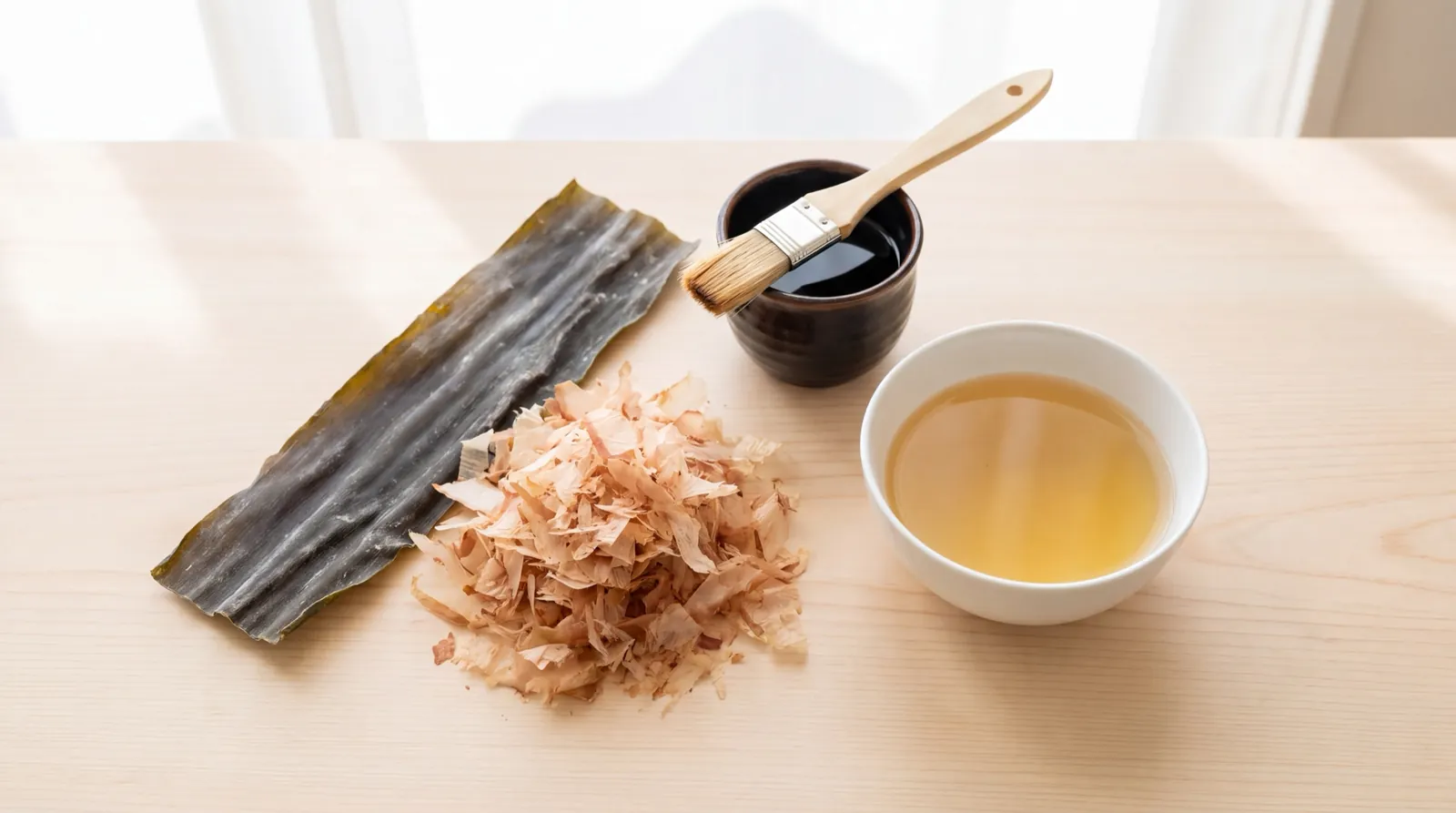
Kombu — about 60°C for 1 hour
The umami compound in kombu is glutamic acid. It is an amino acid and a source of umami. The white powder on the surface is mannitol, a compound with a sweet taste, and it is part of the flavor. Do not wash it off. Just wipe off any sand with a tightly wrung cloth.
If you hold kombu at about 60°C for 1 hour, you can draw out plenty of umami without off-flavors. If you are short on time, a guideline is around 70°C for 30 minutes. Do not let it boil. At high temperatures, the slimy component of kombu dissolves out. This component is called alginic acid. The dashi becomes sticky and cloudy, and even harsh flavors and a strong sea smell come out.
The day before, soak 10 to 20 g of kombu in 1 L of water. Leave it in the refrigerator overnight, for about 10 hours. This is called cold-water extraction. It gives the fewest off-flavors. The next morning you can heat it as is and go on to the katsuobushi, so it also fits the flow of the day's prep.
Katsuobushi — 85 to 90°C for 1 to 2 minutes
The umami compound in katsuobushi is inosinic acid. It is the other source of umami, found in large amounts in fish and meat. To make first dashi, take the kombu out, heat the dashi to 85 to 90°C, turn off the heat, and add the katsuobushi. Let it sit for 1 to 2 minutes, then strain it gently. Do not squeeze it.
Inosinic acid dissolves quickly in hot water, so a short time is enough. If you simmer it for a long time, sourness, astringency, and fishy smells from the dark meat (chiai) dissolve out, and the aroma escapes with the steam. Draw out only the umami and aroma, and stop before off-flavors come out. That is the technique of first dashi.
| Ingredient | Umami compound | Temperature and time | If you go outside these conditions |
|---|---|---|---|
| Kombu | Glutamic acid | About 60°C for 1 hour. Or cold-water extraction in the refrigerator overnight | Boiling brings out sliminess, harshness, and a strong sea smell |
| Katsuobushi | Inosinic acid | 1–2 minutes in water at 85–90°C. Strain without squeezing | Long simmering brings out sourness, astringency, and fishy smells, and the aroma is lost |
| Dried shiitake | Guanylic acid | Rehydrate overnight in cold water at around 5°C, then heat together with the soaking liquid | Rehydrating in boiling water does not produce enough umami |
The umami in dried shiitake is guanylic acid. Rehydrate the mushrooms overnight in cold water, then heat them together with the soaking liquid. Kombu takes a low temperature and a long time. Katsuobushi takes a high temperature and a short time. Keep these opposite directions in mind.
Types of kombu, and the trap of "just before boiling"
Most kombu for dashi comes from Hokkaido. There are four representative types. Makombu is harvested around Hakodate and makes a clear, refined dashi. It is the most versatile kombu. Rausu kombu is rich with a strong aroma, and its dashi has a yellowish tint. Rishiri kombu makes a clear dashi with no off-flavors and is favored in Kyoto cuisine. Hidaka kombu is soft and suited to simmered dishes, but its dashi has less umami than the other three.
Alginic acid is a component of the cell walls of kombu. The traditional teaching to "take the kombu out just before the water boils" is meant to keep it from dissolving. However, if you heat kombu from cold water and take it out just before boiling, it spends only a short time near 60°C. It often fails to release all of its umami. Using a thermometer and holding it at 60°C for 1 hour is more reliable.
Types of katsuobushi, and second dashi
The inosinic acid in katsuobushi is the same compound that forms from a substance called ATP as fish ages (Chapter 10). Skipjack tuna (katsuo, bonito) that has been simmered, deboned, and dried while being smoked is called arabushi. It has a strong smoky aroma and makes a bold dashi.
When the surface of arabushi is shaved and it goes through repeated rounds of mold growth and sun-drying, it becomes karebushi. Katsuobushi that has gone through 3 to 4 or more rounds of mold growth is called honkarebushi. The mold breaks down the fat, and the moisture is brought down to about 15%. That is why its dashi is clear and refined, with no smell of stale fat. Katsuobushi shaved with the dark meat removed has no sourness or fishy smell, and it is suited to clear soups and nikiri.
Add water to the kombu and katsuobushi left after straining first dashi. Once it boils, simmer it over low heat for 5 to 10 minutes, add fresh katsuobushi, and strain. This is second dashi. Its aroma is weak, but umami remains, so it is suited as a base for simmered dishes and tsume.
Niboshi and dried shiitake
Niboshi (dried sardines) are Japanese anchovies that have been boiled and dried. Their umami compound is inosinic acid, the same as in katsuobushi. Remove the heads and guts to prevent bitterness and fishy smells. Either use cold-water extraction, or make the dashi over low heat for about 10 minutes. Simmering over high heat for a long time brings out bitterness and fishy smells.
Fresh shiitake contain almost no guanylic acid. It forms during drying and during heating after rehydration, when the mushroom's own enzymes break down its components. Rehydrating slowly in cold water keeps these enzymes working. If you rehydrate in boiling water, the enzymes stop working too early.
20.5 Umami and synergy
The basic tastes are sweet, salty, sour, bitter, and umami. These five are called the five basic tastes. The idea of umami grew out of research in Japan. Outside Japan, too, the word umami is understood as it is.
Umami grows by multiplication
When you taste glutamic acid and inosinic acid together, umami grows stronger, as if it were multiplied. This is called umami synergy. When the two are combined in a ratio close to 1 to 1, the umami feels 7 to 8 times as strong as the same amount of either one alone. Experiments have shown this. Awase dashi, made from kombu and katsuobushi together, is this principle itself.
This principle is also at work in sushi. Kobujime of white-fleshed fish (Chapters 13 and 15) is a technique that adds the glutamic acid of kombu to the inosinic acid of the fish. It greatly strengthens the umami of mild white-fleshed fish. The nikiri brushed on nigiri is also rich in glutamic acid, and it meets the inosinic acid of the topping in the mouth. That is why a little nikiri is enough. If you brush on too much, the saltiness takes over and the outline of the umami becomes blurred.
20.6 Salt, sugar, mirin, and sake
In a sushi restaurant, salt is chosen by grain size. Salt with large, moist grains is coarse salt. It is said to dissolve slowly and draw out moisture over time. That is why it is preferred for salt curing (shio-jime) kohada (gizzard shad) and mackerel (Chapter 13).
Coarse salt that has been dry-roasted until it flows freely is roasted salt. It dissolves quickly, so it is suited for sprinkling just before serving. A tiny amount is sprinkled on white-fleshed fish, shellfish, or squid to make nigiri that is "eaten with salt." When a little salt brings out sweetness, this is called the contrast effect. It is the same reason watermelon tastes sweeter with a pinch of salt.
Sugar does more than add sweetness. It holds onto water and reduces the water that bacteria can use. It is also a material for the Maillard reaction, which creates gloss and color. Coarse sugar crystals (zarame) dissolve slowly because the crystals are large. So they are suited to things that are reduced for a long time, like tsume.
Hon mirin is an alcoholic beverage. It is made by aging glutinous rice and rice koji in shochu or another spirit until the mixture turns sweet. Its sweetness is milder than sugar, and it adds gloss and richness. However, some products with similar names are different inside. Hon mirin, mirin-style seasoning, fermented seasoning, cooking sake, and seishu (refined sake) all differ in their salt and alcohol content. In particular, most commercial "cooking sake" has about 2% salt added, and it makes nikiri and tsume saltier than you expect. The basic rule is to check the label for how much salt a seasoning contains before you use it.
| Type | Contents | Points to watch |
|---|---|---|
| Hon mirin | About 14% alcohol, about 40–45% sugars | Adds gloss and richness. Cook off the alcohol by heating |
| Mirin-style seasoning | An imitation made with sugars and other ingredients. Less than 1% alcohol | Aroma and richness fall short of hon mirin |
| Fermented seasoning (mirin type) | Made in a way similar to hon mirin, with about 1.5–2% salt added | Include its salt when you calculate the recipe |
| Cooking sake | Most have about 2% salt added | Makes nikiri and tsume salty |
| Seishu (refined sake) | No salt. Good aroma | Suited to nikiri and tsume |
Where salt comes from, and types of sugar
Salt falls into three groups by origin. Sea salt is made by boiling down seawater until it crystallizes. It contains bittern (nigari) components such as magnesium and calcium, which give it mellowness and a faint bitterness. Rock salt is ancient seawater that crystallized underground. It has few bittern components and is often high in purity. Refined salt has been purified to 99% or more sodium chloride. Its taste is sharp and even.
In roasted salt, the bittern components have also changed during roasting. The grains are fine and uniform, and the saltiness hits the tongue evenly. However, it is said that if you use it for salt curing, it dissolves quickly, so only the surface tends to turn salty all at once.
Sugar also comes in different types. Japanese soft white sugar (johakuto) is moist, dissolves easily, and burns easily. Sanonto, a light brown sugar, has a caramel-like richness and deepens the color of tsume and kanpyo (dried gourd strips). In shari, sugar softens the sourness of the vinegar (Chapter 8).
What is inside mirin and sake
Most of the sugar in hon mirin is glucose. Its sweetness is milder than sugar, and it contains oligosaccharides and amino acids, so it adds richness and gloss. When hon mirin is heated, its alcohol carries fishy smells away with it. Together with the sugars, it also firms the surface of ingredients and keeps them from falling apart during simmering.
Mirin-style seasoning is made to taste like mirin with sugars and acidulants. It is cheap, but it has none of the effects that come from alcohol. It may add gloss, but its aroma and richness fall short of hon mirin. Fermented seasoning has salt added so that it cannot be drunk. Most cooking sake contains salt so that it is not subject to the liquor tax.
Chapter summary
- Soy sauce is a fermented seasoning made with koji and moromi, and there are five main types. Usukuchi is light in color but saltier than koikuchi, and saishikomi is dark in color but on the low side in salt. When you change soy sauce, review your nikiri recipe too.
- Nikiri cooks off the alcohol to prevent masking of the fish's aroma, and it takes the edge off soy sauce. If you boil it hard after adding the soy sauce, the aroma escapes and it turns salty. The brush carries bacteria, so pour out small amounts, wash the brush every day, and write dates on containers.
- The color and aroma of tsume come from the Maillard reaction, and its gloss and thickness come from anago gelatin and sugar. Stop while it is still a little loose when hot. Topping up tsume depends on heating and refrigerating it every day.
- Kombu: about 60°C for 1 hour, without boiling. Katsuobushi: 85 to 90°C for 1 to 2 minutes, strained without squeezing.
- When glutamic acid and inosinic acid are combined in a ratio close to 1 to 1, umami feels 7 to 8 times as strong. Awase dashi, kobujime, and the meeting of topping and nikiri are all applications of this.
- Cooking sake and fermented seasonings contain salt, so check the label. Soy sauce, nikiri, and tsume contain wheat.
- Honkarebushi goes through repeated rounds of mold growth that bring its moisture down to about 15%, and it makes a clear dashi. Dried shiitake are rehydrated in cold water to keep their enzymes working, so that guanylic acid can form. (Grade 1)
Review questions
Q1 Which is correct as the main purpose of making nikiri?
a To heat-sterilize soy sauce so it keeps for a long time at room temperature
b To cook off the alcohol so it does not hide the aroma of the fish, and to take the edge off the soy sauce
c To reduce it for a long time to create thickness and gloss
d To evaporate the salt in soy sauce and make it lower in salt
e To make the color of soy sauce lighter so the color of the topping shows
Answer: b
The alcohol in sake, mirin, and soy sauce rises easily into the nose and covers up the delicate aroma of the fish. This is masking. The purpose of nikiri is to cook off the alcohol by heating, and to take the edge off soy sauce with mirin and dashi. a: As a rule, nikiri must be refrigerated, especially nikiri with dashi. c: Tsume is what you reduce to create thickness and gloss. d: Salt does not evaporate, so the more you reduce it, the saltier it gets. e: Making the color lighter is not the purpose.
Q2 Which combination of temperature and time is correct for making dashi with kombu and katsuobushi?
a Kombu boiled for 10 minutes, and katsuobushi at 60°C for 1 hour
b Kombu at about 60°C for 1 hour, and katsuobushi at 85 to 90°C for 1 to 2 minutes
c Both kombu and katsuobushi simmered in boiling water for 30 minutes
d Kombu at about 60°C for 1 hour, and katsuobushi kept at a boil for 20 minutes, then squeezed hard at the end
e Kombu at 85 to 90°C for 1 to 2 minutes, and katsuobushi by cold-water extraction in the refrigerator overnight
Answer: b
Kombu is steeped at a low temperature for a long time. Boiling brings out the sliminess of alginic acid, along with harshness and a strong sea smell. Katsuobushi is steeped at a high temperature for a short time. Long simmering brings out sourness, astringency, and fishy smells from the dark meat, and the aroma escapes with the steam. Squeezing brings out off-flavors, so strain it gently.
Q3 Dried shiitake are rehydrated overnight in cold water at around 5°C, not in boiling water. Which is the best reason?
a Because rehydrating in boiling water destroys the inosinic acid
b Because guanylic acid forms through the work of the mushroom's enzymes during drying and during heating after rehydration, and boiling water would stop the enzymes too early
c Because rehydrating in cold water dissolves alginic acid and makes the dashi thick
d Because rehydrating in boiling water makes the mannitol crystallize and taste bitter
e Because cold water has a sterilizing effect, so the soaking liquid can be used without heating
Answer: b
Fresh shiitake contain almost no guanylic acid. It forms during drying and during heating after rehydration, when enzymes break down the mushroom's components. Rehydrating in boiling water stops the enzymes too early, so not enough umami forms. a: The umami of dried shiitake is guanylic acid. c: Alginic acid is a component of kombu. d: Mannitol is the white powder on the surface of kombu. e: Cold water has no sterilizing effect. Heat the soaking liquid together with the mushrooms before using it.