
Part IV Toppings (Neta)
Chapter 19
Simmered Toppings, Tamagoyaki, Uni, and Ikura
Simmered anago (conger eel), simmered hamaguri (Japanese hard clam), and tamagoyaki (Japanese omelet) are "prepared neta (toppings)" that the chef finishes with great care. They show the restaurant's flavor just as it is. With uni (sea urchin) and ikura (salmon roe), quality depends on how additives are used and how temperature is controlled. In this chapter, you will learn the preparation steps for each, the reasons behind them, and the hygiene points to watch.
In this chapter you will learn
- To explain why you remove the slime from anago and simmer it under a drop lid, and where the gloss and thickness of tsume come from
- To explain why hamaguri is marinated instead of simmered for a long time
- To practice tamagoyaki hygiene: never crack eggs ahead of time, and cook to the center
- To explain the role of alum in boxed uni, how it differs from uni packed in salt water, how to control temperature for ikura, and why farmed salmon can be served raw
- To explain, with numbers for heat conduction, why copper tamagoyaki pans are chosen, and to season and care for the pan (Grade 1)
19.1 Anago
The anago used in sushi restaurants is the whitespotted conger (ma-anago). Its peak season (shun) runs from the rainy season into summer. Anago at this time, called "rainy-season anago," has tender flesh and just the right amount of fat, so it suits simmering. For sushi, smaller anago of about 100 to 150 g are said to be best, because the flesh has a finer texture.
Opening the anago and removing the slime
- Pin the head Take an anago that has been firmed in ice water. Drive an eye spike (meuchi) through its eye to pin it to the cutting board.
- Open In the Kanto region, the standard is opening from the back. In the Kansai region, it is opening from the belly. Remove the guts, backbone, belly bones, and fins.
- Remove the slime Run the back of the knife along the skin from head to tail and scrape off the white slime. Another method is to pour water at about 80°C over the skin, plunge the anago straight into ice water, and scrape off the slime once it turns white and firm. If slime is left, it causes an unpleasant smell and clouds the simmering liquid.
- Wash Rinse quickly under running water and pat dry.
Simmering under a drop lid
The simmering liquid is water combined with sake, soy sauce, mirin, and sugar. Each restaurant has its own ratio. Lay the anago skin side up in the pot without overlapping. Pour in the liquid, put the pot over high heat, and skim off the scum when it boils. Put on an otoshibuta (drop lid) and simmer over low heat for 20 to 30 minutes. A drop lid is a lid slightly smaller than the pot that rests directly on the food. When the anago gives way smoothly as you press it with chopsticks, it is done. Lift it out with a mesh skimmer onto a tray and let it cool. If you leave it in the liquid, it becomes too salty and the flesh falls apart.
The drop lid does three jobs. First, liquid rising from the bottom of the pot hits the lid, flows sideways, and falls from the edge of the lid onto the anago. Even with little liquid, flavor and heat reach every part. Second, the parts above the liquid are not exposed to air, so they do not dry out. Third, the weight of the lid keeps the anago from bouncing around in the liquid, so even soft flesh does not break apart. Figure 19-1 shows this flow of liquid in a cross section of the pot.
Tsume and serving
Tsume (sweet reduced sauce) is a shortened form of "nitsume," meaning "boiled down." It is a sweet, thick sauce brushed on anago and other toppings. To make it, add soy sauce, sugar, and mirin to the anago simmering liquid, and reduce it slowly over low heat. Its strong gloss and thickness come from the concentrated sugar and from gelatin that has dissolved out of the anago's skin and bones. Its color and aroma come from the Maillard reaction, the same reaction that gives seared food its toasty smell. In this reaction, heat makes sugars and amino acids combine, creating brown color and aroma. This is why boiling down only water and seasonings does not make anago tsume. Tsume is kept going by adding to it, but heat it once every day, and refrigerate it once it has cooled (for details, see Chapter 20).
Before serving simmered anago, lightly sear the skin side again. When anago is cold, its gelatin sets and the flesh feels dry and crumbly. Warming it melts the gelatin, so the flesh flakes apart softly and the aroma rises. There is also shio-anago, served with salt and yuzu instead of tsume. Simmered anago keeps for about 2 days in the refrigerator.
Famous sources, and the details of simmering and making tsume
Famous sources of anago include Haneda and Futtsu on Tokyo Bay, Tsushima, and the Seto Inland Sea. The serum toxin is called ichthyohemotoxin.
To open the anago from the back, cut along the dorsal fin and slide the knife over the backbone all the way to the tail. Shave the backbone off with the knife, starting from the head end. Then slice off the belly bones, and trim away the dorsal and anal fins.
One guide for the simmering liquid is 10 parts water to 2 to 3 parts sake, 1 part soy sauce, and 0.5 to 1 part mirin. Use about half as much sugar as soy sauce.
Without a drop lid, the liquid warmed at the bottom of the pot simply rises and escapes from the surface as steam. The top of the food is left exposed to dry air. A drop lid turns the rising bubbles and flow sideways and sends them along the top surface of the food. So even when the food is not fully covered by liquid, gentle heat reaches it evenly from above and below.
Reduce tsume to between one-third and one-quarter of its original volume. Its color and aroma deepen because amino acids dissolved from the anago flesh react with the sugar in the seasonings through the Maillard reaction. The gelatin is concentrated along with the sugar and gives a thickness that sets firm when cold. However, gelatin and sugar do not chemically "bond" in a reaction. Leaving tsume at room temperature is dangerous.
Frozen simmered anago keeps for about 1 month. Once it has been thawed, do not freeze it again.
19.2 Hamaguri, kanpyo, and oboro
Simmered hamaguri: marinated, not simmered
Hamaguri meat shrinks suddenly and becomes hard above 60°C. That is why you must not simmer it for long. Sprinkle the clams in their shells with sake and put them over the heat. Take them out as soon as they open. Remove the meat from the shells, and remove the adductor muscles and sand. Add soy sauce, sugar, and mirin to the remaining liquid, reduce it, and let it cool completely. Put the meat back in and marinate it in the refrigerator for half a day to overnight. This is called tsukekomi (marinating in cooled liquid). The flavor goes in from cold liquid, not from heat, so the meat does not harden. After you shape the nigiri, brush on tsume made by reducing this liquid.
Among rolls, the kanpyo roll is the basic hosomaki (thin roll) of Edomae (Edo-style) sushi. It is made with kanpyo (dried gourd strips) simmered in a sweet and savory liquid. Also, a little oboro (sweet fish or shrimp floss) is sometimes placed between toppings such as kuruma prawn and the shari (sushi rice). Do not use shrimp oboro for guests with a shrimp allergy (see Chapter 17).
Preparing kanpyo
Kanpyo is made from the fruit of the bottle gourd (yugao), peeled into thin strips and dried. More than 90% of Japan's kanpyo comes from Tochigi Prefecture. Unbleached kanpyo is brown. Kanpyo bleached with sulfur dioxide is white, and it is labeled as such.
- Rub with salt Wash in water, coat with salt, and rub to loosen the fibers.
- Soak and boil Rinse off the salt and soak in water for 10 to 15 minutes. Boil in plenty of water for 10 to 15 minutes, until soft enough to tear with a fingernail.
- Simmer to absorb flavor Simmer in dashi, sugar, soy sauce, and mirin for 20 to 30 minutes so the flavor soaks in. Let it cool in the liquid.
The kanpyo roll is the Edomae thin roll that closes a meal. Refrigerate simmered kanpyo in its liquid at 4°C or below, and use it within about 1 week. Rehydrate dried shiitake in cold water overnight, at about 5°C. Simmer them in their soaking liquid with sweet and savory seasonings, and use them in futomaki (thick rolls) and chirashi (scattered sushi).
How to make oboro
Oboro is made from shiba shrimp, or from white-fleshed fish such as sea bream or olive flounder (hirame). The shrimp or fish is boiled, ground, and seasoned with sugar, sake, and salt. Stir it with several cooking chopsticks held together over low heat for 20 to 30 minutes, driving off the moisture. Place a little between the shari and toppings such as kohada (gizzard shad), shin-ika (young cuttlefish), or kuruma prawn. Its sweetness softens the sourness of the vinegared rice and adds to the umami of the topping.
19.3 Tamagoyaki
Dashimaki and atsuyaki
The tamagoyaki of a sushi restaurant comes in two styles. For dashimaki (dashi-rolled omelet), you mix the eggs with dashi and seasonings equal to 30 to 50% of the egg. You pour in thin layers, roll each one, and build up the layers. Atsuyaki (thick sweet omelet) is Edomae work. You mix the eggs with ground shiba shrimp or white fish paste, grated mountain yam, sugar, mirin, and so on. You pour it all in at once and cook it slowly over low heat. The fish paste and yam form a spongelike framework, and the sugar holds on to moisture. That is why it is moist like castella sponge cake and still tastes good when cold. Tamagoyaki made with ground shiba shrimp cannot be served to guests with a shrimp allergy (see Chapter 17).
Why a copper tamagoyaki pan?
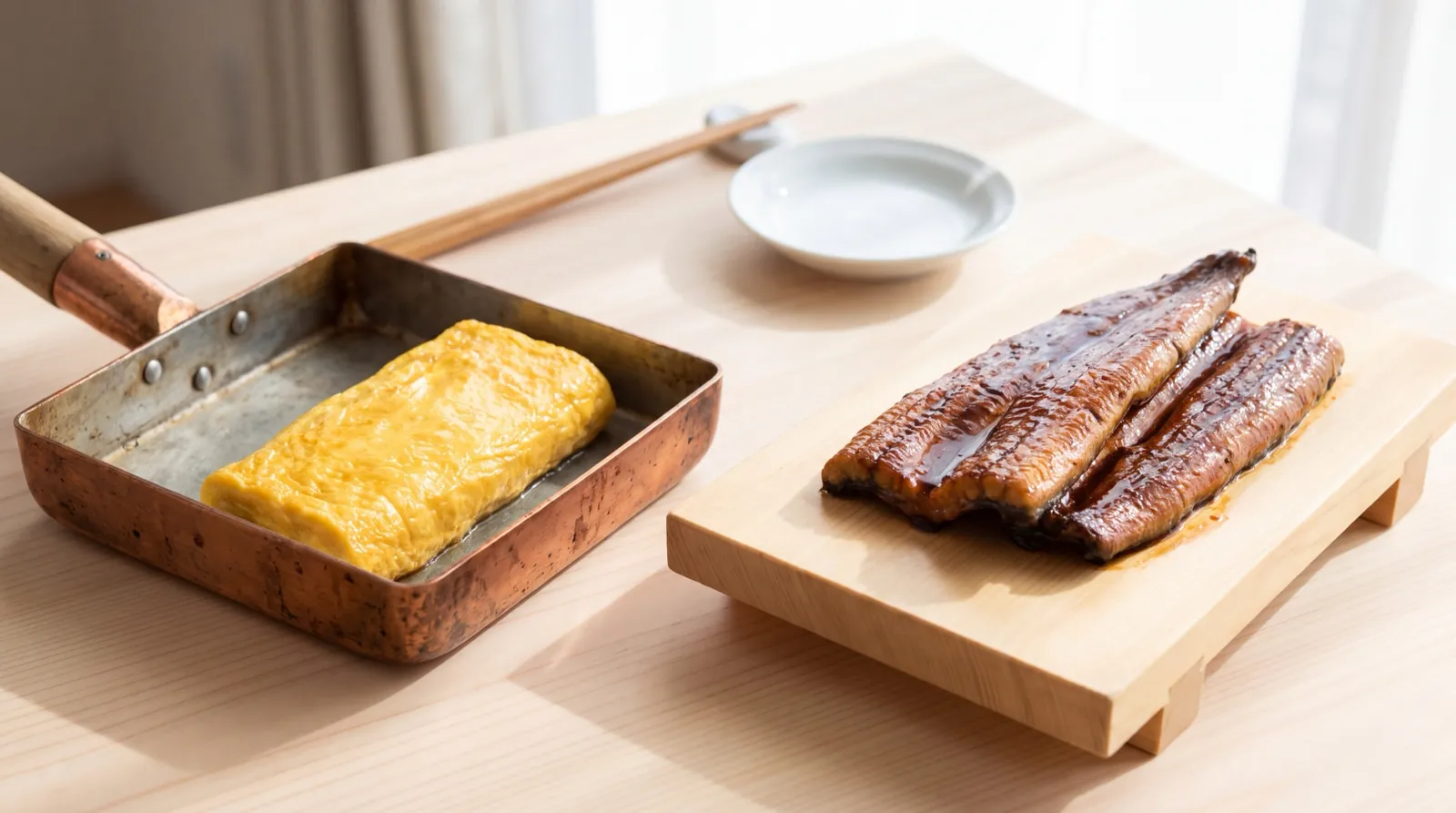
Tamagoyaki is a dish that must "set evenly all the way through, without burning, while holding on to the moisture of the dashi." If even one spot of the pan gets too hot, that spot burns and loses moisture. Copper conducts heat about 5 times faster than iron and about 25 times faster than stainless steel. Heat from the center of the bottom, where the flame hits, spreads quickly to the edges. The whole pan stays at almost the same temperature, so even over low heat the whole egg mixture sets gently and turns out fluffy.
The inside of a copper tamagoyaki pan is lined with tin. Tin melts at 232°C, so never heat the pan empty. After use, do not wash it with detergent. Wipe it with paper while it is still warm. Detergent removes the oil film built up through use, and the next batch will stick and burn.
| Material | Thermal conductivity | Behavior when making tamagoyaki |
|---|---|---|
| Copper | About 400 | Heat spreads quickly across the whole pan, with almost no uneven temperature |
| Aluminum | About 240 | Conducts heat well, but does not store heat well, so the temperature swings easily |
| Iron | About 80 | Only the spot where the flame hits gets hot, leaving patchy burn marks |
| Stainless steel | About 16 | Heat does not spread, and one spot burns |
How burning happens, and how to season the pan and cook
In words, the numbers in Table 19-1 are these: copper about 400, aluminum about 240, iron about 80, and stainless steel about 16. The figure of about 80 for iron is the value for pure iron. The cast iron and steel used for tamagoyaki pans are around 40 to 55, so in practice the gap with copper is even larger.
Egg proteins set at 60 to 70°C. When the surface goes above about 140°C, browning from the Maillard reaction speeds up sharply. Browning means taking on a burnt color. In a copper pan, no single spot goes above 140°C, so local burning does not happen.
- Season with oil For a new copper pan, pour in about 1 cm of oil and warm it over low heat for 10 minutes. Let it cool, pour out the oil, and wipe the pan. Repeat this several times.
- Care Remove burnt spots by rubbing with salt or hot water. Detergent is not used, so that the layer of oil hardened by heat is protected.
- Heat the pan To cook, heat the pan to about 160°C. At this temperature, a drop of egg mixture sizzles and sets at once. Spread oil thinly and evenly with paper.
- Roll For dashimaki, push the rolled egg to the far side of the pan and oil the near side. Pour in the next batch of egg mixture, letting it flow under the rolled egg too, so the layers join into one.
- Atsuyaki Pour it all in at once, cover, and cook over low heat for 30 to 40 minutes, until the surface is dry. Then turn it over.
One step further in egg hygiene
The type of Salmonella that can be found inside eggs is Salmonella Enteritidis. In Japan, eggs are washed before shipping and are labeled with a date until which they can be eaten raw. Even so, cracking eggs ahead of time is prohibited. If you have no choice but to hold cracked liquid egg, store it at 8°C or below. The rule of 70°C for 1 minute for egg dishes is the standard for cooking with eggs in the shell or with unpasteurized liquid egg. It is separate from the standard for pasteurizing liquid egg in a factory.
Refrigerate tamagoyaki at 4°C or below. When serving, take it out of the refrigerator and let it warm up a little. If it is served cold, the sweetness and aroma do not come through.
19.4 Uni
The uni eaten in sushi is the sea urchin's gonads. These are the organs that make eggs or sperm. Two groups are commonly used. One is the bafun uni group, with deep orange, rich-tasting meat. In Hokkaido, ezo-bafun uni is called "aka" (red) at the market. The other is the murasaki uni group, with pale yellow, delicate meat. In Hokkaido, kita-murasaki uni is called "shiro" (white).
Boxed uni and alum, and uni packed in salt water
Once uni meat is taken out of the shell, its own enzymes quickly start to dissolve it. So boxed uni (hako uni, also called ita uni), which is laid out on a wooden board, is first dipped in a solution of alum. Alum is a food additive. It firms up the proteins on the surface of the meat and tightens them, keeping the shape of the lobes for 4 to 5 days. The price is flavor. If the alum is too strong, or the uni soaks too long, the uni takes on a harsh, astringent taste, bitterness, and a medicinal smell.
In contrast, uni packed in salt water is uni meat packed while soaking in about 3% salt water, close to seawater. Because no additives are used, the sweetness and aroma stay intact. However, it loses its shape easily and keeps for only 1 to 2 days.
Judging and storing uni
Good boxed uni has lobes that stand up with a clear shape, a glossy surface, and a sweet smell. The following are signs of lost freshness: water pooling on the board with the lobes melting, called "dare"; darkening at the edges; and a sour smell. A medicinal smell means too much alum was used. Store uni in the refrigerator at 0 to 5°C. Do not tilt the box, and do not leave the lid open. Do not freeze raw uni. Freezing breaks its cells, and it melts when thawed. Uni, which has no fixed shape, is usually served as gunkan (battleship roll), wrapped with a band of nori (see Chapter 24).
Types of uni, and how alum works
| Type | Main producing areas | Peak season (guide) | Features |
|---|---|---|---|
| Bafun uni (Hemicentrotus pulcherrimus) | Sea of Japan coast of Honshu, Seto Inland Sea, and Kyushu | Spring to early summer | Small with short spines. Deep orange, rich-tasting meat |
| Ezo-bafun uni (Strongylocentrotus intermedius) | Hokkaido and Tohoku | Summer (July–August) | Called "aka" at the market. Uni from Rebun and Rishiri, which feeds on kombu, is the finest |
| Murasaki uni (Heliocidaris crassispina) | Honshu to Kyushu | Summer (June–August) | Long, blackish-purple spines. Pale yellow, delicate meat |
| Kita-murasaki uni (Mesocentrotus nudus) | Hokkaido and Tohoku | Early summer to autumn (varies by area) | Called "shiro" at the market. Mild taste and large yield |
| Aka uni (Pseudocentrotus depressus) | Kyushu (Karatsu, Iki, and Amakusa) | Autumn (September–October) | Red shell. Rich, rare, and high-end |
Of the uni in Table 19-2, the ezo-bafun uni from Rebun and Rishiri is considered the finest. Aka uni from Kyushu is also a rich, rare, high-end product. The peak season differs greatly depending on the producing area.
Chemically, alum is potassium aluminum sulfate. The action of firming and shrinking proteins to tighten them is called astringency. Through this action, alum firms up the surface of the gonads and holds back autolysis, in which the meat dissolves through its own enzymes. Uni packed in salt water has no fixed shape, so it is served wrapped in a band of nori, or with salt only.
19.5 Ikura and salmon
Sujiko and ikura
Ikura is the roe of salmon, mainly chum salmon. Roe still wrapped in the membrane of the ovary is called sujiko (salmon roe in the sac). Roe separated from the membrane into single eggs is called ikura. Raw sujiko is on the market from September to November. Early in the season the skins of the eggs are thin and soft. The later it gets, the thicker and harder they become.
- Prepare salt water Make salt water at about 40°C with 3% salt. In cold water, the eggs do not come off the membrane easily. Above 50°C, the surface of the eggs turns cloudy white and hard.
- Separate the eggs Soak the sujiko in the salt water. Press it against the mesh of a grill rack to make the eggs drop, or free them from the membrane with the pads of your fingers.
- Wash Wash 3 or 4 times, changing the salt water each time. Remove floating membrane, blood vessels, and broken eggs. Drain in a colander.
- Marinate For soy-marinated ikura, cook off the alcohol from sake and mirin, add soy sauce to make the marinade, and let it cool completely. Soak the eggs and marinate them in the refrigerator for 12 to 24 hours.
There are four causes of tough ikura skins: overripe eggs, a long soak in a salty marinade, water that is too hot, and drying or freezer burn. A long soak in a strong marinade draws water out of the eggs and toughens the skins. This is the work of osmotic pressure, the same thing that makes a slug shrink when you sprinkle salt on it.
Soy-marinated ikura keeps in the refrigerator (4°C or below) for 3 to 4 days at most. To keep it longer, freeze it at −20°C or below and use it within 2 to 3 months. Thaw it overnight in the refrigerator, and do not refreeze it once thawed. Ikura is eaten without cooking. In 1998, food poisoning from enterohemorrhagic E. coli O157 was caused by commercially sold soy-marinated ikura, with cases across several prefectures. Manage the hygiene of hands, tools, and containers to the same level as for raw fish.
Why can salmon be eaten raw?
For a long time in Japan, people did not eat salmon raw. Wild salmon often carries parasites such as Anisakis. About the only way people ate it raw was as "ruibe," salmon frozen first and then eaten.
Farmed salmon can be eaten raw because it is raised on formulated feed (pellets), which almost entirely cuts off the route by which parasites get in. Parasites enter a fish's body when it eats wild small fish or krill. Krill are small, shrimplike creatures. Under the U.S. FDA guidance and EU regulations as well, farmed fish raised this way are exempt from freezing before being served raw. The orange color of the flesh comes from a pigment mixed into the feed.
However, if you serve wild salmon raw, always freeze it at −20°C for at least 24 hours. It is safest to start counting once the center of the fish reaches −20°C (see Chapter 12). Parasites have been found in farmed fish raised in the sea from wild-caught young fish, and in farmed fish raised on raw feed. Do not feel safe just because a fish is "farmed." Check how it was raised.
Details of ikura preparation, and the history of salmon
In September, the skins of sujiko eggs are thin and soft. From November on, as spawning approaches, the egg membranes become thick and hard.
Another way to separate the eggs is to press and rub the sujiko against the strings of a badminton racket. After washing, drain the eggs in a colander for 10 to 20 minutes. One example of a soy marinade is a ratio of 1 part soy sauce, 1 part sake, and 0.5 part mirin. To salt-cure ikura, soak the eggs for 2 to 3 minutes in strong salt water of about 20% or more, then drain. Adjust the salt level and soaking time of the marinade to the time of the season the eggs came from.
In the 1998 O157 food poisoning, patients were reported in 5 prefectures: Toyama, Tokyo, Chiba, Kanagawa, and Osaka.
Besides Anisakis, wild Pacific salmon often carry the Japanese broad tapeworm (nihonkai-retto-jochu), a type of tapeworm. In the 1980s, Norway launched a program to market farmed Atlantic salmon in Japan. Salmon became established in the 1990s through conveyor-belt sushi (kaiten-zushi). The orange color of the flesh comes from a pigment called astaxanthin that is added to the feed.
Chapter summary
- Pin the anago with an eye spike, open it, and remove the slime with the back of the knife or with hot water. Its blood contains a toxin that heat makes inactive, so never serve it raw.
- A drop lid carries the simmering liquid over the top of the anago and prevents drying and breaking apart. The gloss and thickness of tsume come from concentrated sugar and the anago's gelatin. Heat tsume every day and refrigerate it.
- Hamaguri shrinks above 60°C, so take it out as soon as it opens and marinate it in the cooled liquid.
- A copper tamagoyaki pan conducts heat fast, and the whole pan stays at the same temperature, so there are no uneven burn marks. Never crack eggs ahead of time, and cook to 70°C at the center for at least 1 minute.
- Alum in boxed uni keeps the meat from melting, but too much causes a harsh, astringent taste and bitterness. Uni packed in salt water has no additives and tastes sweet, but keeps only 1 to 2 days. Separate ikura in 3% salt water at about 40°C, and keep it at 4°C or below for 3 to 4 days.
- Farmed salmon is raised on formulated feed, so there is little concern about parasites. If you serve wild salmon raw, freeze it at −20°C for at least 24 hours.
- The thermal conductivity of copper is about 400, about 5 times that of iron. Eggs set at 60 to 70°C, and browning speeds up sharply when the surface goes above about 140°C. Do not use detergent; build up the layer of oil (Grade 1).
Review questions
Q1 Which statement about tamagoyaki hygiene is correct?
a To speed up morning preparation, crack all the eggs the night before
b Japanese eggs are washed, so cracked egg may be left at room temperature
c Crack eggs just before use, and cook tamagoyaki to the center (70°C at the center for at least 1 minute)
d Sweet tamagoyaki does not grow bacteria because of the sugar, so it may be left at room temperature overnight after cooking
e A copper tamagoyaki pan conducts heat well, so bacteria die even if the center is not fully cooked
Answer: c
Eggs may carry Salmonella, and in cracked egg left at room temperature, bacteria multiply explosively. So never crack eggs ahead of time (a and b are wrong); crack them just before use. Cooked tamagoyaki is also high in sugar and water, so bacteria grow easily in it. Do not leave it at room temperature; refrigerate it (d is wrong). What kills bacteria is the temperature at the center and the time, not the material of the pan (e is wrong).
Q2 Which is the main reason for placing a drop lid on anago while it simmers?
a To press the anago flat and thin with the weight of the lid
b To stop evaporation completely so the flavor does not get too strong
c To carry the simmering liquid over the top of the anago and prevent drying and breaking apart
d To keep the simmering liquid much hotter than 100°C
e To make the anago's slime stick to the lid so it can be removed
Answer: c
Liquid rising from the bottom of the pot hits the lid, flows sideways, and falls onto the anago. Even with little liquid, flavor and heat reach every part. The top surface does not dry out, and the anago does not bounce around, so it does not break apart. The lid does not stop evaporation, and it does not raise the temperature of the liquid.
Q3 Which statement about the alum used for boxed uni is correct?
a Alum kills bacteria, so boxed uni can be stored at room temperature
b Through astringency, alum firms up the proteins on the surface of the gonads and keeps the meat from melting through autolysis, but too much gives a harsh, astringent taste and bitterness
c Alum is an additive that adds sweetness, so the more you use, the better the taste
d Uni treated with alum does not melt even when frozen
e Uni packed in salt water also contains alum, and it keeps longer than boxed uni
Answer: b
Alum (potassium aluminum sulfate) firms and tightens proteins through astringency. This holds back melting and keeps the shape for 4 to 5 days. On the other hand, if it is too strong or the uni soaks too long, the uni takes on a harsh, astringent taste, bitterness, and a medicinal smell. Store uni in the refrigerator at 0 to 5°C, and do not freeze raw uni. Uni packed in salt water has no additives and keeps for 1 to 2 days.