

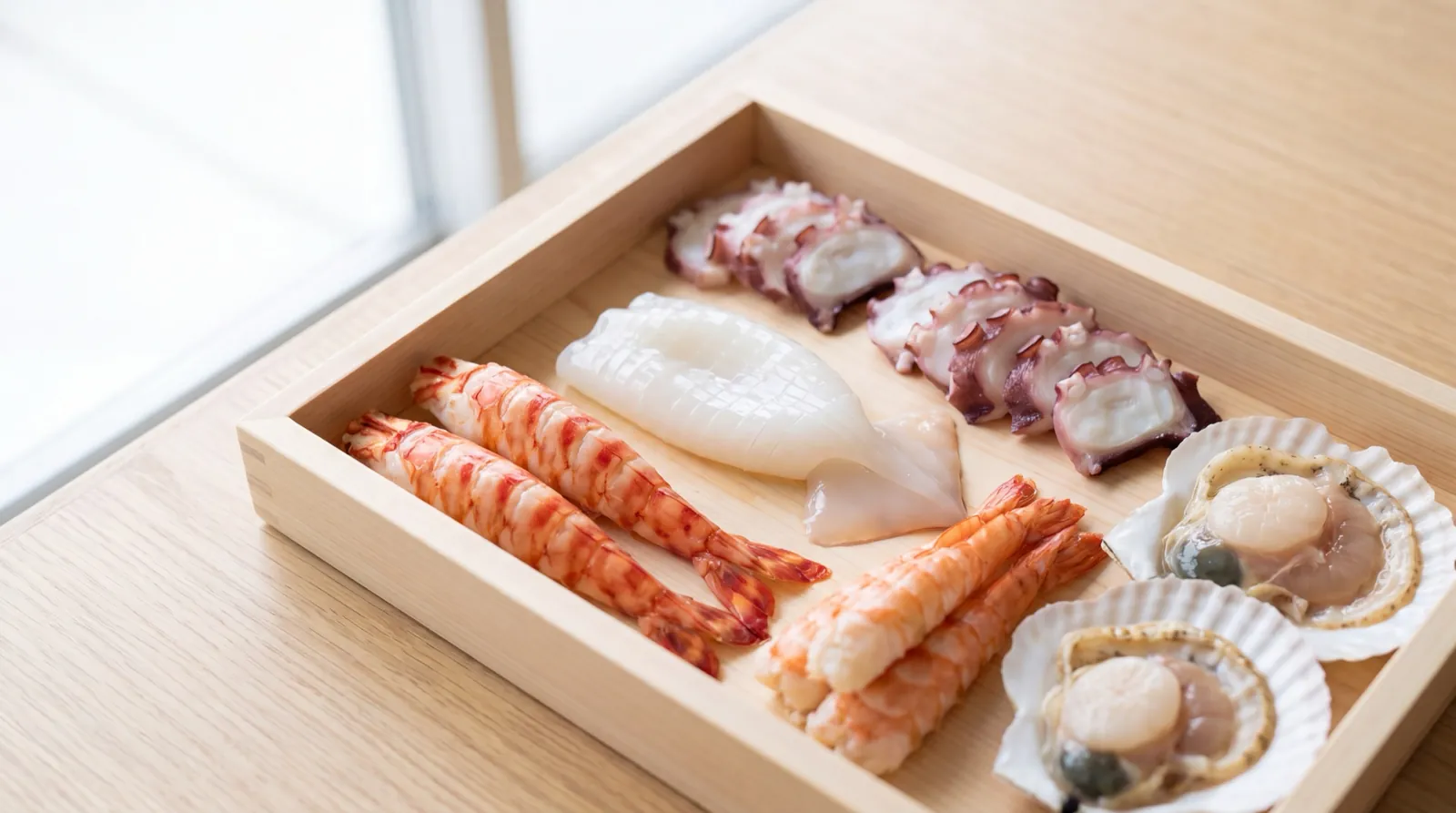
Part IV Toppings (Neta)
Chapter 17
Shrimp, Crab, Squid, and Octopus
Shrimp, crab, squid, and octopus have bodies built in a completely different way from fish. If you handle them the same way you handle fish, they turn tough or rubbery, or a fishy smell stays. In this chapter, you will learn why kuruma prawns go into ice water right after boiling, how to deal with the thin skins of squid and use hidden scoring, and how to salt-rub and pound octopus. You will learn the steps along with the reasons for them.
In this chapter you will learn
- To explain why kuruma prawns are boiled in salted water and then put straight into ice water
- To explain shrimp and crab allergies, and how to prevent "hidden contamination"
- To explain, and tell apart, the purposes of the 4 skin layers of squid and hidden scoring, and of salt-rubbing and pounding octopus
- To take the right precautions against Anisakis and other parasites in squid and octopus
- To explain blackspot in shrimp, the aging of squid, and how to boil octopus, through changes in proteins and enzymes (Grade 1)
17.1 Shrimp
| Kind | How it is used | Key points |
|---|---|---|
| Kuruma prawn | Boiled in salted water | Boil them live, then put them into ice water |
| Ama-ebi (sweet shrimp) | Raw | Its standard Japanese name is hokkoku-aka-ebi (Pandalus eous). Keep at 0–2°C |
| Botan shrimp | Raw | Most "botan" at the market are actually toyama-ebi (Pandalus hypsinotus). The eggs are used for gunkan (battleship rolls) |
| Mantis shrimp | Boiled in salted water, with tsume (sweet reduced sauce) | Boil and peel right after buying. If left sitting, the flesh shrinks |
The main shrimp at sushi restaurants are kuruma prawns, which are boiled and then made into nigiri, and ama-ebi and botan shrimp, which are made into nigiri raw. Mantis shrimp are also boiled in salted water, brushed with tsume, and made into nigiri.
Boil kuruma prawns live
When a kuruma prawn dies, the enzymes inside its body spread into the flesh. It darkens from the base of the head, the flesh turns watery, and it does not taste sweet even after boiling. So buy them live, packed in sawdust, and keep them alive in a cool, dark place at around 10°C.
- Skewer From the belly side toward the head, push a bamboo skewer straight through between the flesh and the shell. When heated, a prawn's belly side shrinks and the prawn curls up, so the skewer keeps its shape.
- Boil in salted water Bring water with about 3% salt to a boil over high heat, and put the prawns in. That means 30 g of salt per 1 L of water. If you boil them in plain water, the umami escapes into the water and the prawns turn watery.
- Take them out For prawns of 30 to 40 g for sushi, the guideline is 2 to 3 minutes after the water returns to a boil. Take them out when the shell turns bright red and the flesh on the belly side turns white. A slight translucency remains in the center.
- Put them into ice water Put them into ice water right away to chill them to the core. Once they are cold, take them out. Do not leave them soaking.
- Peel and open Pull out the skewer, and remove the head and shell. Leave the last tail segment on. Open the prawn from the belly side and remove the vein (the digestive tract).
The reason for putting them into ice water is to stop carryover heat. Even after the prawns leave the water, the heat left in the shell and flesh keeps raising the temperature in the center. If they cook too much, the flesh shrinks hard. Like squeezing a sponge full of water, it squeezes out water that holds the sweet components. The result is a prawn that is tough, dry, and not sweet.
Raw shrimp and frozen shrimp
Ama-ebi is rich and sweet because its flesh has strong autolytic enzymes. Autolytic enzymes keep working after death and break down the proteins in the animal's own flesh. As the breakdown goes on, the amino acids that give sweetness increase. Enzymes work faster at higher temperatures, so keep ama-ebi at 0 to 2°C. At room temperature, the breakdown speeds up sharply and leads to spoilage.
Wash raw shrimp in 3% salt water, not fresh water. If fresh water touches the flesh, the flesh absorbs water and turns watery.
Thaw frozen shrimp in the refrigerator or in 3% salt water (Chapter 12). The darkening at the base of the head is called blackspot (melanosis). It is a change caused by the shrimp's own enzymes. It is not spoilage, but it is a sign that time has passed. Imported shrimp that have been soaked in water-retaining agents (such as phosphates) turn springy like rubber when boiled, and their sweetness is weak. Check the ingredient labels when you choose.
A detailed look at cooking kuruma prawns
If you keep live kuruma prawns in the refrigerator (around 4°C) for a long time, they weaken and die. The guideline for storage is around 10°C. A prawn's muscles are concentrated on the belly side, so the belly side shrinks strongly when heated. The skewer is there to prevent this bending and keep the nigiri shape. The salt in the boiling water uses osmotic pressure to keep water and umami from escaping from the flesh into the water. It also seasons the prawns lightly. Keep the ice water at 0 to 1°C, and take the prawns out once the initial heat is gone.
Shrimp seasons, blackspot, and water-retaining agents
As a guideline, kuruma prawns are in season from early summer to autumn, and live ones are available all year. Ama-ebi and botan shrimp are in season from winter to spring. Ama-ebi flesh is firm right after landing. Within 1 to 2 days, enzymes soften it, the amino acids increase, and the sweetness grows stronger. For botan shrimp, the blue-green eggs carried on the belly are used for gunkan.
Blackspot is caused by an enzyme in the shrimp itself, called tyrosinase. This enzyme oxidizes an amino acid called tyrosine and makes a black pigment called melanin. It is not spoilage, but it is evidence that time has passed at some temperature, and a sign that freshness has dropped. In distribution, sulfites are sometimes used to prevent blackspot, and they must be labeled. Some imported frozen shrimp are soaked in water-retaining agents such as phosphates. This adds weight and prevents juices from leaking out when they are thawed.
Never thaw frozen shrimp under running water or at room temperature. The surface stays in the temperature danger zone (10 to 60°C) for a long time, and fresh water also makes the flesh swell with water. Note also that crustacean allergies are characteristically more common in adults.
Mantis shrimp and shiba shrimp
Boil mantis shrimp while they are still alive, in 3% salt water for 3 to 5 minutes. While they are hot, cut along both sides of the shell with scissors and peel them. As time passes, the flesh shrinks inside the shell, so boil them right after buying. In spring, females carry roe called "katsubushi." The seasons are spring and autumn.
Shiba shrimp are small shrimp with a strong sweetness, in season from autumn to winter. They are ground into a paste and mixed into tamagoyaki. They are also boiled, ground, and dry-cooked with sugar, sake, and salt to make oboro. Oboro is a sweet filling made by dry-cooking shrimp or white-fleshed fish into fine crumbles (Chapter 19).
17.2 Crab
The main crabs at sushi restaurants are snow crab, red king crab, hair crab (kegani), and seiko-gani, the female snow crab. When you boil a crab, put it into 3 to 4% salt water with its shell facing down. This keeps the kani miso (crab innards) from flowing out toward the legs. Picked crabmeat turns watery and starts to smell over time, so use it on the day it is boiled.
Kinds of crab and how to boil them
Snow crab goes by different names depending on where it is caught. In the San'in region, it is called matsuba-gani, and in Fukui it is called echizen-gani. They are all the same species, with long leg meat and a refined sweetness. Hair crab stands out for the sweetness of its meat and the richness of its kani miso. Seiko-gani is also called seko-gani or kobako-gani.
If you put a live crab straight into boiling water, it gets startled and drops its own legs. So kill it first. Either soak it in fresh water or ice water for 10 to 20 minutes, or insert a knife near the mouth on the underside of the shell. Then put it into the salt water. As a guideline, boil a hair crab of about 500 g for 15 to 18 minutes after the water returns to a boil, and a snow crab of 1 kg for 18 to 20 minutes. After boiling, do not plunge it into cold water. Let it cool with the shell facing down. While the legs are hot, cut the shells with scissors, pull out the meat, and pick it apart along the fibers. This gives a fine, fluffy texture.
Inside the shell of a seiko-gani is orange internal roe (uchiko). This is the ovary. On its belly, it carries brown, grainy external eggs (sotoko). These are eggs that have already been laid. Both are available only during the short fishing season from November to December. Boil and pick them apart, then combine them with the leg meat and kani miso. Serve them as gunkan or kora-mori (piled back into the shell).
17.3 Squid
The squid used include Japanese flying squid, bigfin reef squid, golden cuttlefish (sumi-ika), spear squid, and swordtip squid (kensaki-ika).
The skin has 4 layers: remove it down to the last thin skin
The skin on a squid's body looks like a single sheet, but it actually has 4 layers. The outer layers 1 and 2 are colored skin, and they peel off if you pinch them with your fingers. The problem is layers 3 and 4 underneath. They are clear and very tough thin skins. If you leave them on and make nigiri, the cellophane-like skin cannot be bitten through and stays in the mouth.
Remove layers 3 and 4 by rubbing the surface of the flesh in one direction with a dry cloth or a paper towel. The dry fibers catch on the thin skin.
The three jobs of hidden scoring
The cuts made in squid flesh are called hidden scoring. These are shallow cuts that are hard to see from the top. They do three jobs. First, they cut through the strong fibers in the flesh. This gets rid of the rubbery, stretchy texture and makes the squid easy to bite through. Second, soy sauce gets into the cuts, so a small amount of soy sauce is enough for flavor. Third, the cuts create more cut surfaces, so the sweet components reach the tongue more easily.
Resting makes it sweeter
If you rest squid at 0 to 2°C for 1 to 2 days, its autolytic enzymes increase the sweet amino acids, and the texture turns rich and sticky. If you rest it too long, the surface turns slimy and it gives off an ammonia smell. Think of 2 days as the limit.
Kinds of squid and how to tell them apart
| Kind | Peak season guideline | Flesh quality and uses | How to tell it apart |
|---|---|---|---|
| Japanese flying squid (maika) | Summer–autumn | Thin, with a strong bite. Raw, simmered squid, geso (squid tentacles) | Tube-shaped body. Carries the most Anisakis |
| Bigfin reef squid | Autumn–early summer | Thick and rich, sticky texture. The top grade for raw use | The fin runs along the whole body |
| Golden cuttlefish (sumi-ika) | Autumn–winter. Shin-ika (young cuttlefish) in late summer | Crisp to bite, and sweet. An Edomae (Edo-style) classic | Chalky internal shell in the body. Lots of ink |
| Swordtip squid | Summer | Soft and sweet. Raw, aburi (searing with a flame) | The tip of the body is pointed like a sword |
| Spear squid | Winter–spring | Light flavor, thin flesh. Raw, yubiki (quick blanching) | Long and slim, with short arms |
| Firefly squid | Spring (March–May) | Boiled, as gunkan | Small. Serving it raw requires precautions against spirurid nematode larvae |
The top grade for raw use is said to be bigfin reef squid, with its thick, rich flesh. The Edomae classic is golden cuttlefish, which has a chalky internal shell in its body. The parasite found in firefly squid is called a spirurid nematode larva (type X).
The body of a squid is called the mantle. It is a tube-shaped wall of muscle that wraps the organs, and it is the part that sushi chefs call the "flesh." Skin layers 1 and 2 contain chromatophores, the cells that give color. The thin skins of layers 3 and 4 are made of tough collagen. If you cannot get a grip on the edge of the thin skin, put a little vinegar on your fingertips and rub. This stops the slipping and makes it easier to peel.
The logic of hidden scoring, and how to cut it
The mantle is built from bundles of muscle fibers running around the tube, like rings. Collagen fibers crossing at an angle tighten around these bundles like a net. If you bite it as it is, it stretches and stretches and you cannot bite through it. If you cut this net into small pieces with scoring, the flesh melts apart the moment you bite.
The sweetness of squid comes from amino acids such as glycine, alanine, proline, and betaine. The more cut surfaces there are, the more directly these touch the tongue.
There are three ways to make the cuts. Kanoko (fawn-spot pattern) crosses cuts in two diagonal directions. A grid uses cuts running lengthwise and crosswise. Thin strips cut the squid into fine pieces. Kanoko or a grid suits thick bigfin reef squid and golden cuttlefish. Thin strips suit thin Japanese flying squid and spear squid.
Aging squid, and why it is served with salt and sudachi
In fish flesh, after death, ATP, the energy source, breaks down and forms inosinic acid, an umami component (Chapter 10). In squid, almost no inosinic acid forms. Instead, a different umami component called AMP (adenylic acid) builds up. At the same time, autolytic enzymes break down proteins, and sweet amino acids such as glycine increase. That is why squid rested for 1 to 2 days, which has turned cloudy white, is sweeter and richer than crunchy, clear, live squid.
Squid is sometimes served with salt and sudachi because salt brings out the sweetness of the amino acids. This is called the contrast effect (Chapter 15). Soy sauce has a strong color and aroma, and it covers up the delicate sweetness. The acidity and aroma of sudachi give shape to the rich, sticky texture and cut the aftertaste cleanly.
Simmered squid and geso
Edomae sushi includes the work of simmering squid. Japanese flying squid or spear squid is simmered in a liquid of soy sauce, sake, and sugar for only 1 to 2 minutes after it comes to a boil. Then it is put back into the simmering liquid to cool. If you simmer it for a long time, the collagen shrinks and the squid gets tough. So the key is to "simmer it quickly, then let it soak up the flavor as it cools." For geso, rub off the hard rings of the suckers with salt. Then boil the geso in boiling water for 20 to 30 seconds and put it into ice water. Brush it with tsume and make it into nigiri, or sear it.
17.4 Octopus
Salt-rubbing and pounding have different purposes
Salt-rubbing is the job of removing the slime from the surface. The main component of the slime is mucin. It is a mucus made of sugars bound to proteins, and it causes a fishy smell. When you sprinkle plenty of coarse salt and rub, the slime loosens, and the salt grains scrub it off. This is the work of osmotic pressure, the same thing that draws water out of leafy greens when you salt them. Rub until no more white foam comes out, then wash under running water.
Pounding is the job of making the flesh tender. Octopus legs are made of strong fibers. If you boil them as they are, they shrink and get tough. Before boiling, pound them with a wooden pestle or a daikon radish to break down the fibers just enough. This gives the octopus a clean bite. A daikon is used because its hardness is just right and it is less likely to damage the flesh. The explanation that "enzymes in daikon make it tender" is said to have little evidence behind it.
How to boil
Use plenty of water, and lower the octopus in leg tips first. When the leg tips touch the hot water, the muscles contract and the legs curl up. Then sink the whole octopus, and it will boil into a shape with the legs curled outward. After boiling, do not plunge it into cold water. Let it cool on a colander. If you chill it suddenly, the skin shrinks and peels off.
Kinds of octopus, and the logic of salt-rubbing and pounding
The standard octopus at sushi restaurants is the common octopus. Its peak season is said to be summer, but it also tastes good in winter. The giant Pacific octopus (mizudako) from Hokkaido is large, over 10 kg, and its flesh is soft and watery. It is often sliced thin while raw, and the suckers are given yubiki. The webfoot octopus (iidako) is small, and in winter and spring the females full of eggs are simmered whole.
In salt-rubbing, the osmotic pressure of the salt draws water out of the mucin, and the mucus loosens. Then the salt grains scrape it off. As you rub, the mucin rises as white foam. Rub for 10 to 15 minutes, until no more foam comes out.
Pounding works because octopus legs are made of bundles of strong muscle fibers and collagen. If you boil them as they are, the proteins shrink and turn rubbery, so you break down the fibers moderately beforehand. The main enzyme in daikon is diastase. This enzyme breaks down starch. It does not act on proteins, and it is also weak against heat.
What to add to the boiling water, and how long to boil
What to add to the boiling water depends on each restaurant's style, and it changes the color, tenderness, and smell. Bancha and adzuki beans are used to bring out a red color in the skin. Daikon is used to make the octopus tender. Vinegar is used to brighten the color and make it tender.
| What to add | Aim | Logic |
|---|---|---|
| Bancha or hojicha (green teas) | Keep the skin red and reduce the fishy smell | Tannins in the tea are said to bind with proteins in the skin to fix the color, and also to absorb smell components |
| Adzuki beans (their cooking liquid) | Bring out a red color | The astringent components of adzuki beans (relatives of tannins) are said to work the same way as bancha |
| Daikon | Make it tender (it is said) | Daikon enzymes are said to work, but the main enzyme breaks down starch and is weak against heat, so there is little evidence. Daikon is also used for pounding |
| Vinegar | Brighten the color and make it tender | The acid swells the collagen and helps it turn into gelatin, and it stabilizes the color. Too much leaves a sour taste |
For a common octopus of 1.5 to 2 kg, one guideline is 15 to 20 minutes after the water returns to a boil. Turn off the heat and leave it in the water for about 10 minutes, cooking with the remaining heat. To make it even more tender, make yawarakani (tender simmering), simmering it at 80 to 90°C without boiling for 1 to 2 hours. There is also sakura-ni, where the octopus is simmered in soy sauce, sake, and sugar until it absorbs the flavor. Collagen slowly turns into gelatin starting at around 65°C. So simmering hard over high heat for a short time makes it tough, and simmering gently over low heat for a long time makes it tender.
Slicing and storage
Slice the legs with the namigiri (wave cut), pulling the knife while moving it up and down in small strokes. The cut surface comes out in a wave shape. The cut surface becomes larger so soy sauce clings to it, and the surface that meets the teeth is wavy. So even firm flesh is easier to bite through.
Wipe boiled octopus dry and wrap it with plastic wrap pressed tight against it. In the refrigerator (0 to 4°C), 2 to 3 days is the limit. If you freeze it boiled at −20°C or below, you can use it for about 1 month. When raw octopus is frozen, ice crystals break the muscle fibers. So if you thaw it and then boil it, it becomes tender, just as if it had been pounded.
17.5 Outside Japan
Outside Japan, you often cannot get live kuruma prawns or the same squid as in Japan. The core of the work becomes choosing frozen products correctly, thawing them correctly, and taking precautions against parasites.
Choosing products and standards outside Japan
Choose frozen shrimp whose ingredient labels do not list water-retaining agents (phosphates) or sulfites. Choose ones with a thin ice glaze, the film of ice on the surface.
The kinds of squid differ by country. In Southeast Asia, bigfin reef squid and golden cuttlefish are plentiful, so you can do the same thick-flesh work as in Japan. How many Anisakis are present varies by sea area. If you serve squid raw, use squid frozen to Japan's standard or to the standard of the U.S. Food and Drug Administration (FDA). The FDA standard counts by the temperature inside the freezer. Examples are 7 days at −20°C or below, including the freezing time, or freezing at −35°C or below and then holding at −35°C for 15 hours (Chapter 3).
Frozen common octopus from Northwest Africa, such as Mauritania and Morocco, and from the Mediterranean is sold all over the world. Freezing has already broken down the fibers, so no pounding is needed. Salt-rub it before boiling. Even in countries where live octopus is available, local practice often skips salt-rubbing. Always add the step of removing the mucin yourself.
Chapter summary
- Boil live kuruma prawns in 3% salt water for 2 to 3 minutes, leave slight translucency in the center, and put them into ice water. This stops carryover heat and keeps the flesh from shrinking and losing its sweetness.
- Ama-ebi becomes sweet through autolytic enzymes, so keep it at 0 to 2°C. Thaw frozen shrimp in the refrigerator or in 3% salt water.
- Shrimp and crab are specified allergenic ingredients. Watch out for "hidden contamination" from cooking water, hands, oboro, tamagoyaki made with ground shrimp, kanikama, and so on.
- For squid, remove the skin down to the clear thin skins of layers 3 and 4. Hidden scoring is for texture, for holding soy sauce, and for sweetness, and it does not protect against Anisakis. To serve squid raw, freeze it at −20°C for 24 hours or more.
- Salt-rubbing octopus removes the slime (mucin), and pounding breaks down the fibers to make it tender. After boiling, do not plunge it into cold water.
- Overcooking shrimp causes hypercontraction, which squeezes out water and amino acids. Blackspot is the formation of melanin by tyrosinase. Aging squid increases AMP and sweet amino acids. Octopus collagen slowly turns into gelatin starting at around 65°C (Grade 1).
Review questions
Q1 What is the main reason for putting live kuruma prawns into ice water right after boiling them in salted water?
a To make the red color of the shell brighter
b To stop carryover heat, so the flesh does not shrink and squeeze out water that holds the sweetness
c To kill bacteria on the surface with low temperature
d To chill and firm the flesh so it does not fall apart when you make nigiri
e To make the shell easier to peel
Answer: b
Even after the prawns leave the water, the heat left in the shell and flesh keeps raising the temperature in the center. If they cook too much, the flesh shrinks hard and squeezes out water that holds the sweet components, and the prawn turns tough and dry. Low temperatures do not have the power to kill bacteria.
Q2 Which statement about working with squid and octopus is correct?
a For squid skin, peeling off the colored layers 1 and 2 is enough
b If you make fine hidden scoring, it kills Anisakis
c Salt-rubbing octopus is the job of breaking down the fibers in the flesh to make it tender
d Pounding octopus is the job of removing the slime from the surface
e Salt-rubbing octopus is for removing the slime, and pounding is for breaking down the fibers to make it tender. Their purposes are different
Answer: e
For squid, unless you remove the clear, tough layers 3 and 4, the cellophane-like skin stays in the mouth. Hidden scoring only nicks the worms, and it is not a way to kill them. The purposes of salt-rubbing and pounding octopus are easy to mix up, so be careful.
Q3 Which statement about "blackspot," the darkening at the base of the head of frozen shrimp, is correct?
a It is evidence that spoilage bacteria have multiplied, so always throw the shrimp away
b It is a change in which the shrimp's own enzyme, tyrosinase, oxidizes the amino acid tyrosine and makes the black pigment melanin
c It is a discoloration of the phosphates used as water-retaining agents
d It is the color of fat oxidized by freezer burn
e Sulfites used to prevent blackspot do not have to be labeled
Answer: b
Blackspot is a change caused by the shrimp's own enzyme, tyrosinase, and it is not spoilage. However, it is evidence that time has passed at some temperature, and a sign that freshness has dropped. Sulfites used in distribution to prevent blackspot must be labeled.