
Part IV Toppings (Neta)
Chapter 15
White-Fleshed Fish
White-fleshed fish is often the first neta (topping) served in an omakase (chef's choice) course. Unlike tuna, it cannot rely on fat. So everything shows in the taste: the salt, the kombu (kelp), the resting, the skin side, the slicing, and the condiments. In this chapter, you will start with why white-fleshed fish is white. Then you will learn the peak seasons and handling of the main fish, and the reasons behind serving white-fleshed fish at its best.
In this chapter you will learn
- To explain why white-fleshed fish is white, and the signs that its freshness has dropped
- To explain the peak seasons and handling of the main fish, such as red sea bream, olive flounder (hirame), Japanese sea bass, and the amberjacks
- To explain why kobujime (curing between kombu sheets) increases umami, and why white-fleshed fish is paired with citrus and salt
- To explain how to prevent Kudoa and histamine in the amberjacks
- To explain the meaning of tempering (letting cold fish warm slightly), and the freezing standards for serving white-fleshed fish raw outside Japan (Grade 1)
15.1 What white-fleshed fish is
Fish muscle includes red muscle for swimming long distances and white muscle for quick bursts of speed. Red muscle contains a lot of myoglobin, a pigment that stores oxygen (Chapter 14). White muscle contains almost none. Sea bream and hirame are fish that wait quietly on the seabed or among rocks, then pounce the moment prey comes near. Their flesh is almost all white muscle, so it is translucent and white.
White-fleshed fish has little iron flavor. Its appeal is a light, delicate umami. It has a lot of membrane between the muscles, that is, collagen, so it has a firm bite, and it softens when rested. It does not turn brown like tuna. Instead, it loses its translucency and turns cloudy white, and that is the sign that its freshness has dropped.
Fast-twitch and slow-twitch muscle: how it differs from red-fleshed fish
The red muscle for swimming long distances is called slow-twitch muscle. The white muscle for quick bursts is called fast-twitch muscle. Slow-twitch muscle uses oxygen to make energy, so it contains large amounts of myoglobin. Fast-twitch muscle makes energy in a short time without oxygen, so it has almost no myoglobin.
Tuna and skipjack have well-developed dark meat (chiai), which is slow-twitch muscle. On top of that, their ordinary meat, which makes up most of the body and is fast-twitch muscle, also contains a lot of myoglobin. So the whole body is red. In fisheries science, there is a rule of thumb. Fish with about 10 mg or more of muscle pigment protein per 100 g are red-fleshed fish, and fish with less are white-fleshed fish.
In white-fleshed fish, the delicate taste of inosinic acid, the main source of umami, comes straight to the front. On the other hand, it has fewer free amino acids than red-fleshed fish, so its taste is lighter.
| Item | Red-fleshed fish (tuna, skipjack, mackerel) | White-fleshed fish (sea bream, hirame, Japanese sea bass) |
|---|---|---|
| Main muscle | Well-developed slow-twitch muscle (dark meat), and plenty of myoglobin in the ordinary meat too | Fast-twitch muscle |
| Way of life | Migrates through the open ocean without stopping | Lies in wait on the seabed or among rocks |
| Taste | Iron flavor, acidity, and fat. Many free amino acids | Delicate umami of inosinic acid, light sweetness |
| Texture | Soft | Firm bite |
| Resting | Umami increases, but fat oxidation and browning progress fast | Large fish are rested for several days to bring out umami and tenderness |
| Signs of lost freshness | Browning, a sour smell, histamine | Loss of translucency (turning opaque white), sliminess |
| Matching condiments | Ginger, green onion, soy sauce (Chapter 16) | Citrus, salt, wasabi |
In short, red-fleshed fish are migrating fish. They have a strong taste of iron and fat, and they spoil by turning brown. White-fleshed fish are fish that lie in wait. They have light umami and a firm bite, and they spoil by turning cloudy white.
15.2 Red sea bream
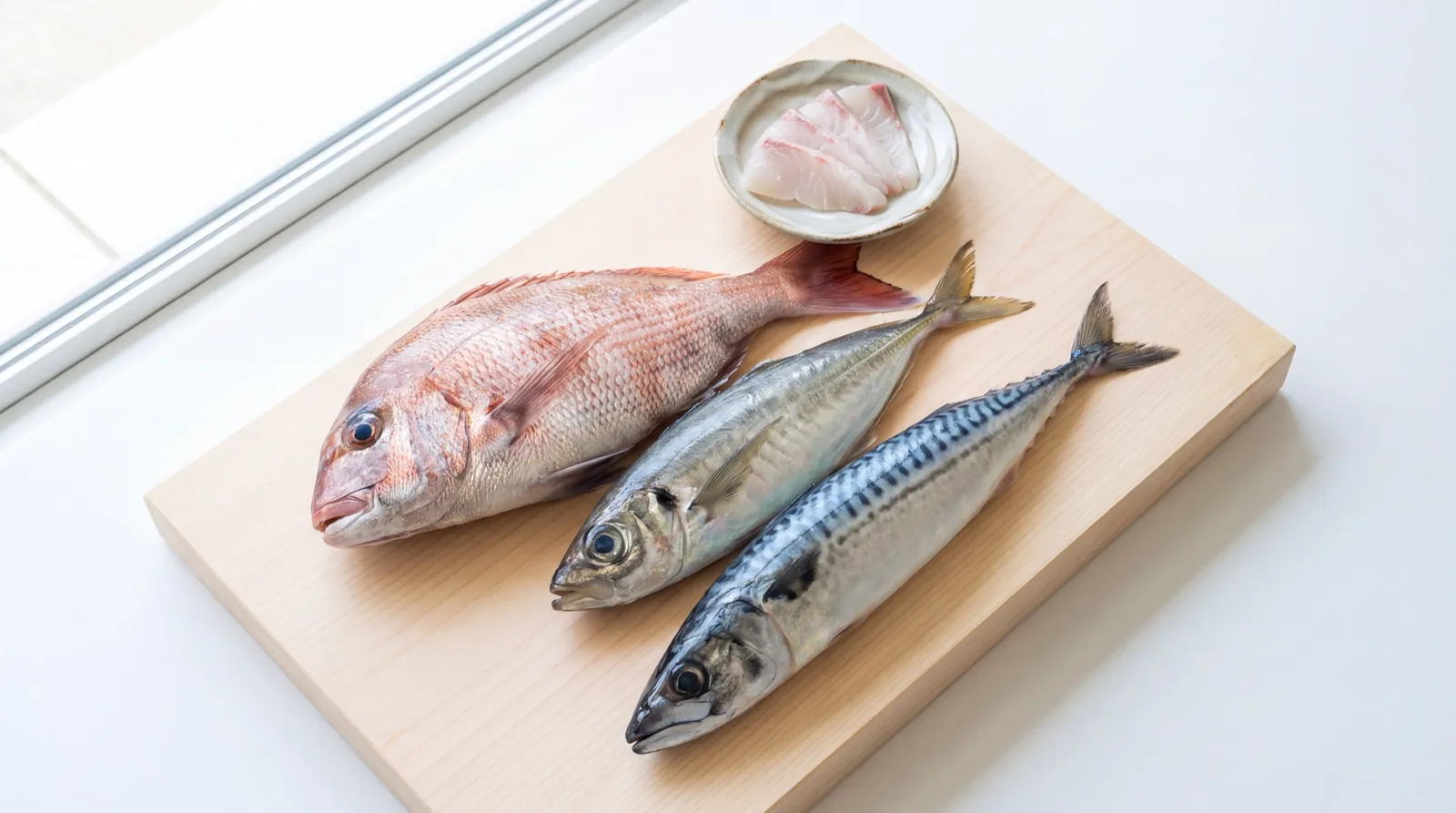
Red sea bream (madai) is the classic white-fleshed fish, essential at celebrations. It has two peak seasons. In spring, before spawning, its body glows a clear cherry-blossom pink, and it is called sakura-dai (spring sea bream). In autumn, when it has fed and regained its fat, it is called momiji-dai (autumn-leaf sea bream). In early summer, after spawning, its flesh is thin. It is called "mugiwara-dai," or "straw sea bream," and its flavor drops.
Wild fish are a vivid cherry-blossom pink, with small blue spots scattered on the back, and the tips of the tail fin are pointed. Farmed fish often have darker bodies, and their tail fins are worn and rounded. Farmed fish have more fat and softer flesh, so slice them a little thinner.
Between the skin and the flesh of sea bream, fat and gelatin gather. This is the most delicious part. A classic preparation that makes use of the skin is matsukawa-zukuri (skin-on sea bream scalded so the skin looks like pine bark). It is also called kawashimo-zukuri. You lay a cloth over the skin side and pour boiling water over it. Then you plunge the fish right away into ice water and wipe off the moisture. The skin shrinks into a pattern like pine bark, and the tough skin becomes soft enough to bite through.
Telling sea bream apart, and the details of preparation
Sakura-dai is at its peak in March and April. Fish from Akashi and Naruto in the Seto Inland Sea are well known. At this time, the fish has not yet sent its nutrients to its roe or milt, so the flesh has fat and umami. Mugiwara-dai comes around June. You can also tell wild from farmed fish by the nostrils. Wild fish have 2 pairs, one on each side. Many farmed fish have nostrils joined into 1 pair. Farmed fish darken from sunburn in shallow pens. If you serve farmed fish raw, slice it thinner, or make use of the fat with yakishimo (searing the skin).
Sea bream scales are hard and large, so remove them carefully. You can flick them off with a scaler. Or you can use sukibiki (shaving off scales with the knife), laying the knife nearly flat and shaving the scales off thinly with the outer skin (Chapter 13). In matsukawa-zukuri, heat shrinks the skin and draws out the gelatin and fat beneath it. Because you do not need to remove the skin, you keep the most delicious layer between the skin and the flesh. Sea bream bones are hard and thick. Pull the pin bones out toward the head with bone tweezers, and shave the belly bones off thinly. The flesh is firm, so slice it a little thinner with sogigiri (angled slice), in a direction that cuts across the fibers.
15.3 Hirame and karei
Hirame is at its peak from late autumn to winter, when it is called kan-birame (winter hirame). In summer, after spawning, its flesh is thin. It is called "neko-matagi," meaning that even a cat would step over it, because its flavor drops so much. When you place the fish with its belly toward you, hirame has its head facing left, and flounder (karei) has its head facing right. There are exceptions among some species.
Hirame has a flat body, so it is cut with five-piece filleting (gomai oroshi) into four fillets and the backbone. Two fillets come from the back half, and two come from the belly half. The engawa (fin muscle of flounder), along the edges of the body, is the muscle that moves the fins. It is fatty, with a crunchy bite and sweetness, and you get only 4 strips from 1 fish. Shape the engawa into nigiri separately. If you shape live-killed fish into nigiri the same day, the firm bite is the star. If you rest it for 1 to 2 days, the umami comes forward.
What engawa really is, and the karei flounders
Hirame has a large mouth and sharp teeth. Farmed hirame often shows black patches on the underside, the blind side, and this is a clue for telling it apart. Engawa is not a fin. It is the muscle that moves the dorsal fin and the anal fin, called the pterygiophore muscle (tankikotsukin). Because it is always moving the fins, it is fatty. Hirame flesh is firm and mild. Resting it for 1 to 2 days increases inosinic acid and brings out umami. It is also one of the best fish for kobujime.
Among the karei flounders, two are used for sushi. Marbled flounder (makogarei) is at its peak in summer. Spotted halibut (hoshigarei) is at its peak from winter to spring. Among marbled flounders, "Shiroshita karei" from Oita is famous. Spotted halibut has black, star-like spots on its fins. Its flesh is thicker and sweeter than hirame, and it is the most prized of the karei flounders. Slice karei flounders thinly with sogigiri too, and shape the engawa into nigiri separately.
15.4 Japanese sea bass and the amberjacks
Japanese sea bass
Japanese sea bass (suzuki) is one of the few white-fleshed fish whose peak season is summer. A summer classic is arai (sashimi rinsed in cold water). Thin slices of live-killed flesh are swished in ice water so they contract. When you shape it raw into nigiri, you can also use yakishimo (searing the skin) on the skin side.
The amberjacks: blue-backed fish served as white-fleshed fish
Japanese amberjack (buri, yellowtail), greater amberjack (kanpachi), and yellowtail amberjack (hiramasa) are called blue-backed fish (jacks, amberjacks). In sushi, they are treated like white-fleshed fish. But they migrate through the ocean and have a large amount of dark meat, so their nature is close to red-fleshed fish. Because they carry a risk of histamine, control their temperature as strictly as you would for mackerel and other blue-backed fish (Chapter 16).
Most buri and kanpachi are farmed. Farmed fish are fatty in every season, and their dark meat tends to darken. To suit the fat, slice them a little thinner. If you score the skin side shallowly, the fat layer can be bitten through along with the flesh. In wild buri, you may sometimes find red, thread-like worms in the flesh. They are called buri shijochu, a thread-like nematode. They are harmless to people, so remove them and use the fish. Striped jack (shima-aji), a member of the jack family, is at its peak in summer. The fat under its skin is delicious, so slice it thinly right after removing the skin.
Large and small white-fleshed fish
Large white-fleshed fish such as longtooth grouper (kue) are hard and tasteless on the day they are killed. Rest them at 0 to 2°C for 3 to 7 days, and the flesh relaxes and the umami comes together. Small fish such as Japanese whiting (kisu) and Japanese halfbeak (sayori) are the opposite. If you rest them, they lose aroma and moisture. Use them on the same day or the next day.
| Fish | Peak season | Suitable preparation | Matching condiments |
|---|---|---|---|
| Red sea bream | Spring (sakura-dai), autumn (momiji-dai) | Matsukawa-zukuri, kobujime, rest 1–2 days | Salt and sudachi citrus, wasabi |
| Hirame | Late autumn to winter | Kobujime, rest 1–2 days. Shape the engawa into nigiri separately | Salt and citrus |
| Japanese sea bass | Summer | Arai, yakishimo | Pickled plum paste (bainiku) and citrus |
| Tilefish (amadai) | Autumn to winter | Salt curing (the flesh is watery, so salt draws out moisture), kobujime | Salt and sudachi |
| Kue | Winter | Rest 3–7 days. Blanch the skin (yubiki) | Salt and citrus, ponzu |
| Buri, kanpachi, hiramasa | Winter for buri, summer to autumn for kanpachi, summer for hiramasa | Raw. Score the skin side shallowly | Wasabi and soy sauce |
| Shima-aji | Summer | Slice right after removing the skin | Wasabi and soy sauce |
To remember them by season: red sea bream in spring and autumn; hirame, kue, and buri in winter; and Japanese sea bass and shima-aji in summer.
Why arai works, and details of the blue-backed fish
Japanese sea bass is a shusse-uo (fish that changes its name as it grows). It is called seigo, then fukko, and finally suzuki. Its peak season is June to August. It enters river mouths and bays, so some individuals have a muddy smell, and you check for this during preparation. In arai, the muscle is chilled suddenly and contracts, so the bite becomes firmer. At the same time, excess fat and odor are rinsed away. In arai, the flesh contracts only if it is live-killed and has not yet gone into rigor mortis. Yakishimo brings out the aroma under the skin that is special to Japanese sea bass.
Buri puts on fat in winter, when it is called winter buri. Hiramasa does so in summer, and kanpachi from summer to autumn. Shima-aji is the most prized fish of the jack family. Its nature is halfway between white-fleshed fish and blue-backed fish. Fish of 1 to 2 kg have the best balance of flavor, and much of it is farmed. Serve it while its dark meat is still bright in color.
15.5 Prized white-fleshed fish from deep water and rocky shores
Kue and ara Kue is a large fish of the grouper family. In Kyushu, it is called "ara." The fish whose standard Japanese name is ara is a different species, but both are prized fish at their peak in winter. Rested for 3 to 7 days, kue's abundant collagen relaxes and its inosinic acid increases. It is the white-fleshed fish best suited to aging. The skin is thick and gelatinous, so it is blanched with yubiki (quick blanching) and used in vinegared dishes or nigiri. The stomach is boiled and sliced.
Tilefish Tilefish (amadai) is called guji in the Kansai region. There are red, white, and yellow tilefish, and the white tilefish is the most expensive. The flesh is watery and soft, and on its own it becomes soggy. The basic method is salt curing (shio-jime): you salt the fish and leave it for a few hours to draw out excess moisture. "Hitoshio," or lightly salted tilefish from Wakasa, is well known. The scales are thin and fine. So there is also a "matsukasa," or pinecone, style: hot oil is poured over the fish with its scales on, so that they stand up like the scales of a pinecone.
Thread-sail filefish Thread-sail filefish (kawahagi) has a swollen liver from autumn to winter. The skin can be peeled off by hand, and the thin inner skin is also removed. The mild flesh is shaped into nigiri with a little liver on top, or served with the liver dissolved in soy sauce. The liver spoils easily and is not cooked. Use it on the day you buy it. Remove the blood vessels and soak the liver in ice water to draw out the blood before you use it.
Isaki, houbou, kinme, and nodoguro Chicken grunt (isaki) is at its peak in the rainy season, when it is called "mugiwara isaki." It has fat on the skin side, so yakishimo suits it. Red gurnard (houbou) is at its peak in winter. Its flesh is firm and sweet, and it suits kobujime. Splendid alfonsino (kinme) is a deep-sea fish that puts on fat in winter. Its body is red, but its flesh is white. Treat the skin side with yushimo (scalding then chilling in ice water) or aburi (searing with a flame). Blackthroat seaperch (nodoguro), officially named akamutsu, is so fatty that it is called "the toro of white-fleshed fish." The classic way to serve it is with the skin side seared and with salt. Slice fatty white-fleshed fish a little thinner, as you would tuna toro, and keep the shari (sushi rice) at body temperature.
Pufferfish Tiger puffer (torafugu) has tetrodotoxin in organs such as the liver and ovaries. This is a deadly poison that is not destroyed by cooking. In Japan, handling it requires a license or certification from the prefecture. The flesh is very rich in collagen and tough, so it is rested for 1 to 2 days and then sliced very thin. The skin is blanched with yubiki. No one without the qualification may handle it.
| Fish | What to check |
|---|---|
| Red sea bream | The pink of the body, blue spots, the shape of the tail fin, the nostrils |
| Hirame | Whiteness of the underside, thickness of the flesh, firmness of the engawa |
| Marbled flounder, spotted halibut | Thickness of the flesh, whether the slime is clear |
| Japanese sea bass | Any muddy smell, redness of the gills |
| Buri, kanpachi, hiramasa | Brightness of the dark meat, quality of the fat |
| Shima-aji | Whether it is 1–2 kg, color of the dark meat |
| Kue, ara | Size, thickness of the skin |
| Tilefish | Moisture in the flesh, fineness of the scales |
| Thread-sail filefish | Size and color of the liver |
| Nodoguro, kinme | Fat on the skin side, whether the eyes are clear |
For every fish, check the color of the body and the dark meat, the amount of fat, the thickness and moisture of the flesh, and how clear the eyes and gills are. For red sea bream, check even the nostrils. For thread-sail filefish, check even the size and color of the liver.
15.6 Kobujime and preparing white-fleshed fish
Kobujime: the preparation that works best on white-fleshed fish
The main source of umami in white-fleshed fish is inosinic acid. The main source of umami in kombu is glutamic acid. When you taste these two different kinds at the same time, your tongue senses umami several times more strongly than with either one alone. This is called umami synergy. It is the same principle as dashi made from both kombu and katsuobushi (dried bonito) (Chapter 20). White-fleshed fish has little glutamic acid. So when glutamic acid moves in from the kombu, it supplies the missing half. At the same time, the dry kombu absorbs moisture from the flesh and firms it.
You learned the steps in Chapter 13. As a guide, thinly sliced flesh takes 2 to 4 hours, and a whole saku (trimmed block of fillet) takes from half a day to one night. If you leave it too long, the flesh turns amber, becomes hard, and the kombu aroma takes over. Kobujime rests the fish while it is still raw. Control its temperature and use-by time as strictly as you would for aging.
Details of salt curing and kobujime
To salt-cure white-fleshed fish, sprinkle the flesh lightly with salt. Leave it for 20 to 30 minutes, or up to several hours, and wipe off the moisture that comes out. Osmotic pressure draws out excess moisture and odor. The proteins on the surface change slightly, so the flesh firms and the cut edges stay crisp (Chapter 13). This works especially well on watery tilefish and Japanese sea bass, and on fatty farmed sea bream.
For kobujime, first wipe the surface of the kombu with a cloth moistened with sake. Lightly salt the flesh and wipe off the moisture. Sandwich it between kombu sheets, wrap it in plastic wrap, and refrigerate it. Use a kombu with a gentle aroma, such as makombu or Rishiri kombu. If you leave it too long, the flesh turns yellowish. Use up the cured flesh within 2 days.
White-fleshed fish to rest, and white-fleshed fish to use right away
Kue, large hirame, and red sea bream over 2 kg stay tough because of their collagen, even after rigor mortis has passed. Wrap them in paper towels and rest them at 0 to 2°C for 2 to 5 days. Kue is rested for close to 1 week. Inosinic acid then increases and the collagen relaxes, so umami and tenderness come together. Small flounders, kisu, and sayori lose moisture and aroma before their umami can increase.
Ikizukuri (live-presented sashimi) is a dish of flesh eaten before or during rigor mortis. What you enjoy is not umami, but the firm bite and the translucency. Neither rested flesh nor live-killed flesh is simply better. You choose based on what you want the guest to taste.
Treating the skin side, and slicing
When you remove the skin, part of the delicious layer between the skin and the flesh goes with the skin. To keep the skin on, you use yushimo or yakishimo. Yushimo means pouring boiling water over the fish and then plunging it into ice water. It suits sea bream and Japanese sea bass, whose skin shrinks softly and shows a pattern. Yakishimo means searing the skin side over a strong flame. It suits isaki, nodoguro, and kinme, whose fat under the skin turns into a toasty aroma. In both methods, heat shrinks the skin. So when you slice, score the skin side shallowly to make it easier to bite through.
For slicing, use sogigiri: lay the knife nearly flat and draw it at a slant across the fibers, cutting thin, wide slices. White-fleshed fish has long, tight fibers, so if you cut along the fibers, the slice cannot be bitten through. Also, if the slice is not thin, it overpowers the taste of the shari. As a guide, it should be thin enough for the cutting board beneath to show through.
15.7 Condiments and serving
Citrus and salt for white-fleshed fish
White-fleshed fish is paired with citrus and salt. Hikarimono (silver-skinned fish) is paired with ginger and green onion. There is a reason for these pairings, and their purposes are opposite.
Condiments for white-fleshed fish are meant to bring out the umami. A little salt makes sweetness and umami taste stronger. The acidity and aroma of citrus such as sudachi, kabosu, or yuzu give the flavor a clear outline. This works the same way as salt on watermelon making it taste sweeter. It is called the contrast effect. Soy sauce has a strong aroma and strong umami, and it covers up the delicate umami of white-fleshed fish, so use it sparingly. Condiments for hikarimono are meant to hide the fishy smell (Chapter 16).
Condiments are tools for hiding fishy smells, not tools for hiding poor freshness. Wasabi and ginger do have some ability to suppress bacteria, but only as a backup. Safety is protected by controlling temperature and time (Chapters 5 and 6).
Using the logic of citrus and salt for other fish
Ginger and green onion are paired with blue-backed fish for masking, which covers up their odor. Condiments for white-fleshed fish are used to bring out flavor, not to hide it. If you understand this division of roles, you can choose condiments logically even for a fish you have never handled before. When you do use soy sauce on white-fleshed fish, limit it to brushing on a thin layer of nikiri (simmered soy glaze) (Chapter 20).
Tempering and serving order
White-fleshed fish right out of the refrigerator is at 0 to 4°C. At this temperature, the tongue is less sensitive. Sweetness and umami are hard to taste, and the aroma does not rise. If you raise its temperature slightly before serving and pair it with shari at body temperature, umami and aroma spread the moment it enters the mouth. This is called tempering.
However, tempering does not mean leaving the fish at room temperature. Tempering is the few minutes between slicing and shaping the nigiri. It does not mean slicing ahead and leaving the slices out in the tsukeba (the chef's work area behind the counter) (Chapter 5). The hotter the country, the more strictly you keep this distinction.
Serve white-fleshed fish early in an omakase course. Its taste is light and delicate. After rich tuna or strongly flavored hikarimono, it would be hard to taste. The principle of serving from light to rich (Chapter 24) begins with white-fleshed fish.
15.8 White-fleshed fish and parasites outside Japan
Fluke is a relative of hirame from the Atlantic coast of North America, and it is the fish closest to hirame. Most sea bass is farmed. Snapper belongs to the snapper family (fuedai), and its flesh is somewhat softer than sea bream. Tilapia is a farmed freshwater fish. It was once used for sushi in Japan, too, under the name "izumidai." The first step is not to try to recreate the taste of Japanese fish with local white-fleshed fish. Slice firm halibut flesh thin and serve it with salt and citrus. Make use of the fat of farmed sea bass with yakishimo.
With white-fleshed fish, parasites need the most care. Wild white-fleshed fish from the sea carry Anisakis. Freshwater fish carry parasites different from those in saltwater fish, such as the Chinese liver fluke (kankyuchu) and Gnathostoma (gakkochu). Avoid eating freshwater fish raw unless they are farmed fish that have been treated by freezing.
| Country or region | Freezing conditions |
|---|---|
| United States (FDA) | −20°C or below, measured as the freezer air temperature, for a total of 7 days including freezing time. Or frozen at −35°C or below and held at −35°C for 15 hours, among other options |
| EU | −20°C or below in all parts of the product for 24 hours or more. Or −35°C or below for 15 hours or more |
The basic rule in the United States is −20°C or below for 7 days. In the EU, it is −20°C or below in all parts of the product for 24 hours or more. Farmed fish raised only on formulated feed have a low parasite risk, so the FDA exempts them from the freezing requirement.
There are two practical ways to serve white-fleshed fish safely outside Japan. One is to use reliable farmed white-fleshed fish, such as sea bass, halibut, or fish of the sea bream family. The other is, for wild fish, to choose fish with a clear record of freezing treatment. Kobujime is a reliable technique for adding umami to white-fleshed fish from any country. Because salt and kombu draw out moisture, it also helps the fish keep slightly longer. In hot countries, the translucency of white-fleshed fish is the easiest sign of freshness to read. If fish has already turned cloudy white when it arrives, or has no springiness when pressed, do not use it even for kobujime. Use it in cooked dishes.
Chapter summary
- White-fleshed fish lie in wait for prey. Their flesh is mostly white muscle, with a light, delicate umami. Losing translucency and turning cloudy white is the sign of lost freshness.
- Red sea bream is at its peak as sakura-dai and momiji-dai, and hirame as kan-birame. With sea bream, matsukawa-zukuri keeps the umami under the skin. A hirame gives 4 strips of engawa per fish.
- Kudoa in hirame is prevented by freezing at −20°C for 4 hours or more, or by heating to a core temperature of 75°C for 5 minutes or more. Vinegar, salt, and wasabi cannot prevent it.
- Buri, kanpachi, and hiramasa are served as white-fleshed fish, but their nature is close to red-fleshed fish. Control their temperature to prevent histamine as strictly as for blue-backed fish. Rest large white-fleshed fish such as kue, and use small ones quickly.
- Kobujime strengthens umami through umami synergy between the inosinic acid of the fish and the glutamic acid of the kombu. For white-fleshed fish, citrus and salt bring out umami through the contrast effect. Condiments are not tools for hiding poor freshness.
- Tempering means the few minutes between slicing and shaping nigiri. It does not mean slicing ahead. Serve white-fleshed fish first in an omakase course (Grade 1).
- Outside Japan, use farmed white-fleshed fish, or choose wild fish with a clear freezing history. As a rule, do not serve freshwater fish raw (Grade 1).
Review questions
Q1 Which is the correct reason why kobujime increases the umami of white-fleshed fish?
a Because the inosinic acid of the kombu combines with the glutamic acid of the fish
b Because the inosinic acid of the fish combines with the glutamic acid of the kombu, creating umami synergy
c Because the salt in the kombu kills bacteria in the flesh
d Because the kombu gives moisture to the flesh and softens it
e Because the acid in the kombu breaks down the proteins in the flesh
Answer: b
The main source of umami in white-fleshed fish is inosinic acid. The main source of umami in kombu is glutamic acid. When you taste two different kinds of umami at the same time, your tongue senses umami several times more strongly. This is umami synergy, the same principle as dashi made from both kombu and katsuobushi. Option a has the two reversed. Kombu does not give moisture to the flesh. It absorbs moisture from the flesh and firms it.
Q2 Which statement about Kudoa in hirame is correct?
a It can be prevented by finding it by eye and removing it
b Curing the fish in vinegar removes its ability to cause illness
c It can be prevented by adding extra wasabi
d Freezing at −20°C for 4 hours or more, or heating to a core temperature of 75°C for 5 minutes or more, removes its ability to cause illness
e It is a kind of Anisakis, so it can be found with a black light
Answer: d
Kudoa is an invisible parasite. If it is eaten raw, it causes temporary vomiting or diarrhea within a few hours. It is a different parasite from Anisakis. Vinegar, salt, and wasabi cannot prevent it. To remove its ability to cause illness, you must freeze the fish at −20°C for 4 hours or more, or heat it to a core temperature of 75°C for 5 minutes or more.
Q3 Which is the most appropriate description of "tempering" white-fleshed fish?
a Setting the saku out in the tsukeba before the restaurant opens, so that it comes to room temperature
b Raising the temperature slightly during the few minutes between slicing and shaping nigiri. It does not mean slicing ahead and leaving the slices out
c Letting frozen white-fleshed fish thaw naturally at room temperature
d Leaving the shaped nigiri in front of the guest for a few minutes before the guest eats it
e Chilling the shari in the refrigerator to match the temperature of the topping
Answer: b
White-fleshed fish at 0 to 4°C dulls the tongue, so sweetness and umami are hard to taste. So you raise its temperature slightly during the few minutes between slicing and shaping, and pair it with shari at body temperature. This is tempering. It does not mean leaving the fish at room temperature, or slicing ahead and leaving the slices out. The hotter the country, the more strictly you keep this distinction.