
Part IV Toppings (Neta)
Chapter 14
Tuna
Tuna is the signature of a sushi restaurant. At many restaurants, it is also the neta (topping) they spend the most money on. Two pieces may carry the same "chutoro" label, but if the species differs, they are different foods. In this chapter, you will learn about tuna in this order: choosing it, keeping it, preparing it, and shaping it into nigiri. For each step, you will also learn why it is done that way.
In this chapter you will learn
- To explain the six main tuna species, and the differences between wild and farmed tuna and between fresh and frozen tuna
- To know the cuts and how the sinew runs, and to tell a good saku block from a poor one
- To explain why tuna changes color, and how to store it to keep its color
- To use zuke, aburi, slicing, and the right nigiri temperature appropriately, with the reasons for each
- To know the cautions about histamine and mercury, and to explain the danger of tuna whose color has been fixed with carbon monoxide (Grade 1)
14.1 Tuna species
The tuna used for sushi belongs to the genus Thunnus in the mackerel family. There are six main species. They differ greatly in size, fat, flesh color, and price.
Bluefin tuna (kuromaguro) is also called hon-maguro, or "true tuna." It is the largest tuna. It can grow to more than 3 m long and 400 kg in weight. Among all the species, it shows the biggest difference in taste between otoro (fattiest tuna belly), chutoro (medium-fatty tuna), and akami (lean tuna). Southern bluefin tuna lives in the Southern Hemisphere. It is also called Indo-maguro, or "Indian tuna." It is generally said to be at its fattiest during the Japanese summer. That fills the season when bluefin tuna loses its fat. At sushi restaurants in the Kanto region, "today's tuna" is often bigeye tuna, which has large eyes and deep red lean meat.
| Species | Fattiest season | Flesh | Main uses |
|---|---|---|---|
| Bluefin tuna | Winter (December–February) | Deep red. Acidity and an iron flavor. The thickest otoro fat of all | The highest price. Top grade for both toro (fatty tuna) and akami |
| Southern bluefin tuna | Japanese summer | Sweet, mellow fat. Mild acidity | High price. Mostly frozen or ranched |
| Bigeye tuna | Autumn to early winter (fresh, from waters near Japan) | Deep red. Soft. Toro only up to chutoro | The mainstay for akami |
| Yellowfin tuna | Spring to early summer (fresh, from waters near Japan) | Bright red. Firm and lean | Akami and zuke. Also used for canning |
| Albacore | Winter | Whitish pink. Soft | Bintoro (fatty albacore). Also used for canning |
| Longtail tuna (koshinaga) | Summer | Pale red. Little dark meat | Eaten mainly where it is landed |
Of the six species, bluefin tuna and albacore are fattiest in winter, and southern bluefin tuna is fattiest in summer. Selling a cheaper species as a more expensive one is against the law. It also costs a chef the trust of guests. The mercury guidance also differs by species (see 14.8). So correct labeling also protects guests' safety.
The six species in more detail
Bluefin tuna has one species in the Pacific and one in the Atlantic. Both migrate through temperate to cold waters of the Northern Hemisphere. The fish is fattiest from December to February, when it feeds on saury and squid and stores fat. Its akami is deep in color, with a clear iron flavor and acidity. Its price is in a different league from the other species.
Southern bluefin tuna lives only in temperate to cold waters of the Southern Hemisphere. Its fat has a mellow sweetness, and the line between akami and toro is clear. It arrives mostly frozen, and ranching is common in Australia. Bigeye tuna has soft flesh with slightly more moisture. Fresh bigeye from waters near Japan is fattiest from autumn to early winter. Frozen bigeye caught by longline fishing is available steadily all year.
Yellowfin tuna is known by its yellow fins. It swims fast near the surface of tropical seas, so its flesh is firm and lean, and it gives almost no toro. Around the world, it is a main source of canned tuna, along with skipjack. Albacore is a small species with long pectoral fins. It is also called bincho. Albacore that has put on fat in winter is popular at conveyor-belt sushi (kaiten-zushi) restaurants as "bintoro." Longtail tuna is a small species of the genus Thunnus. It is common along the coasts from western Japan to Southeast Asia. Its flesh is pale, and it is eaten cheaply where it is landed.
| Species | Most common market size | Main waters |
|---|---|---|
| Bluefin tuna | 100–300 kg (over 400 kg at most) | Temperate and cold waters of the Northern Hemisphere, and the Mediterranean |
| Southern bluefin tuna | 30–100 kg (over 2 m at most) | Temperate and cold waters of the Southern Hemisphere |
| Bigeye tuna | 40–150 kg (over 2 m and over 200 kg at most) | Tropical to temperate waters worldwide |
| Yellowfin tuna | 20–70 kg (over 2 m at most) | Surface waters of the tropics and subtropics |
| Albacore | 20–40 kg (1–1.3 m) | Open temperate oceans worldwide |
| Longtail tuna | A few kg to 10 kg (under 1 m) | Coastal waters of the western Pacific and the Indian Ocean |
The most common market sizes are about 100 to 300 kg for bluefin tuna, 40 to 150 kg for bigeye tuna, and 20 to 70 kg for yellowfin tuna.
14.2 Wild and farmed, fresh and frozen
Wild, farmed, and ranched
Tuna farming takes two forms. Ranching means catching wild juvenile or young fish alive, or adult fish that have grown thin after spawning. They are then fattened in a holding pen for several months to several years. Closed-cycle aquaculture means raising fry hatched from eggs all the way to adults, and then raising new fish from their eggs.
In both forms, the fish are fed fatty mackerel, fatty sardines, or fatty formulated feed, again and again. As a result, fat spreads through the whole body, whatever the season. Marbled fat even reaches the back, which would be akami in a wild fish. This rich, dense fat is appealing, but after several pieces in a row it becomes too heavy. So you handle it differently from wild tuna. For example, you slice the toro thinner, and you prepare wild bigeye or yellowfin separately for akami. Farmed tuna is not worse. It is simply handled differently.
Fresh and frozen: fresh is not automatically better
Distant-water tuna boats process the tuna on board right after catching it. They freeze it at an ultra-low temperature of around −60°C and bring it back. At this temperature, color change and fat oxidation barely progress. Even after more than 1 year, the color and taste hardly change. Parasites such as Anisakis die when frozen at −20°C or below for 24 hours or more. So tuna frozen this way carries practically no risk of parasites (Chapters 3 and 12).
"Fresh tuna," on the other hand, has never been frozen. It is caught in waters near Japan and shipped packed in ice. It can take several days to reach the restaurant. Also, a tuna that struggled for a long time while being landed can develop yake (burnt flesh). In this condition, the flesh turns cloudy white, soft, and sour. It is quite common for tuna frozen right on the boat to be in better condition than fresh tuna that spent days packed in ice. You learned how to thaw it in Chapter 12.
Making the most of farmed fat
In wild tuna, fat collects on the belly side and under the skin. Farmed tuna swim little in their pens and are fed high-calorie feed again and again. So fat reaches deep into the back, and the fish yields "se-toro," or toro from the back. Because the fat comes from the feed, its properties differ. It is said to melt at a slightly lower temperature than the fat of wild tuna. In the mouth, it spreads in a rich, dense way.
This fat sells well, but it needs careful handling. First, you cannot get true akami from it. So in an omakase (chef's choice) course, you cannot plan a flow that "finishes the palate with akami." Second, because the fat melts easily, it also deteriorates faster at room temperature or from the heat of your hands. So you slice the toro thin, you prepare wild tuna separately for akami, and you cut the richness with zuke or aburi.
What freezing stops, and why yake happens
At around −60°C, the action of the enzymes in the flesh, fat oxidation, and the pigment oxidation you will learn about in 14.4 stop almost completely. Fresh tuna often takes 3 to 7 days from the catch to the restaurant. Yake happens when a struggling fish's body temperature rises and lactic acid builds up in its muscle, making the flesh more acidic. The later the fish is chilled, the more likely yake becomes.
The value of fresh tuna lies in its slightly higher moisture and in the selling power of the word "fresh." The value of frozen tuna lies in its stable quality, its freedom from parasites, and its year-round availability. Neither one is simply better. You choose based on what you need.
14.3 Cuts and sinew
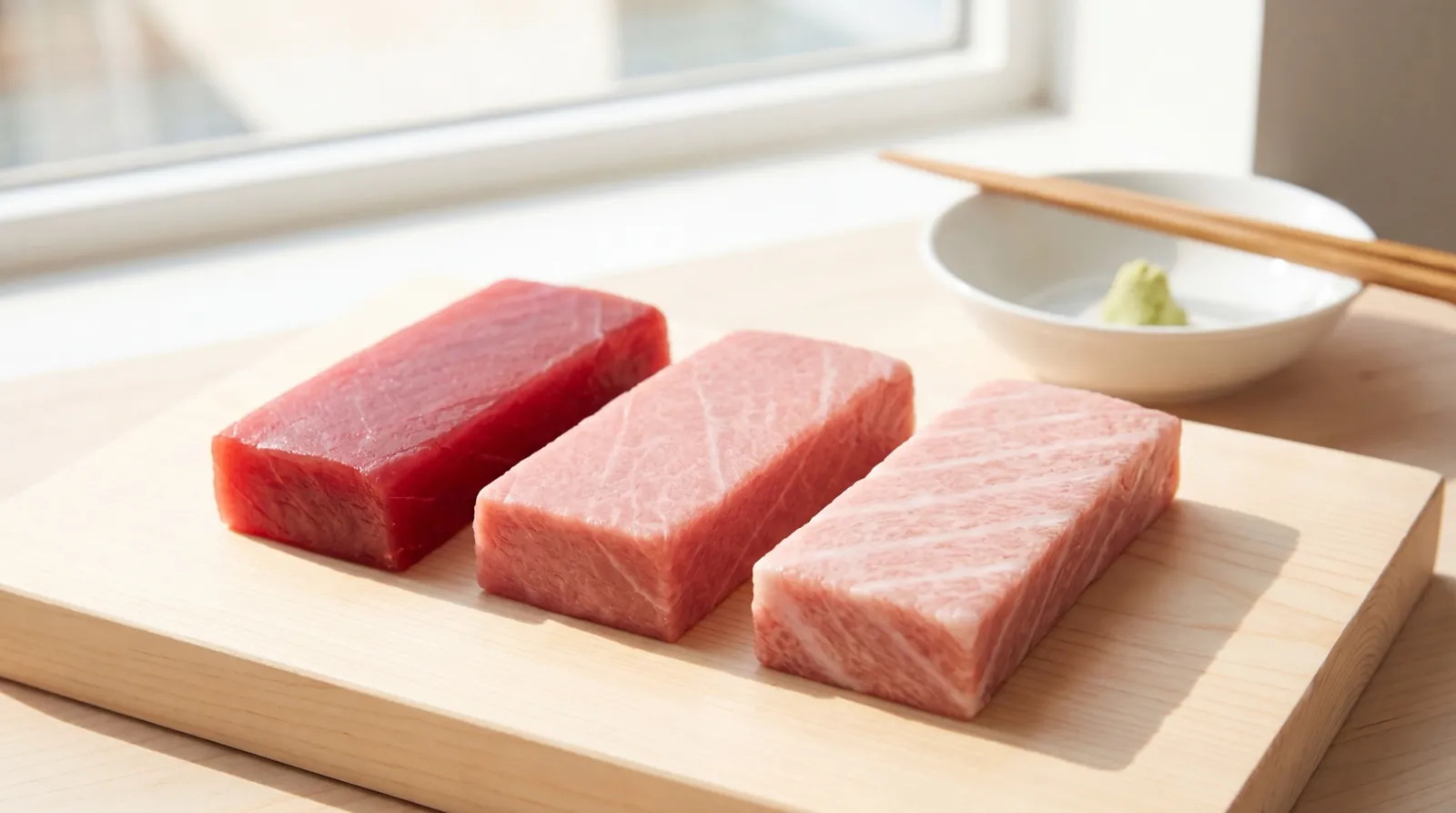
When a tuna is broken down, the back side and the belly side are each divided into three sections, starting from the head: kami (front), naka (middle), and shimo (rear). Akami is in the center of the back side. Toro is in the belly side, near the skin. The closer the belly meat is to the head, the thicker its fat.
| Cut | Location | Features and uses |
|---|---|---|
| Akami (tenmi) | The center of the back side. Tenmi is the core at the highest point of the back | Little fat, with iron flavor and acidity. Almost no sinew. Best for nigiri and zuke |
| Chutoro | The back side near the skin, the middle belly section, the border between belly and back, and similar areas | A good balance of fat and lean meat. The most widely liked |
| Otoro | Under the skin, from the front belly section to the middle belly section. Kama-toro is near the base of the pectoral fin | Marbled meat with the thickest fat. Its sinew is also thick and plentiful (jabara). Slice it thinner, or sear it |
| Nakaochi | Meat scraped from around the backbone | The umami of meat near the bone. For gunkan (battleship rolls), rolls, and negitoro |
| Noten and cheek | Meat from the head | Noten (top of the head) is a rare cut with fat and no sinew, used for nigiri. Cheek meat has coarse fibers and suits grilling |
| Dark meat (chiai) | The dark red band along the border between back and belly | Spoils the fastest. Do not serve it raw. Use it in cooked dishes, such as simmered or grilled dishes |
Reading the sinew
The white lines that run through the flesh are sinew. Sinew is the membrane that joins blocks of muscle together. Its main component is collagen. The closer to the tail, the narrower the spacing between the sinews, and the thicker and harder each sinew becomes. The core of the back near the head, called tenmi, has almost no sinew. Otoro has "jabara," or "bellows," where layers of fat and layers of sinew alternate. This is where both the fat and the sinew are strongest.
When you choose a saku (trimmed block of fillet), check the following. Are the sinews widely and evenly spaced? If they are narrow and crowded, the meat is from near the tail. Is the color even, without dark spots or brown edges? Is the cut surface moist and glossy, rather than dry and whitish?
Why the sinew gets stronger toward the tail, and how to cut saku
When a tuna is broken down, it is divided into six blocks plus the collar, head, and tail. The six blocks are the front, middle, and rear sections of the back, and the front, middle, and rear sections of the belly. The front back section is also called se-ichiban, or "back number one." The front belly section is also called hara-ichiban, or "belly number one."
Fish flesh is made of muscle blocks called myotomes, stacked from head to tail. The sinew runs at an angle along the borders between these myotomes. The closer to the tail, the smaller the myotomes, so the sinews are closer together. The sinews themselves also become thicker and harder, because they carry the swimming power to the tail.
When you cut a block into saku, choose the direction of the saku's long side carefully. The sinew should be cut across, at a right angle or a slant, when you slice the topping. If the sinew runs parallel to the long side of the saku, a whole length of sinew stays in the topping, and nobody can bite through it. When buying, also check that the sinew runs at a neat, even slant across the face of the saku.
14.4 Why tuna changes color
The red of tuna is not the color of blood. It is the color of a pigment in the muscle called myoglobin. Myoglobin stores oxygen inside the muscle. Tuna swim without rest, so their muscle contains a great deal of it.
Freshly cut flesh, or flesh just taken out of a vacuum pack, is a dark reddish purple. When it touches air, the pigment binds with oxygen. In about 20 to 30 minutes, it turns bright red. Up to this point, the change can reverse. With time, however, the iron in the pigment oxidizes and turns brown. This is called metmyoglobin formation, or browning. Once the flesh has browned, it will not return to its original red.
Browning speeds up with higher temperature, more surface exposed to air, more light, and more time. Even in a refrigerator at 0 to 4°C, the surface starts to turn brown in 1 to 3 days. So there are four ways to protect the color.
- Keep it cold. Store it in the coldest part of the refrigerator, at 0 to 2°C.
- Shut out the air. Blot off moisture with paper towels, then wrap it tightly in plastic wrap or vacuum-seal it.
- Avoid light. Do not leave it on display for long in a brightly lit refrigerated topping case.
- Make fewer cut surfaces. Slice the topping only when each order comes in.
If a saku is left over, shave off the thin brown layer on its surface the next day before you use it. Do not serve the shaved-off meat raw. Use it in cooked dishes. Bacteria tend to gather on the surface (Chapter 10).
Also, good color does not mean fresh. The dark color right out of a vacuum pack or the freezer only means the flesh has not touched oxygen. In fact, that is the freshest state. On the other hand, even bright red tuna can be old. Color shows how the flesh has met oxygen, not freshness itself.
14.5 Aging and seasons
Frozen tuna often has little umami and a flat taste right after thawing. This is because the changes that create umami stopped while it was frozen. After thawing, wrap it in paper towels and keep it in the refrigerator at 0 to 2°C for 1 to 3 days. The umami increases, the flesh becomes moist, and the color settles. Change the paper towels every day.
With large fresh bluefin tuna, many restaurants rest the meat as a block, without cutting it into saku, for a few days to more than 1 week. The more cut surfaces there are, the faster drying, oxidation, and browning progress. The dark meat oxidizes fastest, so if you do not remove it early, its smell moves into the meat next to it. Without temperature control and hygiene, this is not aging. It is spoilage (Chapter 10).
Pacific bluefin tuna spawn from spring to summer. They use up their body fat to spawn. In summer, bluefin tuna has lost its fat. The flesh is firmer, and the iron flavor and acidity come forward. This is called summer bluefin. The price drops. But its clean, light akami goes very well with zuke, which lets the flesh absorb the umami of soy sauce. In winter, the fish eat well and store fat, and this is the season for chutoro and otoro (Chapter 11).
Why there is little umami right after thawing
As you learned in Chapter 10, the main source of umami in fish is inosinic acid. It forms after death, when enzymes break down ATP, the energy source of muscle. Distant-water tuna is frozen on the boat before rigor mortis. At −60°C, this breakdown stays stopped, so there is still little inosinic acid right after thawing. When the tuna is refrigerated for 1 to 3 days, the enzymes start working again and inosinic acid increases.
Pacific bluefin tuna spawn around the Nansei Islands and in the Sea of Japan. The acidity of summer bluefin comes mainly from lactic acid in the muscle. The saltiness and umami of soy sauce go well with this acidity.
14.6 Zuke and aburi
Zuke
Zuke (marinated in soy sauce) is the preparation work of soaking tuna in a soy-based marinade. In the Edo period, before refrigerators, it was a way to preserve fish (Chapter 25). Today, it is done to combine the acidity of akami with the umami of soy sauce. For the marinade, soy sauce is mixed with sake and mirin and then heated to burn off the alcohol. This is called nikiri (simmered soy glaze) (Chapter 20).
The key is to do yushimo before marinating. Yushimo means pouring boiling water over the surface of the saku, then plunging it right away into ice water. This sets only the surface, which turns white. The set surface becomes a thin film. It keeps the marinade from soaking in too deeply. If you marinate without yushimo, the salt reaches the core, the whole piece becomes salty, and the color darkens. With yushimo, the outside takes on the color and umami of soy sauce, and the inside keeps the color and acidity of akami.
- Prepare the saku. Cut the akami into a saku as wide as 2 to 3 pieces of nigiri. Pat off moisture with paper towels.
- Yushimo. Pour boiling water over the whole saku, or dip it in boiling water for 3 to 5 seconds. As soon as the surface turns white, plunge it into ice water. Lift it out after 10 to 20 seconds, and wipe off all the moisture.
- Marinate. Submerge it in cooled nikiri and put it in the refrigerator. As a guide, a saku takes from 2 to 3 hours up to half a day, and slices take 10 to 30 minutes.
- Lift it out. Wipe off the liquid, wrap it in paper towels, and refrigerate it. Do not reuse the marinade. Throw it away the same day.
Yushimo is not for killing bacteria or for controlling parasites. A few seconds of yushimo does not raise the core temperature. It does not kill parasites either.
Aburi
Fatty cuts such as otoro and kama-toro can be prepared as aburi (searing with a flame). Searing melts the fat on the surface, so it spreads in the mouth right away. The toasty aroma of the sear softens the heaviness of the fat. The rule is to use a strong flame for a short time and change only the surface. If you warm it all the way through, the fat runs out and the flesh shrinks.
The science of yushimo and aburi
Yushimo turns the surface white because heat sets the proteins on the surface. This film slows the speed at which the marinade enters. Without the film, osmotic pressure drives salt from the salty marinade all the way to the core. When you slice zuke made with yushimo, you see a clean gradient of color, from soy sauce brown on the outside to red at the center.
Searing does two things at once. First, the fat under the skin melts at a low temperature, so it turns liquid in an instant. Second, amino acids and sugars on the surface react at high heat. This is the Maillard reaction, and it creates a toasty aroma and flavor. This toastiness balances the heaviness of the fat. On top of that, the surface is warm while the center stays cold. This temperature difference makes the fat feel lighter.
14.7 Slicing and shaping nigiri
Cutting through the sinew
If you slice the jabara of otoro, or the sinewy part of the rear belly section, as it is, the sinew stays in the mouth. Cross the sinew with the knife edge at a right angle or a slant, and cut it short. If you cut parallel to the sinew, one long piece of sinew stays in the topping, and it will not break when chewed. Sinew does not melt at mouth temperature. But when it is cut short, it disappears from the mouth along with the fat. This is the secret of "melt-in-the-mouth" tuna. Use the sinew-packed part near the tail for negitoro or rolls.
Slice it to "disappear together with the shari"
Slice toro thinner than akami. If you slice rich toro thick, the shari (sushi rice) disappears from the mouth first, and only a lump of fat remains. Akami has little fat and is soft, so it melts even when sliced a little thicker. Thanks to that thickness, its acidity and iron flavor are not overpowered by the shari. For kiritsuke (slicing the topping), use the pull cut (hikigiri): draw the yanagiba (slicing knife) toward you in one smooth stroke, so that you do not crush the cut surface (Chapter 23).
The temperature of the shari and of your hands
Tuna fat softens little by little from refrigerator temperature. It is said to melt completely by around 24 to 30°C. This varies with the cut, the individual fish, and the season. If the shari is at body temperature, about 35 to 37°C, the fat melts and spreads over the tongue when the piece goes into the mouth. With cold shari, like rice straight from the refrigerator, you swallow before the fat has fully melted. It then stays on the tongue like wax. The pleasure of toro is the melting of the fat itself. Shari at body temperature is not a matter of taste. It is a requirement (Chapter 9).
The temperature of the chef's hands also matters. Hands are close to body temperature, which is warmer than the melting point of the fat. If you hold toro for a long time, the fat moves onto your hands. The topping loses its gloss and turns sticky. Fat also gets onto the shari, so it does not come apart well in the mouth. When you shape nigiri with a fatty topping, cool your hands with cold tezu (vinegared hand water) or ice water. Use as few movements as possible, and finish in a few seconds. Being able to feel temperature with your fingertips and adjust is also one of the reasons chefs shape nigiri with bare hands (Chapters 6 and 24).
Change the wasabi and soy sauce depending on the cut, too. The heat of wasabi dissolves easily in fat. So a little more wasabi on toro cuts through the fat. Akami, with its iron flavor and acidity, goes well with more soy sauce. Toro needs less, because its fat repels soy sauce and the saltiness hides the sweetness of the fat. Zuke gets no soy sauce at all.
The pull cut, and timing in the mouth
Shari comes apart and disappears with saliva and a few chews. Soft akami disappears at almost the same speed. But if you slice toro thick, with its strong network of fat, only the shari disappears first. If you slice the toro thin, the moment its fat finishes melting matches the moment the shari disappears. Thickness is a technique for matching the times at which things disappear in the mouth.
In a pull cut, you use the yanagiba from its heel to its tip and draw it toward you in one smooth stroke. If you push to cut, or saw back and forth, you crush the cells. Water and umami then flow out of the cut surface as drip. A single pull cut barely damages the cells. So the edges of the cut stay crisp, the surface shines, and the umami stays inside.
When you shape toro nigiri, set out a small bowl of ice water separate from the tezu. When an order comes in, dip your fingertips in it for 1 to 2 seconds before shaping. If your palms shine with fat after shaping, your hands are too warm or you used too many movements.
14.8 Safety and labeling: histamine and mercury
Tuna is a fish rich in histidine, the substance that histamine forms from. If temperature control fails, bacteria produce histamine. This happens fast at room temperature. It can also happen at refrigerator temperature if the fish is kept long enough.
Mercury and pregnant guests
Tuna sits near the top of the food chain, so it builds up a substance called methylmercury in its body. Babies in the womb are easily affected. So Japan's Ministry of Health, Labour and Welfare (MHLW) gives guidance for pregnant women for each species of tuna.
| Species | Guidance |
|---|---|
| Bluefin tuna, bigeye tuna | Up to once a week, with about 80 g per serving |
| Southern bluefin tuna | Up to twice a week |
| Yellowfin tuna, albacore, mejimaguro, canned tuna | No particular limit at normal serving amounts |
Bluefin tuna and bigeye tuna are limited to once a week, and southern bluefin tuna to twice a week. Yellowfin tuna, canned tuna, and the others have no particular limit. Mejimaguro is young bluefin tuna. If a pregnant guest asks, "What kind of tuna is this?", you must be able to answer correctly (Chapter 26). Pregnant women also face the risk of Listeria, a bacterium that grows even inside a refrigerator. As a basic rule, the chef should not recommend raw food to them.
14.9 Tuna outside Japan: freezing history and CO treatment
Outside Japan, even tuna labeled "fresh" can include fish that was thawed once along the way and then refrozen, or fish that took 3 to 5 days by air. Ask your supplier about the history. If you cannot find out, it is safer to choose tuna with a clear freezing history.
Carbon monoxide treatment, or CO treatment for short, is a process that fixes the color. Carbon monoxide binds to the iron in myoglobin more strongly than oxygen does. It forms bright crimson carboxymyoglobin. This bond is very stable and does not turn brown. Even through repeated freezing and thawing, even as freshness drops, and even when spoilage begins, the color does not change.
The danger is not the poison of carbon monoxide. The danger is that it hides the loss of freshness. Even if histamine has formed, the tuna still looks beautiful. In Japan, the sale of CO-treated fish is not permitted under the Food Sanitation Act. The EU does not permit it either. However, some countries, such as the United States, do permit it. Labeling rules differ by country and by use.
There are four clues for spotting it. The pink is unnaturally even and bright. Even the dark meat is the same cherry pink. The color does not darken as the days pass. The price is too low for the quality. But a reliable judgment requires laboratory analysis. Chefs who work in countries where CO treatment is legal stop using color as a sign of freshness. They judge by smell, temperature history, the trustworthiness of the supplier, and the food temperature at delivery.
Chapter summary
- The six main tuna species are bluefin, southern bluefin, bigeye, yellowfin, albacore, and longtail. They differ greatly in fat, color, and price. Selling one species falsely as another is against the law.
- Farmed and ranched tuna have fat throughout the body in every season, so you handle them differently from wild tuna, for example by slicing them thinner. Tuna frozen at around −60°C hardly changes in color or taste, and it carries practically no risk of parasites. Fresh is not automatically better.
- The closer to the tail, the stronger and more closely spaced the sinew. Put the knife in at a right angle or a slant to the sinew, and cut it short.
- The red of tuna is the color of the pigment myoglobin. When the iron in the pigment oxidizes, the flesh turns brown (browning) and does not turn back. Prevent it by keeping the tuna cold, shutting out the air, avoiding light, and making fewer cut surfaces. Color is not freshness itself.
- After thawing, resting tuna at 0 to 2°C for 1 to 3 days increases its umami. Summer bluefin suits zuke. For zuke, set the surface with yushimo, then marinate the tuna in nikiri.
- Slice toro thinner than akami, and keep the shari at body temperature. Shape fatty toppings quickly, with cooled hands. Pregnant women should limit bluefin and bigeye tuna to once a week, at about 80 g per serving.
- CO treatment fixes the color and hides the loss of freshness and the presence of histamine. It is not permitted in Japan or the EU. In countries where it is legal, stop using color as a sign of freshness (Grade 1).
Review questions
Q1 A saku of tuna kept in the refrigerator for 3 days has turned brown on the surface. Which explanation is correct?
a The pigment has bound with too much oxygen. One more night in the refrigerator will turn it red again
b It is in the same state as tuna just out of a vacuum pack. After 20 to 30 minutes in the air, it will turn red again
c The iron in the pigment has oxidized (browning), and it will not return to its original red. Shave off a thin surface layer, and use the shaved-off meat in cooked dishes
d It is a color found only in tuna treated with carbon monoxide
e Blood from the dark meat has spread into it, so it will wash off with water
Answer: c
The brown color comes from browning, the oxidation of the iron in the pigment. It will not return to its original red. It is not the pigment "binding with too much oxygen." Option b describes the dark reddish purple of tuna just out of a vacuum pack. Tuna treated with carbon monoxide does the opposite: it stays cherry pink for days. Washing the flesh with water makes it watery, and the color does not come back. Bacteria tend to gather on the shaved-off surface, so do not serve it raw.
Q2 What is the correct purpose of yushimo before marinating zuke?
a To kill bacteria on the surface so the tuna keeps longer raw
b To kill Anisakis
c To set only the surface into a film, so the marinade does not soak into the core and make it salty
d To cook the whole piece through and remove the fat
e To fix the color as a bright cherry pink
Answer: c
Yushimo sets only the surface white to form a film, and it keeps the marinade from soaking in too far. A few seconds of yushimo does not raise the core temperature, so it does not kill bacteria or control parasites. With yushimo, the outside takes on the color and umami of soy sauce, and the inside keeps the color and acidity of akami.
Q3 Which statement about tuna treated with carbon monoxide (CO-treated tuna) is correct?
a The greatest danger is that carbon monoxide poison stays in the flesh and causes poisoning when eaten
b Carbon monoxide binds strongly to the iron, so the color stops changing. You can no longer see a loss of freshness or the formation of histamine
c In Japan, it may be sold if it is labeled
d Metmyoglobin increases, and the color is fixed as brown
e It is the same as tuna frozen at −60°C, so its quality is guaranteed
Answer: b
Carbon monoxide binds to the iron in myoglobin more strongly than oxygen does. It forms a bright crimson pigment called carboxymyoglobin. This color does not change, so the tuna looks beautiful even when its freshness drops or histamine forms. The main danger is not poison. It is that the treatment hides the loss of freshness. Under Japan's Food Sanitation Act, the sale of CO-treated fish is not permitted.