

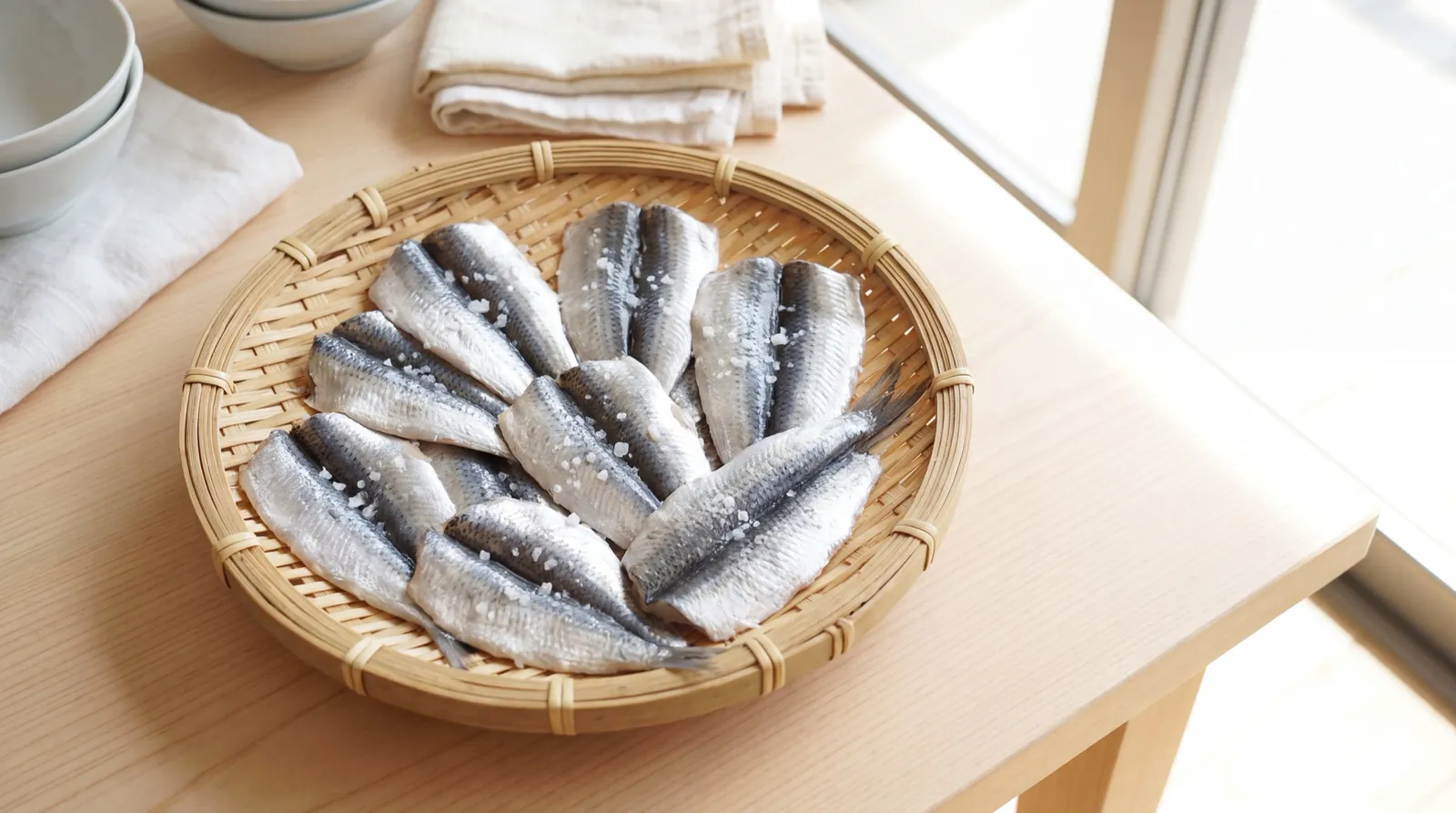
Part III Knowing Fish
Chapter 12
Freezing and Thawing
Freezing is a tool. It protects guests from parasites and keeps fish tasting good. But if you freeze or thaw fish the wrong way, the umami flows out, and you can no longer keep the fish safe. In this chapter you will learn what happens inside fish flesh when it is frozen and thawed, and the right way to do both in a restaurant.
In this chapter you will learn
- To explain the freezing conditions that control parasites, and why you count the time from the temperature at the center of the fish and keep a record
- To explain why quick freezing is better, based on how the zone of maximum ice crystal formation relates to drip
- To explain what causes freezer burn, and how to prevent it with good wrapping and freezer management
- To explain how and why to thaw in warm salt water and in ice water, and why you must not refreeze fish or use certain other methods
- To explain what ultra-low-temperature freezing at −60°C stops, and why you rest fish after thawing (Grade 1)
12.1 Protecting Guests from Parasites by Freezing
The most important job of freezing is to kill parasites. Mackerel, Pacific saury, sardine, horse mackerel, skipjack tuna, salmon, squid, and other seafood can carry Anisakis. It is the larva of a parasite, white and threadlike, 2 to 3 cm long. If you eat it alive, it burrows into the wall of the stomach or intestine and causes severe pain (Chapter 3). Only two things can kill Anisakis: freezing and heating.
- Freezing At −20°C or below for 24 hours or more. This is the method that Japan's Ministry of Health, Labour and Welfare recommends. It is not a legal requirement.
- Heating At 70°C or above, or at 60°C for 1 minute.
Vinegar, salt, wasabi, and soy sauce do not kill it. This is why cases of anisakiasis from vinegar-cured mackerel occur every year. Under a black light, which is an ultraviolet lamp, the larvae glow a bluish white. However, you can only see larvae within about 0.5 mm of the surface. Searching by eye is only a backup. It does not replace freezing.
Count the time at the center of the fish, and keep a record
"I put it in a −20°C freezer for 24 hours" is not enough. The reason is that it takes many hours for the center of a thick block to fall to −20°C. To be certain, count 24 hours from the moment the center of the fish reaches −20°C.
Home freezers are usually set at −18°C or below. Many models cannot reach −20°C. Each time the door opens, the air inside briefly rises to nearly −10°C. Do not rely on a home freezer to control parasites. Use a commercial freezer, and check with a freezer thermometer that the air inside is −20°C or below. Then use a probe thermometer, a thermometer that measures the temperature at the center, to check the center of the fish before you start counting the time.
Finally, record the date and time the fish went in, the temperature inside the freezer, and the date and time it came out. You cannot see the effect of freezing. Only the record proves that you took the measure.
Freezing standards in other countries
The rules on freezing to control parasites differ from country to country, both in the conditions and in how the temperature is measured. The EU sets its rule by the temperature in every part of the product, which means all the way to the center. The United States sets its rule by the air temperature inside the freezer, and at −20°C the time is longer, at 7 days. Japan's recommendation does not say how to measure the temperature. Always check the rules of the country where you operate.
The less you can trust the distribution chain in a region, the more you should choose frozen fish. In Japan, fish is kept at 0 to 4°C all the way from landing to the restaurant, and you can get fish from seas with few parasites. In the world as a whole, these conditions are the exception. Fish that a reliable supplier has quick-frozen and delivered still frozen is often higher in both quality and safety than "fresh fish" laid out at a market without even ice. In regions where the law requires freezing to control parasites, it is normal to buy fish for raw use with freezing records attached. Thawing in warm salt water and thawing in ice water need only hot water, salt, ice, and a thermometer. So these methods are most useful in restaurants with little equipment.
| Standard | Conditions |
|---|---|
| Japan (recommendation of the Ministry of Health, Labour and Welfare) | At −20°C or below for 24 hours or more. Not a legal requirement |
| EU (Regulation 853/2004) | Every part of the product at −20°C or below for 24 hours or more, or at −35°C or below for 15 hours or more |
| United States (FDA Food Code) | Freezer air at −20°C or below for 7 days, counting the freezing time in the total. Or frozen solid at −35°C or below, then held at −35°C or below for 15 hours or more. There is also a rule of freezing at −35°C and then holding at −20°C for 24 hours |
Preparing for power outages
Decide in advance what you will do in a power outage. If you keep the door closed, a full freezer stays frozen for about 48 hours, and a half-full freezer for about 24 hours. This is a general guideline from the U.S. FDA. In hot weather, the time is shorter. During an outage, keep the door closed and record the temperature inside.
When the power comes back, fish that still has ice crystals and a center at 4°C or below can be used for cooking. For fish meant to be eaten raw, it is safer to set a rule: if the center ever rose well above −18°C, do not serve it raw. Throw away anything you cannot judge because there is no record. In hot countries, outages often last several hours. Having a generator ready, and writing your discard rules and posting them on the wall, are also part of a chef's hygiene.
12.2 How You Freeze Changes the Taste: Quick Freezing
Fish flesh is 70 to 80% water by weight. When water freezes, its volume grows by about 9%, and it grows into grains of ice, or crystals. The water in the flesh has salts and other substances dissolved in it. So it starts to freeze not at 0°C but at around −1°C. By the time it reaches −5°C, most of it has turned to ice. This range from −1 to −5°C is called the zone of maximum ice crystal formation. It is the temperature range in which most of the water in the flesh turns into ice.
If the flesh passes through this zone slowly, the ice grains grow large and break the cell membranes. When the fish is thawed, liquid containing umami flows out of the broken cells. This is called drip, the juices lost from the flesh. Think of the red water that collects on the plate as umami that has escaped. On the other hand, if the flesh passes through this zone quickly, the ice grains stay small, and there is less drip.
In Japan, freezing in which the temperature at the center passes through this zone within 30 minutes is called quick freezing. A regular freezer runs at −18 to −20°C, and its cold air flow is fairly weak. If you put a thick saku, a trimmed block of fillet, into it, the center takes several hours to get through this zone. This is called slow freezing. It is exactly the condition in which ice grains grow large. Figure 12-1 shows the line for quick freezing passing through this zone in a short time, and the line for slow freezing staying in the zone for a long time.
How ice grains destroy cells
The liquid outside the cells has less dissolved in it than the liquid inside, so it freezes first. When you freeze slowly, only a few ice seeds form at first. The surrounding water gathers on them, and large ice crystals grow outside the cells. These crystals pull water out of the cells by osmotic pressure and crush the cell membranes. Cells with broken membranes cannot hold water after thawing. The drip that comes out this way contains inosinic acid, a source of umami, and free amino acids. When you freeze quickly, countless ice seeds form at the same time, and the grains stay small until freezing is complete.
Different methods of quick freezing
There are several methods of quick freezing. Air blast freezing blows cold air at −35 to −40°C hard onto the fish. The fish holds of distant-water tuna boats belong to this group. Brine freezing dips the fish, still in its bag, into alcohol or strong salt water at −30 to −40°C. Other methods freeze with liquid nitrogen at −196°C, or use magnetic or electric fields. What they all share is this: they apply something very cold in a way that transfers heat quickly. One thing you can do in the restaurant is to salt the fish lightly before freezing (Chapter 13), draw out the extra water, and then wrap it. Less water means less ice, and less damage to the cells.
12.3 Freezer Burn and Freezer Management
At −18°C, bacteria do not grow. But they do not die either. Freezing only puts bacteria to sleep. Changes in the color of the flesh and the oxidation of fat also continue, though slowly. Distant-water tuna is frozen at −50 to −60°C to almost stop these changes (12.4).
Fish left in the freezer for a long time turns white and dry on the surface, and after thawing it has lost its flavor and aroma. This is freezer burn. It has two causes. The first is drying. The ice on the surface turns directly into water vapor without melting, and escapes. This is called sublimation. The frost on the freezer walls is moisture taken from the food. The second cause is the oxidation of fat. On the dried-out surface, fat reacts with oxygen, and the fish turns yellowish and smells of old oil. The fattier the fish, the faster this happens.
There are three ways to prevent it. First, press plastic wrap tightly onto the flesh to push out the air, and then put it in a bag. If you can, vacuum-pack it. Second, open and close the door less often, and keep the temperature steady. Place a freezer thermometer inside, and look at the actual temperature, not the setting. Third, write the freezing date on the package, and follow first in, first out (FIFO) (Chapter 5).
Recrystallization and ice glaze
When the temperature inside the freezer rises and falls, some of the small ice grains near the surface partly melt. When the fish cools again, that water attaches to larger grains and refreezes. This is called recrystallization. In a freezer whose door is opened often, the ice grains slowly grow larger even if the setting is −20°C. Do not block the cold air vents, do not overfill the freezer, and remove frost regularly.
If you dip frozen fish into cold water for an instant, a thin film of ice forms on the surface. This is called an ice glaze. The film sublimates instead of the flesh, and so protects it. Ice glaze is widely used on blocks of tuna and on shrimp.
If you use a regular freezer for fish to be eaten raw, the guideline is 2 to 4 weeks for fatty fish and 1 to 2 months for white-fleshed fish. Send anything older than this to cooking.
12.4 The World of Ultra-Low Temperatures: −60°C
Distant-water tuna longline vessels bleed and gut the tuna on board as soon as they are caught. Then they freeze and store the fish in holds at −50 to −60°C. Freezing at roughly −50°C or below is called ultra-low-temperature freezing, and in practice it means −60°C. This system is the reason sushi restaurants in Japan can use tuna of consistent quality all year round.
So why is −18°C not enough? −18°C is enough to stop bacteria from growing. But it does not stop chemical changes or the work of enzymes. The red color of tuna comes from myoglobin, a protein that stores oxygen in muscle. When the iron in this pigment oxidizes, it turns into brown metmyoglobin. This is called browning (metmyoglobin formation) (Chapter 14). Browning continues even at −18°C, and within a few months tuna fades to brown. Oxidation of fat also produces a smell like old oil. The enzymes that break down the flesh also keep working, very slowly.
As a general rule, each time the temperature drops by 10°C, chemical changes slow to about one-half to one-third of their speed. If you lower the temperature by 40°C or more, they slow to about one-tenth to one-hundredth. Also, even at −18°C, some water stays unfrozen because dissolved substances become concentrated in it. This is called unfrozen water, and changes continue in it. At −60°C, there is even less unfrozen water and it can hardly move, so changes barely progress. In fact, tuna kept at −60°C holds its red color and flavor for more than a year. Tuna kept at −18°C loses its value as a product within a few months. However, even at −60°C, changes do not stop completely. It does not mean the fish can be stored forever.
Why frozen tuna can be safer than fresh
Tuna frozen at −60°C has safety advantages that fresh tuna does not. First, parasites are killed for certain. −60°C goes far beyond the condition of −20°C for 24 hours. Second, the fish is frozen within a few hours of being caught. So there is no time for spoilage bacteria to grow, or for the flesh to break down through its own enzymes. The ATP in the cells, a substance that becomes the source of umami (Chapter 10), also remains in large amounts. Fresh tuna takes several days to reach the restaurant from landing, and all that time it keeps changing at 0 to 4°C. The ranking "fresh is good, frozen is worse" does not hold. A Grade 1 chef does not judge fish by whether it is fresh or frozen. A Grade 1 chef judges it by how it was frozen and how it was thawed.
12.5 How to Thaw
There are three rules for thawing. First, get the fish through the zone of maximum ice crystal formation quickly. If it stays in the zone for a long time, ice grains grow again. Second, do not let the surface temperature rise. If the surface thaws first and goes above 10°C, it is in the temperature danger zone (Chapter 2), and bacteria grow. Third, do not let fresh water touch the flesh directly (Chapter 13). If you try to thaw quickly, the surface warms up. If you keep the surface cold, it takes time. The methods below are ways to achieve both goals at once.
| Method | How to do it | Features |
|---|---|---|
| Thawing in ice water | Put the fish in a bag, remove the air, and sink it in ice water at 0–1°C | Many times faster than the refrigerator, and the surface does not go far above 0°C. A saku 3 cm thick takes 1–2 hours |
| Thawing in warm salt water | Thaw only the surface in salt water at about 40°C with about 3% salt, then move the fish to the refrigerator | Widely used for tuna saku. It also removes frost and dark spots from the surface |
| Thawing in the refrigerator | Wrap the fish in paper towels and plastic wrap, and keep it at 0–4°C | Safe, but a saku takes half a day to a full day, and there is more drip than with thawing in ice water |
| Thawing under running water | Put the fish in a bag and run tap water over it | With summer tap water (25–30°C), the surface enters the temperature danger zone. Only when you are in a hurry |
| Thawing at room temperature, microwave | Do not use | At room temperature, the surface turns lukewarm while the core is still frozen. In a microwave, some parts cook while other parts stay frozen |
To sum up Table 12-2, restaurants mainly use thawing in ice water and thawing in warm salt water. Thawing in the refrigerator suits restaurants that prepare the night before. Use thawing under running water only when you are in a hurry. Never use room-temperature thawing or microwave thawing for fish to be served raw.
Thawing in ice water is fast because water carries heat far better than air. It is the same as the difference between a sauna and hot water. The air in the refrigerator is also at 0 to 4°C, but it carries heat poorly, so thawing takes longer. You put the fish in a bag to protect it from fresh water and from bacteria in the water. Remove the air from the bag, because air makes it harder for heat to pass through.
Steps for thawing in warm salt water
- Make the salt water Dissolve about 30 g of salt in 1 L of water at about 40°C. Check the temperature with a thermometer.
- Dip briefly Keep the fish under for about 1 to 3 minutes, until the frost on the surface disappears and the surface feels slightly soft when pressed. Even for a thick saku, do not go over 5 minutes. You thaw only the surface.
- Wipe and refrigerate Lift the fish out right away, wipe off the water, and wrap it in dry paper towels and plastic wrap. Put it in the refrigerator at 0 to 4°C, and leave it for several hours to overnight, until the core thaws.
40°C is not a temperature that destroys cells. What damages cells is the zone from −1 to −5°C. The 40°C water provides the heat that pushes the surface of the saku through this zone all at once. Melting ice absorbs heat, so the surface does not rise to the temperature of the water. For a few minutes, the flesh will not cook.
About 3% salt is close to the concentration of seawater. It is not the same concentration as the fish's body fluids (Chapter 13). Even so, unlike fresh water, it does not make the flesh soak up water. If you leave the fish in after the surface has thawed, the surface enters the temperature danger zone, turns white, and takes on a salty taste. The rule is: when the surface has thawed, take it out.
Choosing a thawing method by its reasons
When thawing in ice water, put a weight on the bag so it does not float, and add ice partway through so it never melts away completely. The water touches the surface of the bag with no gaps, and its ability to carry heat is more than 20 times that of air. So even at the same temperature, the fish thaws several times faster than in the refrigerator, and gets through the zone of maximum ice crystal formation relatively quickly. At the same time, the water is at 0 to 1°C, so the surface never goes far above 0°C. The difference in temperature between the surface and the center is small, so this method puts little stress on the cell membranes.
Let us look more closely at the 40°C of the warm salt water. Myosin, a protein in fish muscle, starts to change at temperatures in the 40s °C. Even so, the fish does not cook, because the hot water touching the frozen saku loses its heat to melting the ice. Thawing all the way to the core is the refrigerator's job afterward. The salt water also washes away frost, the layer dried out by sublimation, and the surface darkened by oxidation, so the color comes up nicely.
You can also understand by reasoning why the microwave is a bad idea. A microwave heats food by shaking water molecules, but ice does not absorb these waves well. So only the parts that have already thawed get hot suddenly. You always get uneven results: some parts cook and turn white, and others stay frozen. With room-temperature thawing, bacteria keep growing on the surface for hours, from the time the surface goes above 10°C until the core thaws.
12.6 Half-Thawing and Refreezing
Half-thawed flesh, still slightly frozen at the core, is firm and easy to cut. It is good for cutting saku blocks and for skinning. However, do the kiritsuke, the slicing of the topping, for nigiri only after the fish has thawed to the core. If you slice it thin while it is half-thawed, it thaws after cutting, and drip runs onto the plate.
Never refreeze fish that has thawed once. There are two reasons. First, refreezing in a restaurant freezer is slow, so ice grains grow large, and there is much more drip than the first time. Second, the bacteria that grew while the fish was thawed do not die when it is frozen. Freezing only puts bacteria to sleep. When you thaw the fish again, they start growing from where they left off. Thaw only as much frozen fish as you will use. Send leftover thawed fish to cooking, or throw it away.
Resting fish after thawing
Tuna that was quick-frozen on the boat is frozen while a lot of ATP still remains in its cells. The enzymes were stopped, so the breakdown of ATP into inosinic acid, a source of umami (Chapter 10), has hardly progressed. This is why tuna that has just been thawed tastes watery and thin. It is not that the fish is not fresh. Its aging simply has not started yet.
After thawing, wrap the tuna in paper towels and rest it in the refrigerator at 0 to 2°C for one to several days. Change the paper towels every day. The enzymes start working again and the breakdown moves forward. The umami comes out, and the color settles. Flesh with a very large amount of ATP left may suddenly contract during thawing. This is called thaw rigor. The flesh shrinks, and there is more drip. The lower the temperature and the slower the thawing, the milder this contraction is. For a large block, use a saw to cut off only what you will use while it is still frozen, and put the rest back in the freezer right away.
Chapter summary
- Anisakis is killed by freezing (−20°C or below for 24 hours or more) or by heating (70°C or above, or 60°C for 1 minute). Vinegar, salt, wasabi, and soy sauce do not kill it. Count the time from the moment the center of the fish reaches −20°C, and record the dates, times, and temperatures.
- If the flesh passes slowly through the zone of maximum ice crystal formation, from −1 to −5°C, the ice grains grow and destroy the cells, and drip comes out. Quick freezing passes through this zone within 30 minutes.
- Freezer burn is caused by drying through sublimation and by the oxidation of fat. Prevent it with tight wrapping, a steady temperature, and dating packages and following first in, first out.
- When thawing, get through the zone quickly, do not warm the surface, and do not let fresh water touch the flesh. Use thawing in ice water (0 to 1°C) and thawing in warm salt water (about 40°C and about 3%, surface only, for a few minutes). Do not thaw at room temperature, do not thaw in a microwave, and do not refreeze.
- At −18°C, browning, fat oxidation, and enzyme activity continue, but at −60°C they almost stop. Frozen tuna can be safer and of higher quality than fresh tuna. (Grade 1)
- Tuna right after thawing tastes thin because the breakdown of ATP has not progressed. Rest it at 0 to 2°C for one to several days. (Grade 1)
Review questions
Q1 Which statement about freezing to control Anisakis is correct?
a Once 24 hours have passed after putting fish in a freezer set at −20°C, even a thick block meets the condition.
b The reliable way is to count 24 hours or more from the moment the center of the fish reaches −20°C, and to record the dates, times, and temperatures.
c For mackerel that is well cured in vinegar, 12 hours of freezing is enough.
d Even a home freezer is reliable if the fish stays in it for 24 hours.
e If you remove the larvae that glow under a black light, there is no need to freeze.
Answer: b
It takes many hours for the center of a thick block to fall to −20°C. So you count 24 hours or more from the moment the center reaches −20°C, and keep a record. Option a may fall short, because it does not count the time it takes for the center to cool. Option c is wrong, because vinegar does not kill Anisakis. Option d is wrong, because a home freezer may not reach −20°C. Option e is wrong, because a black light shows only larvae within about 0.5 mm of the surface.
Q2 Which statement about thawing in warm salt water is correct?
a Leave the fish in salt water at about 40°C with about 3% salt until it thaws to the core.
b 40°C is a temperature that destroys cells, so the brief dip destroys cells on purpose.
c Thaw only the surface in salt water at about 40°C for a few minutes, wipe the fish, and then thaw it to the core in the refrigerator.
d 3% salt is the same concentration as the fish's body fluids, so no water moves in or out at all.
e The surface thaws quickly, so it is best to leave the fish at room temperature until the core thaws.
Answer: c
Thawing in warm salt water pushes the surface through the zone of maximum ice crystal formation all at once, and lets the core thaw slowly in the refrigerator. Option a is wrong, because if you leave the fish in for a long time, the surface enters the temperature danger zone and turns white. Option b is wrong, because what damages cells is the zone from −1 to −5°C. Option d is wrong, because 3% is close to the concentration of seawater, and is stronger than the fish's body fluids. Option e is wrong, because at room temperature, bacteria grow on the surface.
Q3 Which statement about ultra-low-temperature freezing at −60°C is correct?
a At −60°C, chemical changes stop completely, so tuna can be stored forever.
b Bacteria do not grow even at −18°C, so tuna keeps its color and flavor for more than a year.
c At −18°C, browning and fat oxidation continue, but at −60°C they barely progress.
d Even freezing at −60°C does not kill parasites.
e Tuna tastes thin right after thawing because freezing destroyed its umami.
Answer: c
−18°C is enough to stop bacteria from growing, but browning, fat oxidation, and enzyme activity continue. At −60°C, these barely progress. Option a is wrong, because changes do not stop completely. Option b is wrong, because tuna at −18°C fades to brown within a few months. Option d is wrong, because −60°C goes far beyond the condition for controlling parasites. Option e is wrong. The thin taste is because the breakdown of ATP has not progressed yet, and resting the tuna brings out the umami.