

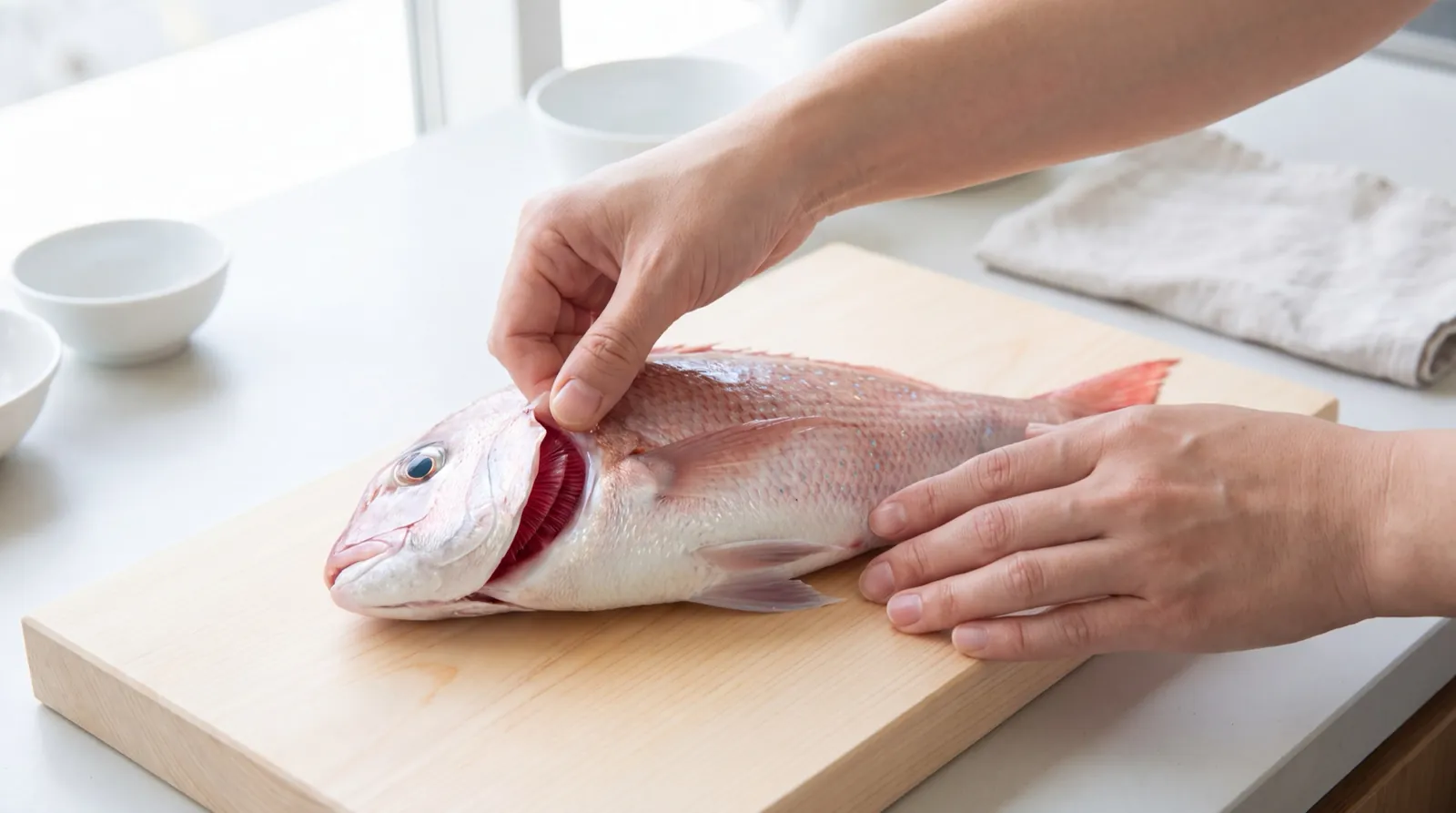
Part III Knowing Fish
Chapter 10
What Happens After a Fish Dies: Rigor Mortis, Aging, and Spoilage
A fish keeps changing inside its flesh even after it has been killed. It stiffens, then gradually relaxes as its umami grows, and finally it spoils. Four things decide the order and speed of these changes: how the fish was killed, temperature, the kind of fish, and hygiene. In this chapter, we explain the difference between aging and spoilage by asking "who is doing the work?" You will also learn how to age fish safely.
In this chapter you will learn
- To explain why ikejime (killing the fish instantly and bleeding it), shinkei-jime (destroying the spinal cord), and bleeding improve the flavor and shelf life of fish
- To explain the order of rigor mortis, aging, and spoilage, and the difference between what drives aging and what drives spoilage
- To state the temperatures and steps for aging fish safely, and to recognize the signs of spoilage
- To explain how umami is produced and what the K value is, and to give the numbers for the best time to eat and the start of spoilage (Grade 1)
- To explain, with reasons, which kinds of fish are suited or unsuited to aging (Grade 1)
10.1 How a Fish Is Killed Decides What Comes After
The quality of a fish is mostly decided at the moment it is landed. The way the fish dies changes how much of the "energy source" remains in its muscle. This energy source later becomes the basis of umami. It also slows down the stiffening of the flesh. The less the fish struggles before it is killed, the more of it remains. If you cannot read how a fish you bought died, you cannot plan how to age it.
- Nojime (fish left to die in the net or on ice)
- Nojime means letting a fish caught by net or line die as it is, in the air or in ice. The fish struggles and uses up its energy. As a result, it develops less umami, stiffens quickly, and goes bad quickly.
- Ikejime
- Ikejime is a way of killing a live fish by quickly destroying its brain, so that it has no time to struggle. A hand hook (tekagi) or a blade is driven in behind the eye. Next, the point where the brain joins the nerves of the backbone, called the medulla oblongata, is cut.
- Shinkei-jime
- Shinkei-jime is done after ikejime. A thin wire is passed through the nerve inside the backbone, the spinal cord, to destroy it. Even after the brain is destroyed, the body keeps twitching for a while and goes on using energy. Shinkei-jime stops this. It is a technique for "buying time" by delaying the stiffening of the flesh. It does not directly improve the flavor.
- Bleeding
- Bleeding means cutting the base of the gills and the base of the tail at the same time as the fish is killed. The blood is then let out in seawater while the heart is still beating. Once the heart stops, the blood will not drain. The first few minutes after killing are what count.
- Ice-slurry killing (kori-jime)
- Kori-jime means putting small fish such as horse mackerel or sardines, still alive, into a mix of ice and seawater at around 0°C. The fish is chilled quickly and dies. It is a far better method than nojime.
There are three reasons to bleed a fish. First, blood feeds bacteria and speeds up spoilage. Second, the iron in blood speeds up the oxidation of fat and causes a fishy smell. Third, blood left in the flesh turns dark and spoils the appearance.
If a fish arrives with a hole in its head and a cut at the base of the gills, it was killed by ikejime. If there is also a cut at the base of the tail, it has been bled as well. On the other hand, a fish with its mouth and gill covers wide open, scales coming off, and a curved body died struggling. Do not rest such a fish. Use it up the same day, or cook it.
Looking at Killing Methods Through ATP, the Energy Currency
The "energy source" is really ATP (adenosine triphosphate). It is a substance that cells use when they move muscles, like a currency of energy. Muscle also stores the sugar that ATP is made from, called glycogen.
A fish left to die by nojime suffocates and keeps struggling. During that time, its muscles contract violently and use up their ATP and glycogen. At the same time, lactic acid builds up and the muscle temperature rises. Almost no ATP is left when the fish dies. So the fish develops little umami, and rigor comes early and passes early. Ikejime kills the fish while ATP and glycogen are still in the muscle. It also prevents the buildup of lactic acid and the rise in body temperature. In one phrase, the aim is "to kill the fish without letting its muscles spend their energy."
A fish still moves after its brain is destroyed because the spinal cord remains. As long as it remains, the muscles contract by reflex, even without commands from the brain. Shinkei-jime stops this wasted energy use. It depends on the kind of fish and the temperature, but the start of rigor is delayed by several hours to more than half a day. Even after a long journey, the fish can arrive at the restaurant before rigor or during rigor. A thin hole visible in the cross-section of the backbone is the sign of shinkei-jime.
The iron in blood is found in a red pigment called hemoglobin. This iron strongly promotes the oxidation of fat. If you open the gills and they look pale and bloodless, the fish has been bled well. A fish that has not been bled enough cannot stand up to aging, however carefully you control the temperature. Note that the word "shimeru" in the sushi world has two meanings. One is killing the fish. The other is the preparation step of firming the flesh with salt or vinegar. The second meaning is covered in Chapter 13.
10.2 Rigor Mortis: Firm, but Still Low in Umami
After a fish dies, the energy source in its muscle gradually decreases. When it runs out, the muscle sets in a contracted state, and the fish becomes stiff as a board. This is rigor mortis. It does not mean the fish has gone bad. It is a natural change that happens to every fish. It starts sooner in fish that died struggling. In general, it comes sooner in small fish and later in large fish.
Flesh in rigor has a crunchy bite, and its freshness is at its peak. But its umami is still low, and its flavor is mild. In sushi, it is important that the umami of the neta (topping) is not overpowered by the shari (sushi rice). For this reason, most fish are used after rigor has passed. If you fillet a fish during rigor, the flesh curls and shrinks, and it also splits easily. The basic rule is to let the fish go through rigor whole and to fillet it after rigor has passed.
How Rigor Works: Actin and Myosin
In living muscle, threads of two kinds of protein, actin and myosin, slide past each other as the muscle contracts and relaxes. When myosin grabs actin and pulls it in, the muscle contracts. When ATP attaches to myosin, myosin lets go, and the muscle relaxes. In other words, ATP is also the key that lets the muscle relax.
When a fish dies, oxygen no longer reaches the muscle. For a while, the muscle turns glycogen into lactic acid and makes a little ATP. Before long, the glycogen runs out, and ATP only goes down. The lactic acid that builds up lowers the pH of the muscle. pH is a scale of sourness, and the smaller the number, the more acidic. It falls from around 7 in the living fish to around 6.0 to 6.5 in white-fleshed fish such as cod, and to around 5.5 in tuna, which has a lot of glycogen. When ATP falls to about 1 micromole or less per gram of muscle, myosin can no longer let go of actin. Rigor mortis is the state in which these bonds have set throughout the body.
What Changes the Speed of Rigor
- Killing method Fish killed by nojime have little ATP, so they stiffen early and relax early. Fish killed by ikejime or shinkei-jime stay longer in the state before rigor.
- Temperature The lower the temperature, the slower enzymes work. At around 0°C, the start of rigor is delayed and rigor lasts longer. At 15 to 20°C, rigor sets in within a few hours, passes quickly, and the fish moves on toward spoilage.
- Kind and size of fish Rigor takes 1 to several hours in horse mackerel and sardines, and can take more than half a day in tuna and Japanese amberjack (buri, yellowtail). Active migratory fish tend to use ATP quickly. Bottom fish that stay still on the seabed tend to use it slowly.
However, in red sea bream (madai), olive flounder (hirame), and some other fish, rigor can actually come sooner if the fish is chilled suddenly to 0°C right after ikejime. This is reported as cold-shock rigor. Some producing areas keep fish at 5 to 10°C for several hours right after killing and then chill them. This practice only works at the producing area, right after killing, when the fish is still clean. Fish that have arrived at the restaurant should, as a rule, be kept at 0 to 4°C so that bacteria do not grow (Chapter 5). Also, if you fillet a fish before rigor, the flesh loses the support of the bones and shrinks shorter and thicker when rigor sets in.
10.3 Aging and Spoilage: Who Is Doing the Work?
Aging: The Fish's Own Enzymes Create Umami
After rigor, enzymes already present in the flesh gradually cut the framework of the muscle. An enzyme works like a pair of scissors that breaks down the flesh. The flesh loosens and becomes softer. By this time, the energy source left in the muscle has been changed by enzymes into inosinic acid. This is the substance known as the umami of katsuobushi (dried bonito). Enzymes also break down proteins further and increase the amino acids that give sweetness and depth. This period, when umami increases and the flesh becomes smooth and rich, is what chefs call "resting" the fish. It is aging (jukusei).
However, inosinic acid also breaks down over time and finally turns into a bitter substance. The best time to eat the fish is the time when the most umami remains.
Spoilage: Bacteria From Outside Do the Work
Aging and spoilage do not happen separately. They lie on the same timeline, and spoilage comes after aging. The difference is who does the work. Aging is driven by the fish's own enzymes, which create umami. Spoilage is driven by bacteria that were on the skin, gills, and guts of the fish. The bacteria feed on the amino acids and other substances made by the enzymes. As they grow, they produce unpleasant-smelling substances and slime. The main cause of the fishy smell of sea fish is also the work of bacteria. They turn an odorless substance naturally present in the flesh into a substance that smells.
In short, "fresh" does not mean "delicious." And "old" does not mean "aged." A fish that has just been killed has little umami, and a fish left without care simply spoils. Aging is "managed time": you keep bacteria in check with low temperature and hygiene while letting enzymes create umami.
10.4 How Umami Is Produced, and the K Value
The relaxing of rigor is called resolution of rigor. The enzymes at work are the protein-cutting enzymes among the autolytic enzymes in the fish's own cells. The bond between actin and myosin does not come apart. Instead, the framework that bundles them together breaks down, and the flesh softens.
From ATP to Inosinic Acid, and Then to Bitterness
After death, the ATP left in the muscle changes form step by step through the action of enzymes. ATP becomes ADP, then AMP, and then IMP. IMP is inosinic acid. From there it becomes HxR (inosine), and finally Hx (hypoxanthine).
The steps from ATP to IMP go quickly. Even at low temperatures, most of the ATP becomes IMP within several hours to about 1 day after death. This is where umami is born. The steps after IMP are slow, so IMP builds up in the muscle for a while. This is the real reason behind the saying "fish gets tastier when you rest it." In time, IMP turns into HxR, which has almost no taste, and then into Hx, which is bitter. The time when the most IMP has built up is the best time to eat that fish.
The speed at which IMP breaks down differs greatly by kind of fish. In red sea bream, olive flounder, flounder, tuna, and similar fish, IMP is said to last a long time. In horse mackerel, mackerel, sardines, skipjack tuna (katsuo, bonito), and similar fish, it is said to break down relatively quickly. One report found that red sea bream stored in ice still had a K value below 40% after 16 days, while fish of the cod family reached 60% in 2 to 3 days.
The K Value: Freshness in Numbers
The K value is a number that shows freshness by how far this breakdown has gone. Take the total of the six substances from ATP to Hx. The K value shows what percentage of that total is HxR and Hx, the two near the end. As a guide, it is below 10% right after instant killing. Fish can be served as sashimi at 20% or less. Around 40% is suited to cooking, and 60% or more is considered the start of early spoilage.
The K value measures changes caused by the fish's own enzymes, not by bacteria. So it always rises over time, even when there are few bacteria. It is not a ruler for "fresh because there are no bacteria." It is a ruler for "tasty because inosinic acid still remains." The speed at which it rises depends on temperature. Even for the same fish, the speed can differ several times over between 0°C and 10°C.
Changes in Amino Acids and Fat
During aging, enzymes cut proteins and increase peptides, which are a few amino acids linked together. They also increase amino acids such as glutamic acid, alanine, and glycine. When glutamic acid is combined with inosinic acid, the umami becomes much stronger. This is called umami synergy (Chapter 20). This is why aged white-fleshed fish tastes "sweet" and "rich."
Fat changes too. An enzyme that breaks down fat, called lipase, works on it and makes the flavor of the fat more complex. However, fat oxidizes when it touches air, and as oxidation goes on, it gives off a smell of old oil. The fattier the fish, such as toro (fatty tuna), Japanese amberjack, and mackerel, the more care it needs.
The same mechanism applies when thawed tuna is rested in the refrigerator. While frozen, the enzymes are almost stopped. After thawing, the breakdown of ATP starts again, and inosinic acid increases. Note that the amount of fat never increases after death.
10.5 The Right Way to Age Fish
Aging is a balancing act. You want the fish's own enzymes to work, but you do not want bacteria from outside to grow. The trouble is that many of the bacteria that spoil fish can grow even near 0°C. Cooling alone is not enough. It is important to reduce the number of bacteria before you start aging.
The temperature is 0 to 4°C, and 0 to 2°C if possible. The higher the temperature, the faster bacteria grow. At 10°C, spoilage goes several times faster than at 0°C. The refrigerator compartment of a home refrigerator is 3 to 6°C, which is too high. If the fish touches ice directly, that part gets too cold. The cells break, the flesh turns white, and water seeps out. This is called ice burn. If the fish sits in meltwater from the ice, water with no salt enters the flesh and makes it watery. The meltwater also becomes a breeding ground for bacteria. Vacuum-packed fish must be stored at 3°C or below, because some bacteria grow where there is no air and can also grow at low temperatures.
- Remove the guts and gills first Spoilage starts in the guts, which are full of digestive enzymes and bacteria. The gills hold a lot of blood and are the first place bacteria grow. Remove them on the day you buy the fish. Also scrape out the blood line (chiai) along the backbone.
- Rinse briefly in cold water Wash off all the blood. Do not soak the fish for long. Fresh water makes the flesh watery and does not work against most bacteria (Chapter 13).
- Wipe it completely dry Wipe with paper towels, including inside the belly. This is the step people skimp on most. If you wrap the fish while it is wet, the surface will be slimy by the next day.
- Do not touch the flesh with bare hands Human hands carry Staphylococcus aureus (Chapter 3). Handle filleted flesh with clean tools or through paper towels.
- Keep tools and work areas clean Use separate cutting boards and knives for washing and for cutting the flesh, or wash them before you switch (Chapter 4).
- Wrap, chill, and label Wrap the fish in paper towels, then in plastic wrap to keep it from drying out, and put it at 0 to 2°C. Write the date, the kind of fish, how it was killed, and the planned number of days on the label.
- Check every day and change the paper Wet paper is a breeding ground for bacteria. Change it at least once a day, and every few hours on the first day. Each time you change it, you also remove bacteria from the surface.
| Fish | Guide | Reasons and cautions |
|---|---|---|
| Large white-fleshed fish such as red sea bream, olive flounder, and Japanese sea bass (suzuki) | 2–5 days | Umami lasts a long time. Low in fat, so slow to oxidize |
| Japanese amberjack, greater amberjack (kanpachi), and striped jack (shima-aji) | 2–4 days | Fat oxidizes easily. Stop when the dark meat (chiai) starts to blacken |
| Blue-backed fish such as horse mackerel, mackerel, sardines, and Pacific saury | Same day to next day | Umami is said to fade quickly, and there is also a risk of histamine. Cure with salt and vinegar (Chapter 16) |
| Squid | Same day to next day (2 days at most) | Resting does little to increase the umami of inosinic acid. For changes in sweetness, see Chapter 17 |
| Shrimp | Same day (until the next day if the heads are removed) | Enzymes in the head dissolve the flesh and turn it black |
| Shellfish | Store alive, and use the same day once opened | Dead shellfish go bad rapidly |
Remember this: large white-fleshed fish can be rested for several days, while blue-backed fish, squid, shrimp, and shellfish should be used on the same day or the next day. Tuna is covered in Chapter 14.
Wrapping Techniques, and Handling Scales and Skin
Bacteria that grow even near 0°C are called psychrotrophs. Typical examples are Pseudomonas and Shewanella. That is why you need both cooling and reducing bacteria. If water is left on the surface, bacteria grow. If the surface dries too much, the flesh hardens and oxidation also speeds up. Wrapping solves this conflict.
- Paper towels They absorb moisture and drip (juices lost from the flesh) from the surface of the fish and from inside the belly.
- Dehydrating sheets These sheets are made of an absorbent material and a membrane. They draw out only the water on the surface of the flesh by osmotic pressure. Bacteria grow less easily on the surface, and the flesh firms up. They are suited to aging saku.
- Vacuum packing It cuts off air to prevent fat oxidation and browning (metmyoglobin formation), which turns red meat brown (Chapter 14). Type E of Clostridium botulinum grows where there is no air, and it can grow even at around 3°C. Storing vacuum-packed fish at 3°C or below is an international guideline to guard against it. If drip forms inside the bag, bacteria grow there. Vacuum packing is not a technique that "stops fish from spoiling."
When aging a whole fish, many chefs leave the scales on. The scales and skin are a natural wrapping that protects the flesh from the outside air. Removing the scales leaves tiny scratches on the skin, so moisture escapes and bacteria get in. When aging saku, leave the skin on to protect one side. However, the fat under the skin oxidizes easily. So for fatty fish, keep the time after cutting into saku short. Before serving, remove the skin and, if needed, shave off a thin layer of the surface. Bacteria collect on the shaved-off surface, so do not use it even for the staff meal (makanai).
10.6 Telling Aging From Spoilage
Once the umami has peaked, enzymes start to create bitterness. Around the same time, bacteria grow and the smell of spoilage appears. Use the following signs to tell them apart.
| What to check | Well aged (still usable) | Start of spoilage (do not use) |
|---|---|---|
| Smell | The sea aroma fades, faintly sweet | Sour, sharp, an unpleasant fishy smell |
| Surface | Dry and slightly taut, or smooth and rich | Stringy slime, a white film |
| Color | White-fleshed fish loses some clarity and turns milky white. Red-fleshed fish darkens slightly, and the surface may turn brown (shave off the surface before use, and do not use the shaved flesh raw; see Chapter 14) | White-fleshed fish looks gray or yellowish. The dark meat turns black and falls apart |
| Drip | Clear to light red, a small amount | Cloudy white, sticky, a large amount |
| Springiness | Springs back slowly when pressed | A mark remains, your finger sinks in, or the flesh falls apart |
| Taste (final check) | Strong umami and sweetness | Bitterness, sourness, a tingling on the tongue |
A bad smell, slime, cloudy drip, and flesh that does not spring back are the signs to stop serving the fish. A brown color on red-fleshed fish comes from the oxidation of iron in the red pigment of the flesh. By itself, it is not proof of spoilage.
Substances Produced by Spoilage, and Rulers for Measuring It
- Hypoxanthine (Hx) This is the final breakdown product of inosinic acid. It is made by enzymes, not by bacteria. But it causes bitterness and signals the end of umami.
- Amines Bacteria make these from amino acids. Histamine is made from histidine. It is common in red-fleshed fish and blue-backed fish, it is not destroyed by cooking, and it causes food poisoning that looks like an allergy (Chapter 3). Cadaverine is made from lysine, and putrescine from ornithine. Both have the smell of rot.
- Ammonia Bacteria make this sharp-smelling substance from amino acids. Sharks and rays carry urea in their bodies, so they give off an ammonia smell soon after death.
- Trimethylamine (TMA) The muscle of sea fish contains an odorless substance called trimethylamine oxide (TMAO). It helps keep the concentration of the body's fluids balanced. Bacteria such as Shewanella turn it into TMA. This is the main cause of the fishy smell of fish. Most freshwater fish have little TMAO, so their fishy smell is of a different kind.
- Hydrogen sulfide and methyl mercaptan These come from amino acids that contain sulfur, and they smell like rotten eggs. At this stage, the fish is fully spoiled.
The total amount of volatile nitrogen, such as ammonia and amines, is called volatile basic nitrogen (VBN). Per 100 grams of fish flesh, 5 to 10 milligrams is considered fresh, 30 to 40 milligrams early spoilage, and over 50 milligrams spoiled. The K value measures the change in umami caused by enzymes. VBN measures spoilage caused by bacteria. They are separate rulers. So a fish can have a low K value but many bacteria, and another fish can have few bacteria but have lost its taste. A white film or stringy slime is a sticky substance made by bacteria. White-fleshed fish turns gray or yellowish because of the oxidation of pigments and fat.
10.7 Which Kinds of Fish Suit Aging
"Anything gets tastier if you rest it" is wrong. Each kind of fish differs in how fast IMP breaks down, how much fat it has, how much histidine it has, which is the raw material of histamine, and what kind of umami it has.
- Red-fleshed fish (tuna, skipjack tuna)
- In tuna, IMP is said to break down relatively slowly. Tuna is also fatty and large, so it is considered well suited to aging. As a guide, frozen tuna is aged 1 to 3 days after thawing, and fresh tuna from several days to more than 1 week. But this varies greatly by cut and by individual fish, and specialist intermediate wholesalers (nakaoroshi) often age tuna before selling it. Always watch out for browning and for histamine. Skipjack tuna has even more histidine, and its IMP breaks down quickly, so it is not suited to long aging (Chapter 14).
- White-fleshed fish (sea bream, olive flounder, Japanese sea bass, flounder)
- In these fish, IMP lasts a long time, and they are low in fat and slow to oxidize. The effect of aging is easiest to notice in them. In 2 to 5 days, their sweetness and umami increase, and firm flesh becomes smooth and rich. They also go well with kobujime (curing between kombu sheets) (Chapter 15).
- Blue-backed fish (horse mackerel, mackerel, sardines, Pacific saury)
- In these fish, IMP breaks down quickly, the fat oxidizes easily, and there is a lot of histidine. The risk of spoilage outweighs the benefit of aging. So use them on the same day or the next day, or cure them with salt and vinegar. Curing lowers the water content and the pH of the flesh, which holds back both enzymes and bacteria (Chapter 16).
- Squid
- In squid muscle, the breakdown of ATP tends to stop at AMP. Its umami comes from AMP and from amino acids such as glycine and proline. Since IMP does not build up, resting does not make squid much tastier. Instead, the flesh turns cloudy white and its texture gets worse.
- Shellfish
- While alive, shellfish keep bacteria out by themselves. But the moment they die, the bacteria inside them all start to grow at once. The idea of aging does not apply to them. The sweetness of scallops comes mainly from amino acids such as glycine and alanine, and it does not increase with aging. Glycogen itself is not sweet, but it adds depth of flavor (Chapter 18).
- Shrimp
- The digestive gland (midgut gland) in the head holds strong digestive enzymes. After death, they flow into the flesh and dissolve it. This is called mi-toke (flesh melting). Blackening caused by enzymes also starts at the head. The sweetness of ama-ebi (sweet shrimp) comes from amino acids such as glycine, and it does increase over time. But at the same time, the flesh melts and blackens. Store shrimp with the heads removed, and use them by the next day (Chapter 17).
Chapter summary
- Ikejime kills the fish without letting it struggle, so the energy source remains. Shinkei-jime delays the stiffening of the flesh. Bleeding is done while the heart is still beating. Do not rest a fish that died struggling. Use it the same day.
- Flesh in rigor mortis is firm. Its freshness is at its peak, but its umami is low. Most fish are used after rigor has passed, and they are filleted after going through rigor whole.
- Aging is driven by the fish's own enzymes, which make inosinic acid and amino acids and increase umami. Spoilage is driven by bacteria from outside, which create odor and slime. "Fresh" does not mean "delicious," and "old" does not mean "aged."
- Age fish at 0 to 4°C (0 to 2°C if possible). Remove the guts, gills, and blood, wipe the fish dry, and do not touch it with bare hands. Keep vacuum-packed fish at 3°C or below. In hot countries, do not age fish whose refrigeration was broken on the way. If in doubt, do not serve it raw.
- Large white-fleshed fish are suited to aging. Blue-backed fish, squid, shrimp, and shellfish should be used on the same day or the next day.
- ATP breaks down in this order: ADP, AMP, IMP (umami), HxR, and Hx (bitter). The K value is below 10% right after instant killing, 20% or less is the guide for sashimi, and 60% or more means early spoilage. VBN is a separate ruler that measures spoilage caused by bacteria (Grade 1).
- The main cause of the fishy smell of sea fish is trimethylamine, which bacteria make from TMAO. Rigor mortis happens when ATP runs out and actin and myosin can no longer separate (Grade 1).
Review questions
Q1 Which of the following is correct about the aging and spoilage of fish?
a Aging is driven by bacteria from outside, and the more the bacteria grow, the more umami increases.
b Fish in rigor mortis are at their best time to eat, with the most umami.
c Aging is a change in which the fish's own enzymes create umami, and it is done at a low temperature of 0 to 4°C with proper hygiene management.
d Blue-backed fish are fatty, so the longer they are rested, the tastier they become, more so than white-fleshed fish.
e If there is no bad smell, there is no need to worry about histamine.
Answer: c
Aging is driven by the fish's own enzymes, and spoilage is driven by bacteria from outside. So a is wrong. Flesh in rigor mortis is at its freshest, but its umami is still low, so b is also wrong. The umami of blue-backed fish is said to fade quickly, their fat oxidizes easily, and there is a risk of histamine. So they are used on the same day or the next day, or cured with salt and vinegar. d is wrong. Histamine can reach dangerous levels before any smell appears, and it is not destroyed by cooking. e is also wrong.
Q2 Which of the following is the correct way to age fish in a restaurant?
a It is enough to put the fish in the refrigerator compartment of a home refrigerator (3 to 6°C).
b To chill the fish easily, place it directly on ice and let it sit in the meltwater.
c Remove the guts and gills first, rinse briefly in cold water, and then wipe it dry, including inside the belly.
d Once the fish is vacuum-packed, bacteria do not grow, so you do not need to worry about temperature.
e To prevent drying, leave the paper on for several days without changing it, even when it gets wet.
Answer: c
Aging is done at 0 to 4°C, and at 0 to 2°C if possible. The refrigerator compartment of a home refrigerator is too warm, so a is wrong. Parts that touch ice directly get ice burn, and meltwater makes the flesh watery and becomes a breeding ground for bacteria. b is also wrong. Even with vacuum packing, some bacteria grow where there is no air, so the fish is stored at 3°C or below. d is wrong. Wet paper is a breeding ground for bacteria, so it is changed at least once a day. e is also wrong.
Q3 Which of the following is correct about the changes in fish after death?
a The main cause of the fishy smell of sea fish is hypoxanthine, which is formed when inosinic acid breaks down.
b The K value measures the number of bacteria, so if there are few bacteria, it does not rise over time.
c Rigor mortis happens when ATP increases too much and actin and myosin can no longer separate.
d The main cause of the fishy smell of sea fish is trimethylamine (TMA), which bacteria make from the TMAO in the muscle.
e Squid builds up IMP easily, so the longer it is rested, the tastier it becomes, more so than white-fleshed fish.
Answer: d
Sea fish carry odorless TMAO in their muscle, and a fishy smell appears when bacteria turn it into TMA. The hypoxanthine in a causes bitterness, not the fishy smell. b is wrong. The K value measures changes caused by the fish's own enzymes, so it rises over time even when there are few bacteria. c has it backward. When ATP runs out, myosin can no longer let go of actin. e is also wrong. In squid, the breakdown of ATP tends to stop at AMP, and IMP does not build up.