

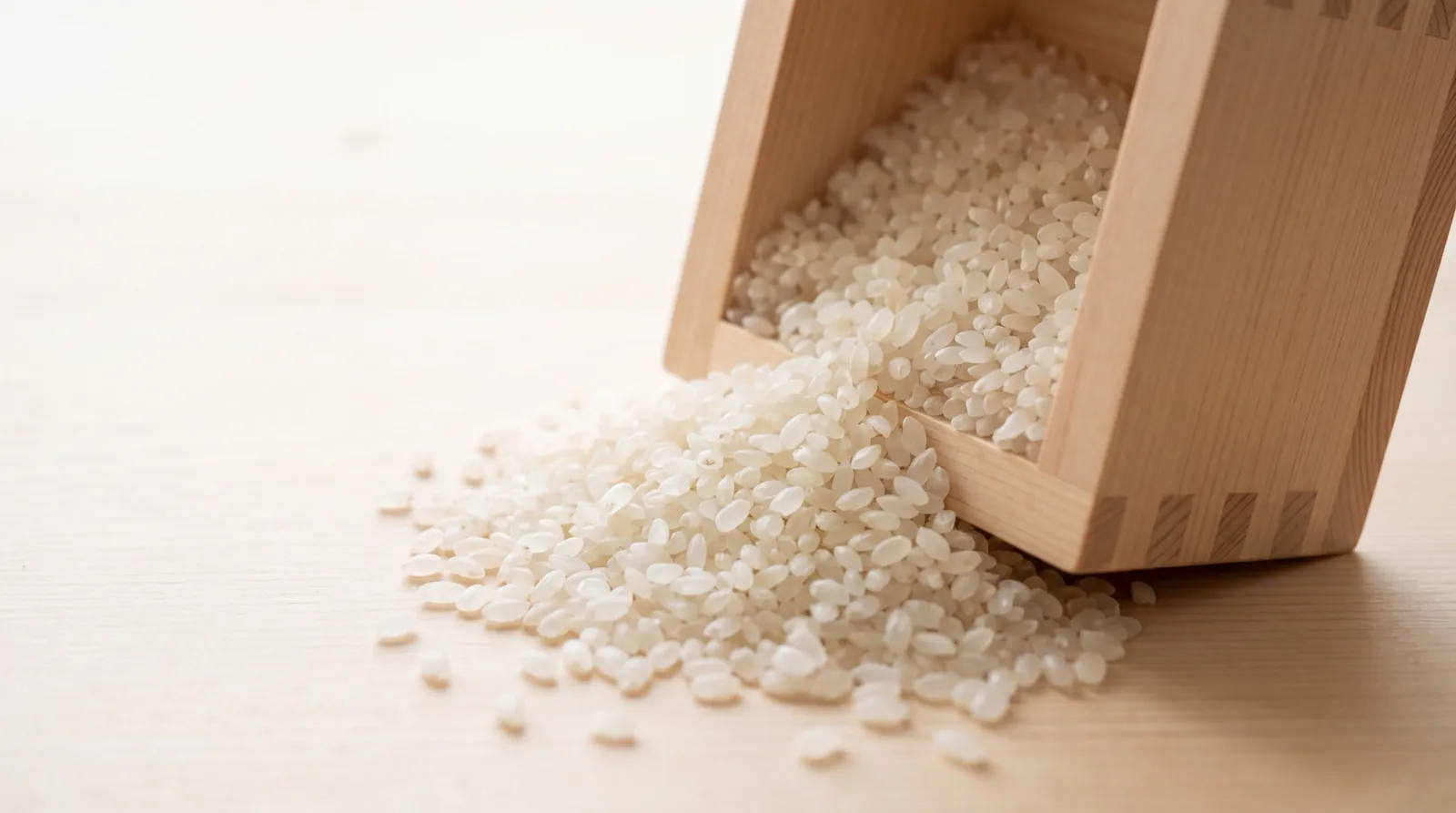
Part II Shari: Sushi Rice
Chapter 7
Knowing Rice: Rice and Cooking It
Chefs often say that half the flavor of sushi depends on the shari (sushi rice). And the quality of the shari is mostly decided before the sushi vinegar is ever added. It is decided when you choose the rice, wash it, let it absorb water, and cook it. In this chapter you will learn which rice suits sushi, and each step up to the moment the rice is cooked. For every step, you will also learn why it is done.
In this chapter you will learn
- To explain what makes rice suitable for sushi, and how to handle new-crop rice and the previous year's rice
- To explain the steps of washing, soaking, and draining in a colander, and the reason for each
- To explain what happens when you cook rice in hard water, and how to deal with it outside Japan
- To explain the key points of cooking and resting the rice, and why you must not leave rice unattended while it soaks or after it is cooked
- To explain the gelatinization and retrogradation of starch, together with the temperature and moisture conditions for each (Grade 1)
7.1 Rice for sushi
Most of a grain of rice is starch. Starch comes in two kinds. One is amylose, whose molecules link in a straight line, like a single chain. The other is amylopectin, whose molecules branch out and spread like a cluster.
Straight sticks come apart easily, even when you tie them in a bundle. Twigs with many side branches tangle together and do not come apart. In the same way, rice with more amylose has grains that separate easily. Rice with more amylopectin is stickier. The ratio of these two starches largely decides the texture of rice.
The non-glutinous rice (uruchi) eaten every day in Japan contains about 17 to 20% amylose. Glutinous rice (sticky rice), used for rice cakes and festive red-bean rice, contains almost 0% amylose. It is so sticky that it forms a lump and does not come apart in the mouth. On the other hand, most long-grain rice, that is, most indica rice, is high in amylose, at 20 to 30%. When cooked, it turns dry and separate, and you cannot shape it into nigiri. Rice for sushi sits in between. It is sticky enough to hold its shape, yet it comes apart grain by grain in the mouth.
Three things to look for
- The rice should not be too sticky.
- The grains should be firm. They should not get crushed when cooked, or when the vinegar is mixed in. Chefs describe this as the grains "standing up."
- The rice should not harden easily as it cools. Shari is not eaten piping hot. It is eaten after it cools to body temperature.
Sasanishiki has grains that separate well, and its light flavor does not clash with the vinegar. That is why Edomae (Edo-style) chefs have long favored it. Koshihikari is stickier and sweeter, so chefs use less water or blend in older rice. Low-amylose rice such as Milky Queen is too sticky for sushi. The key is to choose rice for its properties, not for how famous the brand is.
| Type or variety | Amylose | When cooked | For sushi |
|---|---|---|---|
| Glutinous rice | Almost 0% | Very sticky and stretchy | Not suitable (forms a lump) |
| Low-amylose rice (such as Milky Queen) | About 10% | Soft and chewy | Not suitable (too sticky) |
| Koshihikari | About 17–18% | Very sticky and sweet | Adjust by using less water and blending in older rice |
| Sasanishiki, Hatsushimo, and similar | About 19–20% | Grains stand up and separate easily | Suitable |
| Long-grain rice (most indica rice) | About 20–30% | Dry and separate | Not suitable (cannot be shaped) |
In short, rice with too little or too much amylose does not suit sushi. Non-glutinous rice with around 17 to 20% amylose is the right middle ground.
A closer look at rice varieties
About 75% of polished white rice is starch. Hatsushimo has large, firm grains. Nanatsuboshi is a variety with a good balance of stickiness and firmness. Both keep their flavor well even when cooled. Together with Nipponbare, they are said to contain about 19 to 20% amylose. Sasanishiki is slightly higher in amylose, and this is where its well-separated grains come from. Milky Queen contains around 10% amylose. The figures for each variety are only a guide, and they change with the growing region and the year. In the end, you decide based on your own restaurant's sushi vinegar and neta (toppings). Think of rice and vinegar as a pair (Chapter 8).
7.2 New-crop rice and the previous year's rice
Rice harvested in the current year is called new-crop rice (shinmai). Rice harvested the year before is called the previous year's rice (komai). While rice is stored, its components change little by little, and the grains become harder. Many people think rice hardens because it loses moisture. However, the main cause is the change in its components.
New-crop rice has soft grains that absorb water readily. If you cook it with the usual amount of water, it turns sticky, and the grains break easily. On top of that, it has little room left to absorb the sushi vinegar. The vinegar stays on the surface, and the shari tends to turn watery.
The previous year's rice has hard grains, so it keeps its shape well when cooked. During cooking, it absorbs a lot of water. Chefs explain that, for this reason, it also absorbs the sushi vinegar all the way through and does not turn sticky.
This is why many sushi restaurants blend new-crop rice with the previous year's rice. The blend varies by restaurant, from 7 parts new-crop rice to 3 parts older rice, up to an even split of 5 to 5. If you cook new-crop rice alone, use 5 to 10% less water than usual. The previous year's rice takes longer to absorb water, so soak it longer. Whenever you change the blend, always review the soaking time and the amount of water.
Aging of stored rice, and room to absorb
After harvest, brown rice is dried to a moisture content of about 15% and then stored. As the months pass, its lipids, starch, proteins, and enzymes change little by little. This is called aging of stored rice, and the tissue of the grain becomes harder. The rice also loses a little moisture in storage, but the main cause of hardening is this aging.
In new-crop rice, the endosperm, which is the inside of the grain, is soft and absorbs water easily. The previous year's rice is known to absorb a larger proportion of water during cooking than new-crop rice. This greater room to absorb is the reason chefs deliberately blend in older rice. Chefs explain that it absorbs the sushi vinegar all the way through, so the flavor settles in and the rice does not turn sticky.
However, if the previous year's rice is stored poorly, the lipids in the bran layer spoil and it develops an "old rice" smell. Choose rice that was stored in a cool warehouse at 15°C or below.
Storing rice
Ordinary white rice is brown rice whose surface has been ground away until it weighs about 90 to 92% of the original brown rice. This grinding is called polishing, or milling. Once rice is polished, its flavor declines day by day. Buy rice polished as recently as possible, a little at a time.
Rice in storage has four enemies: heat, humidity, insects, and oxidation. The ideal is 15°C or below, and insects become active at 20°C or above. Keep rice in an airtight container in a cool place. Each time the rice bin is empty, wash and dry it. Never pour new rice on top of old rice. If you do, old rice will stay at the bottom forever. This is the same idea as first in, first out (FIFO), which you learned in Chapter 5.
Degree of polishing, and how fast flavor declines
The bran layer that covers the surface of brown rice is rich in lipids. It is the main source of oxidation and off-odors. For sushi rice, some restaurants polish the rice down to 88 to 90% of the weight of the brown rice. The more you polish, the less bran smell and off-flavor there is. But if you polish too much, the grains break easily.
After polishing, the lipids begin to oxidize. After 2 to 3 weeks, the flavor declines. If you leave the rice in its bag somewhere above 30°C, such as a kitchen in summer, the flavor declines within 1 month. Rice with a high moisture content, as a guide above 16%, grows mold easily. Insects such as rice weevils become active at 20°C or above.
7.3 Washing rice: wash it, do not scrub it
The purpose of washing rice is to remove the bran and fine powder left on its surface. In the past, milling was rough, so cooks had to rub the grains against each other to "scrub" them. Today's milling machines remove almost all of the bran. If you scrub hard, the grains crack, and starch leaks out of the cracks and makes the rice sticky. Today, think of it as "washing," not "scrubbing."
Dry rice absorbs the first water it touches most rapidly. It is like dropping a dry sponge into water: it soaks up the water all at once. The bran smell dissolves into that first water. If you are slow, the rice absorbs that smell too. So pour in the first water and throw it away immediately.
The same reason explains why you must not wash rice in lukewarm water. In warm water, the rice absorbs water all at once. It soaks up the bran smell and the cloudy water as well. Grains that take in too much water have surfaces that break down easily, and this makes the cooked rice sticky. Note that starch starts to turn into a paste only at around 60°C. Lukewarm water does not cook the surface of the rice.
- Weigh Measure rice by weight. 1 sho (about 1.8 L) of rice weighs about 1.5 kg.
- The first water Pour in plenty of cold water all at once, stir 2 or 3 times, and throw it away within 10 seconds.
- Wash Add just enough water to cover the rice. Keep your fingers upright and stir gently in circles 10 to 20 times, then pour off the cloudy water. Repeat this 2 or 3 times. Stop when the water is only slightly cloudy. Do not wash until it runs clear.
- Rinse Give the rice a quick rinse under running water. Finish within 3 to 5 minutes of adding the first water. The longer it takes, the more cloudy water the rice absorbs, and the more the grains crack.
Cold water, short, and gentle. These are the basics of washing rice.
7.4 Soaking and draining
Soaking is the step that carries water all the way to the center of each grain. For rice to cook up plump, it needs both water and heat. If you cook rice before water reaches its center, only the starch on the surface turns into a paste first, and it forms a film. This film blocks the path for water and heat to get inside. The result is undercooked rice with a hard core.
Rice absorbs water rapidly for about 30 minutes after it goes into water. In about 2 hours, it is almost full. By then, its weight has increased by about 20 to 25%. The colder the water, the more slowly the rice absorbs it. If you soak rice for a long time in warm water, the surface of the grains breaks down and the flavor suffers. So soak in cold water, and adjust with time. As a guide, soak for 30 minutes to 1 hour in summer, when the water is around 25°C. Soak for 1 to 2 hours in winter, when the water is 5 to 10°C. For the previous year's rice, add about 30 minutes more.
Do not leave rice draining for long
After soaking, put the rice in a colander and let the water on the outside drain off. This lets you measure the cooking water accurately. However, if you leave the rice in the colander for a long time, only the surface of each grain dries and shrinks. The inside stays swollen with water, and the difference causes cracks. These are called fissured grains. When you cook fissured rice, starch flows out through the cracks. The result is sticky rice with broken grains.
As a guide, move the rice to the pot within 15 to 30 minutes of draining. In a dry kitchen, make it even shorter. Cover the rice with a tightly wrung damp cloth to keep it from drying out.
A starting point for the amount of water
Shari for sushi is cooked firmer than ordinary rice. During soaking, the rice has already absorbed water equal to about 20 to 25% of its weight. So it needs less water than the usual way of cooking. Among chefs, a common starting point is water equal to 1.0 to 1.1 times the weight of the drained rice. However, the right amount of water varies greatly with the pot and the heat source. Set your own restaurant's standard, record it, and adjust it by looking at how the rice turns out.
7.5 Water: soft water and hard water
During soaking, rice absorbs water equal to more than 20% of its weight. It absorbs even more water during cooking. The quality of the water becomes the quality of the shari.
The biggest factor is water hardness. This is the amount of calcium and magnesium dissolved in the water. Water with a lot of them is called hard water, and water with little is called soft water. Under the classification of the World Health Organization (WHO), water with up to 60 mg per liter is soft water. This amount is counted as the equivalent amount of calcium carbonate. Water with 60 to 120 mg is moderately hard, and water with more than 120 mg is hard. Most tap water in Japan has less than 100 mg, which places it between soft and moderately hard.
Rice cooked in hard water turns out hard and dry. The usual explanation is that calcium hardens the tissue of the rice, so water has trouble getting inside. Some details of how this works are still unclear. Magnesium also adds bitterness. With soft water, the water enters the rice freely, and the rice cooks up plump.
Hardness, pectin, and the properties of water
The WHO classification goes further. Water with 120 to 180 mg is hard, and water with 180 mg or more is very hard. For Japanese tap water, the water quality target for hardness is 10 to 100 mg per liter.
Here is how hard water is said to make rice cook up hard. The cell walls of rice contain a substance called pectin. Calcium links pectin molecules together, as if building bridges between them, and this hardens the tissue. When the walls harden, water has trouble getting inside, and gelatinization does not progress well. However, this mechanism was confirmed in beans and vegetables. The cell walls of rice contain little pectin, and how much this effect matters in rice has not been fully confirmed.
As a rule, the water's pH should be close to neutral. Slightly alkaline water makes rice a little softer, and acidic water makes it a little firmer. A water softener is a device that uses a material called ion-exchange resin to replace calcium and magnesium with sodium. If the water smells strongly of chlorine, run it through a water filter.
7.6 Cooking and resting the rice
In raw rice, the starch molecules are packed tightly together in a hard state. Not even water can get in. When water and heat are added, this packed arrangement loosens. Water flows into the gaps, and the starch holds the water and swells. In this way, it changes into a soft, sticky state. This is gelatinization. It is also called alpha conversion. When you heat potato starch mixed with water, it turns thick and clear. This is the same change. Rice starch begins to gelatinize at around 60°C. To gelatinize the rice all the way to the center, you must hold it at 98°C or above for about 20 minutes.
Heat control and steam holes
Sushi restaurants bring the water to a boil fairly quickly. Once it boils, they cook the rice on high heat, but not so hard that the starch falls apart. This is the approach at most restaurants. For ordinary rice cooking, about 10 minutes to reach a boil is considered right. Shari for sushi will absorb the sushi vinegar later, so it is cooked firmer than ordinary rice, with less water. The amount of water varies greatly with the pot and the heat source, so set your own restaurant's standard and record it.
On the surface of well-cooked rice in the pot, you will see a number of holes a few millimeters across. These are called steam holes (kani-ana). They are the paths that steam bubbles took as they formed at the bottom of the pot over strong heat and pushed up through the layers of rice. They show that the whole pot boiled vigorously and that steam passed from the bottom to the top. If the heat is too weak or there is too much water, they are less likely to form.
Resting and the pot
After you turn off the heat, leave the lid on for about 10 minutes. The remaining heat and steam carry gelatinization through to the core. The rice also absorbs the extra moisture on its surface. If you rest it too long, you lose the heat that is just right for adding the vinegar. Stop at about 10 minutes, and move the rice to the handai while it is hot (Chapter 9).
Most sushi restaurants use gas rice cookers. They give strong, direct heat from a flame, which tends to make shari with grains that stand up. IH (induction) rice cookers control temperature precisely, so they cook the same way every time. Pressure cookers tend to make the rice soft, so use less water. As a guide, cook an amount that fills 60 to 80% of the pot's capacity. If you fill it to the top, the rice gets crushed under its own weight.
Judging the cooked rice
There are steam holes on the surface. The outline of each grain is clear, and there is no film of water. When you turn the rice over with a rice paddle, no water has collected at the bottom. The rice does not lift up in a lump, but falls apart lightly. When you crush a grain, it has no hard core. This is well-cooked rice. If it is too soft, reduce the water and the soaking time. If a hard core remains, increase the soaking time. If no steam holes appear, try cooking a smaller amount.
Gelatinization at the molecular level
The starch in raw rice is called beta starch (raw starch). Its amylose and amylopectin molecules are packed together in a tight, regular arrangement by weak links called hydrogen bonds. This hard structure keeps out both water and digestive enzymes.
When water and heat are added, the hydrogen bonds between the molecules break. Water molecules enter the gaps that open up, and the starch holds the water and swells. This is called swelling. The regular arrangement comes apart, and the starch changes into soft, sticky alpha starch (gelatinized starch). Gelatinization is the change in which water and heat break the hydrogen bonds between the molecules, and water enters the gaps and makes the starch swell.
Heating speed and types of pot
If the rice is slow to reach a boil, it stays for a long time at the temperatures where an enzyme in the rice called amylase is active. Amylase is an enzyme that turns starch into sugar. The rice becomes sweeter, but the grains are said to stand up less well. For shari with grains that stand up, a fairly quick boil is best.
A gas rice cooker can create strong convection in a short time with a direct flame. A pressure cooker raises the boiling point above 100°C and gelatinizes the rice to the core in a short time. A traditional flanged iron pot, called a hagama, holds heat well and creates strong convection, so it produces the most steam holes. Right after you turn off the heat, water still remains on the surface of the grains, and gelatinization inside is not yet finished. Resting generally takes 10 to 15 minutes. Sushi restaurants, however, keep it to about 10 minutes, to keep the rice hot enough for adding the vinegar.
Some restaurants add a little kombu or sake when cooking. However, kombu can make the rice stickier because of alginic acid, the component that makes it slimy. If you add it, take it out before the water boils. When you check the cooked rice, also make sure it tastes sweet and has a slight springiness when you chew it. Cooking an amount that fills 60 to 80% of the pot's capacity gives the best convection.
7.7 Retrogradation of starch: why cold rice turns hard
Over time, the molecules of gelatinized alpha starch bond together again through hydrogen bonds. They push out the water and line up again in a hard arrangement. This is called retrogradation. It is also called beta conversion, because the starch returns to beta starch. Retrogradation is the reverse of gelatinization. This is why cold rice becomes hard and crumbly.
Retrogradation is fastest at 0 to 4°C, which is refrigerator temperature. At this temperature, the molecules move slowly, but not too slowly, and the water is not yet frozen. This makes it easy for the molecules to line up again. That is why rice kept in the refrigerator becomes hard and dry by the next day. In a freezer at −18°C or below, retrogradation hardly progresses. Keeping rice warm at 60°C or above also slows it, but the rice dries out and turns yellowish. Retrogradation is fastest when the moisture content is 30 to 60%. Cooked rice has a moisture content of about 60%, which falls within this range.
One reason to keep shari at body temperature, 35 to 37°C, is to slow this retrogradation. Retrograded starch can gelatinize again to some extent and soften when reheated. It is the same as cold rice softening when you warm it up. But if you reheat shari, the acetic acid evaporates. Only the surface gelatinizes too much, and the rice turns sticky. So as shari, it cannot be restored. Shari is something you "keep at body temperature and use up while it is still at body temperature." You will learn why sugar slows retrogradation in Chapter 8, and how to manage the temperature of shari in Chapter 9.
Chapter summary
- Choose sushi rice for its properties, not its brand. Look for non-glutinous rice whose grains stand up, that is moderately sticky, and that does not harden easily as it cools. As a guide, the amylose content is about 17 to 20%.
- The previous year's rice has harder grains because its components have changed. It absorbs a lot of water during cooking, so it is said to absorb the sushi vinegar well too. For new-crop rice, reduce the water by 5 to 10%, or blend it with older rice. Store rice airtight at 15°C or below, and never add new rice on top of old rice.
- When washing rice, "wash" it, do not "scrub" it. Use cold water, and be short and gentle. Throw the first water away immediately.
- Soak in cold water, as a guide for 30 minutes to 1 hour in summer and 1 to 2 hours in winter. If soaking is not enough, a hard core remains. Drain for 15 to 30 minutes. If the rice is left too long, the grains crack. Never leave soaking rice or cooked plain rice at room temperature (because of Bacillus cereus).
- Hard water makes hard, dry shari. Outside Japan, use a water softener, RO water, or water with a hardness of 60 mg or less, and measure both rice and water by weight.
- Gelatinization starts at around 60°C and takes about 20 minutes at 98°C or above. A pot of rice cooked over strong heat shows steam holes. Stop resting at about 10 minutes, and move the rice to the handai while it is hot.
- Gelatinization is the change in which water and heat break the hydrogen bonds between molecules, and water enters and makes the starch swell. Retrogradation is fastest at 0 to 4°C. Shari cannot be restored by reheating, so keep it at body temperature and use it up (Grade 1).
Review questions
Q1 After soaking, rice was left in a colander for a long time. Which of the following is likely to happen?
a The rice absorbs more water and cooks up plump
b Only the surface of each grain dries and shrinks, cracks (fissured grains) form, and the rice turns sticky when cooked
c The water drains well, so the shari has no hard core
d The starch gelatinizes, and the shari becomes sticky
e It takes on the properties of the previous year's rice and absorbs the sushi vinegar well
Answer: b
If rice is left draining for a long time, only the surface dries and shrinks. The difference between the surface and the water-filled inside causes the grains to crack. These are fissured grains. When cooked, starch flows out through the cracks, and the result is sticky rice with broken grains. As a guide, move the rice to the pot within 15 to 30 minutes of draining. Option d, gelatinization, is a change that needs both water and heat and starts at around 60°C. It does not happen in a colander.
Q2 Which of the following correctly describes what happens to the grains when rice is cooked without enough soaking?
a The starch inside gelatinizes first, and the surface stays hard
b The starch on the surface gelatinizes first and forms a film, so water and heat cannot reach the inside and a hard core remains
c Amylose flows out, and the whole batch turns sticky
d The grains crack and fall apart
e Many steam holes form, and the rice turns out watery
Answer: b
Rice that has not soaked enough has water only on its surface. So the surface gelatinizes first and forms a film. The film blocks the path for water and heat to get inside, and a hard core remains. This is what is called undercooked rice. Option d, cracked grains, is a different problem that happens when rice is left draining in a colander for a long time.
Q3 Which of the following is correct about the retrogradation of cooked shari?
a Retrogradation is fastest at 60°C or above, so it is better not to keep the rice warm
b Retrogradation is fastest at 0 to 4°C, so do not refrigerate shari. Keep it at body temperature and use it up while it is still at body temperature
c Retrograded shari returns to its original vinegar flavor and texture when reheated
d Retrogradation is the change in which water and heat break the hydrogen bonds between molecules and the starch swells
e Freezing at −18°C or below makes retrogradation fastest
Answer: b
Retrogradation is the change in which gelatinized starch bonds together again through hydrogen bonds and lines up again in a hard arrangement. It is fastest at 0 to 4°C, which is refrigerator temperature. Option c is wrong. Reheating makes the acetic acid evaporate, and only the surface gelatinizes too much and turns sticky, so it does not return to being shari. Option d describes gelatinization. Freezing at −18°C or below and keeping rice warm at 60°C or above both slow retrogradation.