
Part I Food Safety
Chapter 6
Why Sushi Can Be Made with Bare Hands
In many countries outside Japan, sushi is made with gloved hands. Japanese chefs make it with bare hands. A sushi chef must be able to explain, with reasons, why bare hands are safe. The answer lies in a system: handwashing, tezu (vinegared hand water), the acid in vinegared rice, and time control.
In this chapter you will learn
- To explain the problems with gloves, and the situations in which gloves are necessary
- To explain the roles of handwashing and tezu, and to use tezu correctly
- To explain why vinegared rice resists spoiling, and why time control is still needed
- To explain why wasabi, gari, and tea are only “supporting” measures, and the principle of “protection by acid” that sushi shares with nare-zushi and sourdough
- To explain how acetic acid inhibits bacteria, and the documents and records needed to get a bare-hand system approved outside Japan (Grade 1)
6.1 You Cannot Make Great Sushi with Gloves On
The FDA Food Code, the U.S. food hygiene standard, in principle prohibits bare-hand contact with ready-to-eat food. Ready-to-eat food is food that goes into the guest's mouth without cooking or other treatment. Vinegared rice, sashimi, and nigiri sushi all fall into this category. That is why many sushi restaurants in the United States make sushi with gloves on. Europe and Oceania also have rules that ask workers not to touch ready-to-eat food with bare hands when it is not necessary. However, these rules are not a general ban like the one in the United States.
The problem of flavor
A good rice ball for nigiri (shari-dama) is firm on the outside and light and airy inside (Chapter 24). The chef makes this shape by feeling the rice grains with the fingertips and adjusting the pressure. Gloves take away this sense of touch. The pressure goes wrong. The result is either a hard lump with no air in it, or a ball that is too loose and falls apart. Rice grains also stick to the gloves and carry over to the next piece of sushi.
The problem of hygiene
Gloves are not as clean as they look. There are four reasons.
First, no one washes the surface of gloves. From the time gloves are put on until they are taken off, they are never washed. Gloves that have touched fish, touched the cash register, and wiped the cutting board go straight on to shape the next ball of shari (sushi rice).
Second, because the hands do not feel dirty, the wearer moves on to the next task without washing, even at moments when bare hands would be washed. Gloves that are not changed become tools for carrying bacteria.
Third, tezu does not spread well on gloves, so rice stays stuck to them. Fourth, the inside of a glove gets warm and damp, so bacteria on the skin multiply. And when thin gloves tear, it is hard to notice.
The Japan Sushi Association's position is clear. Only chefs who have mastered the hygiene system for working with bare hands may make sushi with bare hands. Bare hands are not allowed simply because they are traditional. The bare hands of a chef who follows the system every day are safer than gloves that are never washed or changed. And those hands can make great sushi.
When gloves are necessary
Even so, there are situations where you should use gloves. The first is when you have a cut, rough skin, or an infected sore on your hands. The second is when you work in a country or region that prohibits bare-hand contact, and you have not yet received approval for an exception (section 6.6). The third is when you handle foods that cause allergies. The problem is not gloves themselves. It is the belief that “once you put gloves on, hygiene is complete.”
6.2 Handwashing and Tezu
The system that protects bare-hand sushi is made up of four pillars and several supporting measures. The four pillars are handwashing, tezu, the acid in vinegared rice, and time control. Wasabi, gari (pickled ginger), and tea are supporting measures.
| Measure | What it does | Role |
|---|---|---|
| Handwashing | Lifts bacteria off with soap and rinses them away (Chapter 4) | Pillar (foundation) |
| Tezu | Keeps the surface of the hands acidic, and keeps rice from sticking | Pillar |
| Acid in vinegared rice | Lowers the pH to 4.0–4.5, making it hard for bacteria to grow | Pillar |
| Time control | Shari that has passed the set time is thrown out | Pillar |
| Wasabi, gari, and tea | Reported to inhibit bacteria. They also cleanse the palate | Support |
Handwashing and nails
The foundation is handwashing (Chapter 4). Wash your hands when you arrive at work, after using the toilet, after washing raw fish, after touching money or your face, and before you start making nigiri. After very dirty work, do double handwashing. Keep your nails short, and scrub them with a nail brush. Under the nails is where the most bacteria remain. Remove rings and watches, because you cannot wash underneath them.
What tezu is
The water used to moisten the hands when making nigiri is called temizu (hand water). Water with vinegar added to it is called tezu (vinegared hand water). The ratio of water to vinegar is roughly between 1 to 1 and 3 to 1, and each restaurant adjusts it. A ratio of 3 to 1 means 3 parts water to 1 part vinegar. Table vinegar has a pH of about 2.5 to 3. Even when it is diluted to 3 parts water to 1 part vinegar, tezu stays at around pH 3.
Tezu has three roles.
The first is to keep rice from sticking to the hands. Moistening the hands creates a thin film of water between the hands and the rice grains. This film lets you handle the grains without damaging them. Vinegar is also said to help keep rice from sticking, but how it does so is not well understood.
The second is to keep the surface of the hands acidic. Bacteria have a hard time multiplying on acidic hands. However, tezu is not a disinfectant that kills bacteria. It works by holding back their growth, and this is called a bacteriostatic effect. It is meaningless unless you have first removed bacteria by washing your hands.
The third is to moisten and cool the hands.
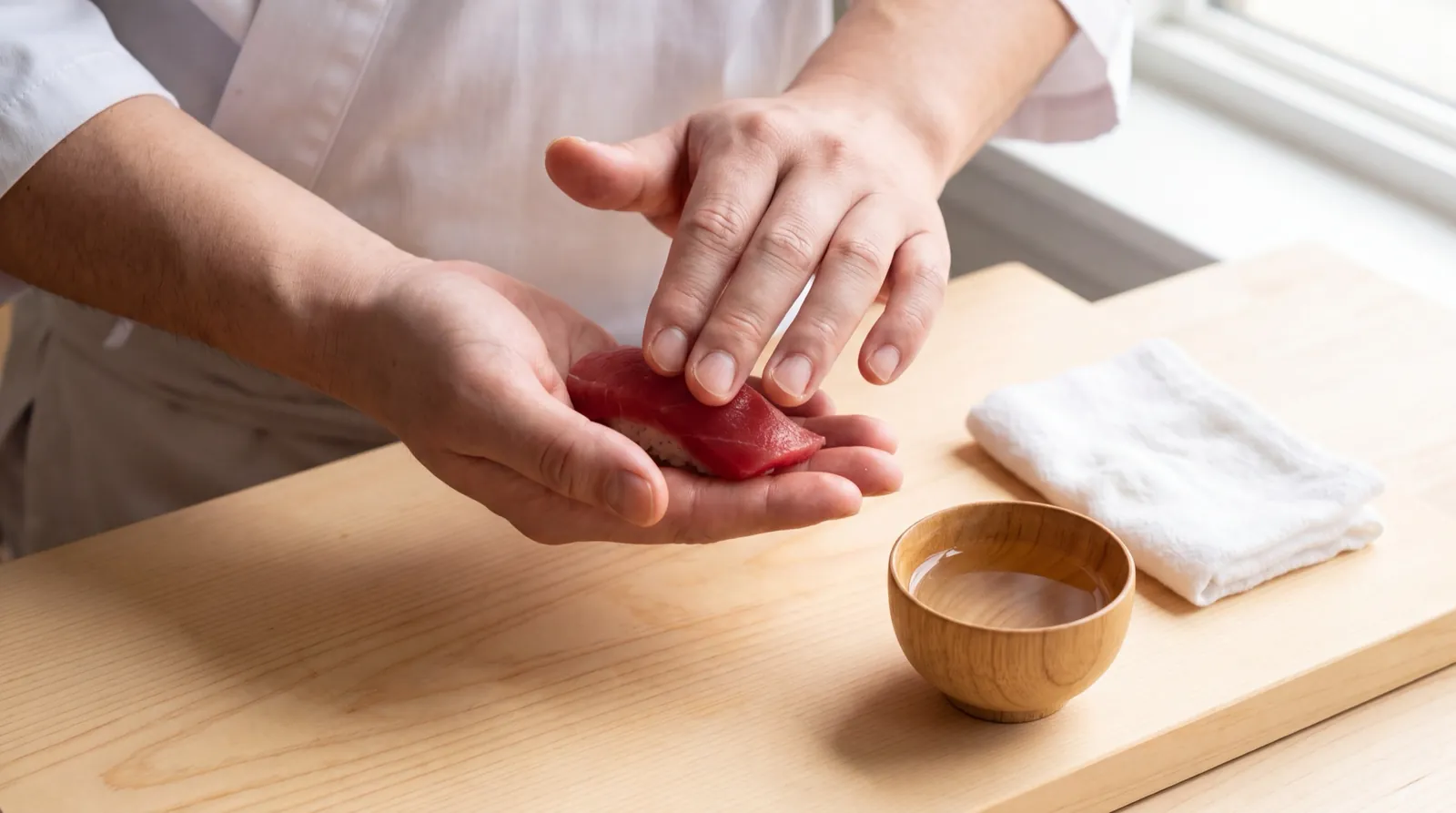
To use tezu, dip your fingertips in it and spread a thin layer over both palms. A good guide is “just enough to make your palms shine.” Too much makes the shari watery. Too little lets the rice stick. Reapply it every time you switch tasks. Tezu with rice grains or fat floating in it carries bacteria, so replace it with fresh tezu several times during service.
Cool your hands and reduce handling
Human body temperature is about 36°C. The surface of the palm is also around 30°C. The fat in toro (fatty tuna) is solid at refrigerator temperature. But it softens and starts to melt at temperatures below body temperature (Chapter 14). When toro stays in a chef's hands too long, the fat on its surface melts, the flavor suffers, and the toro sticks to the shari. That is why many chefs cool their hands in ice water before shaping nigiri with very fatty neta (topping).
The same is true for hygiene. The more often and the longer the hands touch the food, the more heat and bacteria move from the hands to the topping and the shari. When the surface of the topping warms up, it gets closer to a temperature at which bacteria on the topping can multiply easily. In tegaeshi, the hand-turning sequence (Chapter 24), chefs keep the number of hand movements low. This is not only for a beautiful shape. It is also to keep the time the hands touch the food as short as possible.
Reset between tasks
Reset your hands at every break between tasks. Do not pick up a saku (trimmed block of fillet) with the hands that just rinsed raw fish. Do not handle payment with the hands that just cut a saku. Do not make nigiri with the hands that just handled payment.
How strong the acid in tezu is
Commercial table vinegar contains 4 to 5% acetic acid. The pH of tezu, around 3, is well below pH 4.6, which is considered the limit for Clostridium botulinum. It is also lower than the minimum at which many food-poisoning bacteria can grow, such as the limit of around pH 3.7 considered to apply to Salmonella. Even so, its effect is only bacteriostatic. Only handwashing removes bacteria.
6.3 The Acid in Vinegared Rice, and Time Control
Cooked rice is full of moisture and nutrients. Its pH is 6 to 7, which is close to neutral. pH is a scale from 0 to 14 that shows how acidic or alkaline something is. A pH of 7 is neutral, and the lower the number, the more acidic. Rice that is close to neutral is a comfortable place for bacteria. When you add sushi vinegar (awasezu) to it, the pH of the vinegared rice drops to roughly 4.0 to 4.5. Depending on the recipe and uneven mixing, it can be above 4.6.
The lower the pH, the harder it is for most bacteria to grow. But the idea that “bacteria cannot grow at pH 4.6 or below” is wrong. The value 4.6 is the limit below which Clostridium botulinum cannot grow. It is not the limit for all bacteria. Salmonella and Staphylococcus aureus can sometimes grow slowly even at the pH of vinegared rice. Vinegar does not kill bacteria. It only makes it harder for them to grow.
Body temperature is right in the middle of the danger zone
When you make nigiri, the shari is at body temperature, roughly 35 to 37°C (Chapter 9). This is right in the middle of the temperature danger zone of 10 to 60°C, and many bacteria grow well at this temperature. In other words, sushi is a food that gives up on controlling bacteria with temperature, and controls them with acid and time instead. This clears up two misunderstandings.
The first misunderstanding is that “it's vinegared rice, so it's fine no matter how many hours it sits.” Rice carries Bacillus cereus. This bacterium comes from soil and is commonly found on rice. It survives the heat of cooking by taking the form of a spore, a hard protective shell (Chapter 2). Then it wakes up in rice at room temperature, multiplies, and produces toxins. The toxin that causes nausea is not destroyed by heating. The acid in vinegared rice greatly slows its growth. But where the vinegar is not well mixed in, there is room for it to grow.
That is why each restaurant sets a time for throwing out shari. Write down the time the vinegar was mixed in. Once the set time has passed, throw out the shari, even if it has not been used up. Many restaurants in Japan use 2 to 4 hours as a guide.
The second misunderstanding is that “chilling it in the refrigerator makes it safe.” Chilled shari is safe, but it becomes hard and crumbly (Chapter 7). It also cannot melt the fat of the topping in the mouth. Having chosen to protect sushi with acid and time, a sushi chef must be strict about time.
Limits for each bacterium, and how acetic acid works
Food rules around the world use pH 4.6 to separate “acidic foods” from “low-acid foods.” This is because the rules are based on Clostridium botulinum. However, the pH limit below which bacteria cannot grow differs for each bacterium. Here we compare the minimums when all other conditions are favorable. Vibrio parahaemolyticus stops growing below about pH 4.8, and Bacillus cereus stops growing below about 4.3. On the other hand, the minimum for Salmonella is about 3.7, and the minimum for Staphylococcus aureus is about 4.0 (Chapter 2). These two can grow slowly even at the pH of vinegared rice. Vinegared rice combines a low pH and the action of acetic acid with time control. Together, these push such bacteria to the side where they “have a hard time growing.”
Water activity plays a supporting role
Another form of protection is lowering water activity. Water activity is a number from 0 to 1 that shows how much of the water in a food bacteria can use (Chapter 2). The water activity of plain rice is high, at around 0.98. The salt, sugar, and vinegar components in sushi vinegar bind with water and slightly reduce the water that bacteria can use. However, with the amounts that go into shari, water activity drops only a little. The main role belongs to pH, and water activity is only a support. Even so, salt and sugar are not there just for flavor.
Time rules, and tools for keeping shari warm
The toxin of Bacillus cereus that causes nausea is called cereulide. It is not destroyed even by heating at 126°C for 90 minutes. Not letting the bacteria grow is everything.
When food is managed by time, the U.S. FDA Food Code requires that it be served or thrown away within 4 hours after it is taken out of temperature control.
There are also tools that protect shari with temperature. A high-temperature rice warmer runs at about 70°C and can keep shari at 60°C or above, where bacteria do not grow. But the rice dries out, and the acetic acid evaporates. If you refrigerate shari, the starch undergoes retrogradation and the rice becomes hard (Chapter 7). Both ruin the flavor of shari. That is why sushi has chosen the path of protection by acid and time.
6.4 Wasabi, Gari, and Tea Are “Supporting” Measures
Each piece of sushi is built with many layers of protection. But not one of them has the power to bring bacteria down to zero.
The heat of wasabi is created when it is grated and its cells break. Components inside the cells and an enzyme mix in water, and the pungent compound is formed (Chapter 21). Experiments have shown that this pungent compound inhibits the growth of E. coli O157, Staphylococcus aureus, and other bacteria. Wasabi is placed between the topping and the shari to trap its aroma, which escapes easily. At that boundary, where moisture and nutrients gather, some help in inhibiting bacteria can also be expected. But the wasabi in one piece of sushi cannot kill all the bacteria. It does not kill Anisakis either (Chapter 3).
Gari is ginger pickled in sweet vinegar. The pickling liquid is around pH 3, so gari itself is a food that does not spoil easily. Components of ginger have also been reported to inhibit bacteria. Gari is also a palate cleanser that removes the fat and smell of the previous piece.
In sushi restaurants, hot tea is called agari. Its heat melts the fat in the mouth and washes it away. Catechins, the source of tea's astringent taste, tend to bind with proteins. This astringency cuts through oiliness and makes the flavor of the next piece clear. Catechins have also been reported to inhibit bacteria.
The salt in soy sauce and nikiri (simmered soy glaze) also protects the toppings. So does Edomae (Edo-style) shigoto (preparation work), such as salt curing (shio-jime), vinegar curing (su-jime), kobujime (curing between kombu sheets), and zuke (marinated in soy sauce). These are techniques that draw out moisture and protect the toppings with salt or acid (Chapter 13). Sushi is a food with many layers of protection. But each of them is only a support.
Looking at the supporting protections by their components
The pungent compound in wasabi is allyl isothiocyanate. When wasabi cells are crushed, a component called sinigrin is converted into this compound by the action of an enzyme called myrosinase. It has been reported to have antibacterial effects against E. coli O157, Staphylococcus aureus, Salmonella, and other bacteria. This compound is volatile, so it turns into a gas and spreads to its surroundings.
At the boundary between the topping and the shari, cold fish touches rice at body temperature, and the moisture and nutrients that come out of the fish mix with the rice. This is thought to be a place where bacteria grow easily. When wasabi is placed there, its compound spreads throughout the boundary. The heat and aroma trapped between the layers rise up the moment the sushi enters the mouth. Wasabi placed on top lets its aroma escape, and it does not protect the boundary.
Gingerol, found in the ginger used for gari, has also been reported to have antibacterial effects. The catechins in tea have astringency. This means they bind strongly with proteins and tighten them. Koikuchi (dark soy sauce) is about 15% salt. In the Standard Tables of Food Composition in Japan, its salt equivalent is 14.5 g per 100 g (Chapter 20). Its pH is 4.7 to 4.9, and its water activity is around 0.8. In soy sauce, food-poisoning bacteria can hardly grow. Nikiri coats the surface of the topping with salt and acid.
Curing is also a hygiene technique. Salt curing draws out moisture with salt and lowers water activity. Vinegar curing lowers the pH and changes the properties of proteins. Kobujime moves moisture from the fish into the kombu, lowering water activity while adding umami. Zuke protects the surface with the salt in soy sauce and with sake. All of these are techniques of “drawing out moisture and protecting with acid or salt” that developed in the days before refrigerators. Edomae shigoto was a hygiene technique as much as a flavor technique.
| Ingredient | Active components | How it protects |
|---|---|---|
| Vinegared rice | Acetic acid, salt, and sugar | pH 4.0–4.5. Lowers water activity slightly |
| Tezu | Acetic acid (around pH 3) | Keeps the surface of the hands acidic, and keeps rice from sticking |
| Wasabi | Allyl isothiocyanate | At the boundary between topping and shari, the volatile compound helps inhibit bacteria as a support |
| Gari | Acetic acid and gingerol | Resists spoiling thanks to its own acid. Resets the sense of taste as a palate cleanser |
| Tea | Catechins and heat | The hot water washes away fat, and astringency resets the mouth |
| Soy sauce and nikiri | About 15% salt, pH 4.7–4.9 | Coat the surface of the topping with salt and acid |
| Salt curing, vinegar curing, kobujime, and zuke | Salt, acetic acid, kombu, and soy sauce | Draw out moisture, lower the pH, and protect the surface |
6.5 Protection by Acid: Nare-zushi, Sourdough, and Pickles
Sushi began as a “sour preserved food”
The origin of sushi is nare-zushi (fermented sushi). It was a preserved food made by packing fish with salt and rice and fermenting it for months, or even years. It is said to have come to Japan from Southeast Asia by way of southern China (Chapter 25).
Salted fish is buried in cooked rice and weighed down with a heavy stone. Then lactic acid bacteria multiply, feeding on the starch in the rice. Lactic acid bacteria are bacteria that make lactic acid from sugar. The pH of the whole mass drops to around 4. Salt draws out moisture, and the weight shuts out air. In this acidic barrel, neither spoilage bacteria nor food-poisoning bacteria can grow much. The fish kept for months, and the soured rice was thrown away. Funa-zushi from Lake Biwa in Shiga Prefecture still keeps this form today.
In the Muromachi period, namanare appeared, with a shorter fermentation and rice that was eaten along with the fish. In the Edo period, haya-zushi (quick sushi) appeared, which skipped fermentation and mixed vinegar into the rice. Lactic acid bacteria used to take months to make “sour rice,” but now it could be made right away with vinegar. Vinegared rice can be called a modern version of nare-zushi, in which vinegar replaces the time of fermentation.
Sourdough and pickles work on the same principle
Sourdough is bread with a sour taste. It is leavened with a starter made by fermenting flour and water. In the starter, lactic acid bacteria make lactic acid and acetic acid, and wild yeasts make carbon dioxide gas. The pH of the dough drops to 3.8 to 4.5. This acid slows the growth of mold. It also inhibits Bacillus subtilis, which spoils bread by making it sticky and stringy. This is one reason bread could keep for days in an age with no refrigerators or preservatives.
Bacillus subtilis is a relative of Bacillus cereus, which grows in rice. Both form spores and survive the heat of baking or cooking. And both have a hard time growing in acid. Sourdough and vinegared rice have defeated the same enemy with the same weapon.
Nukazuke (rice-bran pickles), kimchi, and sauerkraut protect vegetables by making them acidic through lactic acid fermentation. Pickles are made acidic with vinegar. Most of the world's preserved foods are built on a combination of three things: making food acidic, limiting the action of water with salt and similar ingredients, and controlling air and time. Sushi belongs to this family too.
An idea shared by preserved foods around the world
Yogurt is made when lactic acid bacteria turn the sugar in milk into lactic acid. At pH 4.0 to 4.6, the milk sets and is protected at the same time. Cheese combines acid, salt, and the removal of moisture. Umeboshi (pickled plums) are protected by salt and by citric acid, the acid in the plums. Shiokara (salted fermented seafood) and fish sauce lower water activity with a high salt content.
Each of these foods combines some of three methods: lowering the pH, lowering water activity, and controlling air and time. In Chapter 2, you learned the idea that “as long as bacteria do not grow, food can in principle be eaten forever.” People have known this from experience for a very long time.
6.6 In Countries Where Gloves Are Required
If you make sushi outside Japan, follow this order of priority: first the laws of that country, second science, and third the Japanese way. If you break the rules, you can lose your business license and damage the reputation of Japanese sushi as a whole. Even so, the path to working with bare hands is not necessarily closed.
The U.S. FDA Food Code prohibits bare-hand contact. At the same time, it allows bare-hand contact if you apply to the health authority for an alternative procedure and receive approval. In the application, you show in writing your handwashing system, how you manage employee health, and other points. This option cannot be used in places that serve food to people who are vulnerable to infection, such as hospitals and nursing homes. What Japanese chefs lack is not the system. It is the habit of writing it down, recording it, and showing it.
For vinegared rice, too, many regions require you to show that it is acidic enough. Standards vary by region. Some require pH 4.6 or below, and some require 4.2 or below. Keep a pH meter, an instrument that measures pH, in the kitchen. On each business day, adjust its readings using standard solutions of pH 4.0 and 7.0. This is called calibration. Then measure and record the pH every time you cook rice. If you manage the rice by time, write down the time 4 hours after it is taken out of temperature control, and serve it or throw it away by then.
Preparing the application for an alternative procedure
For an alternative procedure under the FDA Food Code, you show the following in writing.
- A list of the foods that will be touched with bare hands.
- A floor plan showing that handwashing facilities are right next to the work area.
- An employee health policy. This is a rule that requires employees to report symptoms such as vomiting, diarrhea, and jaundice, and that restricts the work they may do.
- Records of training and of handwashing.
- At least 2 control measures in addition to handwashing. Examples include double handwashing, nail brushes, hand sanitizer after handwashing, a system such as paid sick leave that lets staff stay home when they are ill, and other measures that the authority approves.
Whether tezu counts as one of the control measures is up to the authority. If you put the bare-hand system in this chapter into writing, you can meet most of the requirements. A handwashing sink within reach is not just a matter of equipment. It is part of the hygiene system.
On the other hand, some tasks do make sense to do with gloves. These are tasks in which you keep touching ready-to-eat food for a long time, such as plating cooked dishes. Bare hands and gloves are tools that you choose for each situation.
Measuring and recording the pH of vinegared rice
Standards for the pH of vinegared rice differ by region. The state of New South Wales in Australia and some counties in California in the United States use pH 4.6 or below. The approach of the FDA Food Code is below 4.2. Following this approach, Maricopa County in Arizona and Snohomish County in Washington State require 4.2 or below. Some places set a target of 4.1 or below. There are four steps to measuring.
- Calibration On each business day, calibrate the meter with standard solutions of pH 4.0 and 7.0. A reading from a meter that has not been calibrated means nothing.
- Sample After the vinegar has been mixed in thoroughly, take vinegared rice from several spots. Make it into a paste using the method the authority specifies, such as mixing it with an equal amount of distilled water.
- Measurement and recording Read the value once it stabilizes. Record the date, the time, which batch it was, the pH value, and the person in charge.
- Care Rinse the electrode, and store it in storage solution.
Do not use a batch that fails the standard as it is. If you add vinegar, mix the rice again thoroughly and measure again in several spots. If it still does not meet the standard, manage it by time or throw it out. Then review your recipe and your mixing method. However, if you add too much vinegar to lower the pH, you ruin the flavor. The key to a stable pH without changing the recipe is the skill of shari-giri (mixing vinegar into the rice), which spreads the sushi vinegar evenly (Chapter 9). Here, too, hygiene and flavor go hand in hand.
Even when you control pH, you need time control in hot places. In kitchens or outdoor spaces where the temperature is above 30°C, shorten the time limit for shari to about 2 hours.
Chapter summary
- Chefs can make sushi with bare hands because they have mastered a system of handwashing, tezu, the acid in vinegared rice, and time control. Bare hands are not allowed simply because they are traditional.
- Gloves take away the sense of touch, and if they are not washed or changed, they carry bacteria. Use gloves when you have a cut on your hand, when rules require them, and when you handle foods that cause allergies.
- Tezu mixes water and vinegar at a ratio of roughly between 1 to 1 and 3 to 1, and its pH is around 3. It does not kill bacteria. It only makes it harder for them to grow (a bacteriostatic effect), so it cannot replace handwashing. Cool your hands and reduce handling.
- Even at pH 4.0 to 4.5, vinegared rice cannot completely stop bacteria. Body temperature is right in the middle of the danger zone, so set a time for throwing out shari and stick to it.
- Wasabi, gari, and tea are supports. Nare-zushi, sourdough, pickles, and vinegared rice all rest on the same principle of protection by acid.
- Acetic acid passes through the bacterial membrane in its undissociated form. It then releases acid inside the bacterium and stops its growth. Water activity plays only a supporting role (Grade 1).
- In countries where gloves are required, follow the law. Show your bare-hand system through an application for an alternative procedure, records from a calibrated pH meter, and 4-hour time control (Grade 1).
Review questions
Q1 A chef says, “I use tezu, so I can skip handwashing.” Which is the correct way to think about this?
a Tezu is around pH 3, so it kills bacteria and can replace handwashing
b Tezu has a bacteriostatic effect that makes it harder for bacteria to grow, and it is meaningless unless bacteria have first been removed by handwashing
c If you make the tezu stronger, you can skip handwashing
d If you wear gloves, you need neither handwashing nor tezu
e Vinegared rice is acidic, so bacteria on the hands are not a problem
Answer: b
Tezu keeps rice from sticking, and it keeps the surface of the hands acidic so that bacteria have a hard time growing. But it is not a disinfectant that kills bacteria. The foundation is handwashing. Choices a and c mistake tezu for a disinfectant. Choice d is wrong, because you must also wash your hands before putting gloves on and after taking them off. Choice e is also wrong. The acid in vinegared rice does not kill bacteria either. It only makes it harder for them to grow.
Q2 Which statement about the safety of vinegared rice is correct?
a Vinegared rice is at pH 4.6 or below, so no bacteria can grow, and it is safe no matter how many hours it sits
b If you put wasabi between the topping and the shari, you do not need time control for the shari
c The acid in vinegar makes it harder for bacteria to grow but cannot completely stop them, so each restaurant sets a time for throwing out shari and follows it
d Shari at body temperature is above the danger zone, so bacteria do not grow
e The toxin of Bacillus cereus is destroyed if you reheat the shari
Answer: c
The acid in vinegared rice slows the growth of bacteria, but cannot completely stop it. That is why you write down the time the vinegar was mixed in, and throw out shari that has passed the set time. The 4.6 in a is the value for Clostridium botulinum. Salmonella and Staphylococcus aureus can sometimes grow slowly at a lower pH. The wasabi in b is only a support. The body temperature in d, 35 to 37°C, is right in the middle of the danger zone of 10 to 60°C. As for e, the toxin of Bacillus cereus that causes nausea is not destroyed by heating.
Q3 At a restaurant outside Japan, you measure the pH of the vinegared rice and get 4.9. What is the most appropriate response?
a It is close to 4.6, so use it as it is without concern
b Adding salt lowers the pH, so add salt
c Chilling it in the refrigerator makes it safe, so chill it before use
d Do not use it as it is. Manage it by time or throw it out. If you add vinegar, mix it again thoroughly and measure again in several spots, and review the recipe, the mixing method, and the calibration of the pH meter
e Sprinkle vinegar over the top, measure again only in that spot, and use it
Answer: d
A pH of 4.9 is above 4.6, on the less acidic side. The salt in b does not lower the pH. The refrigeration in c ruins the quality of the shari. Simply pouring vinegar over the top, as in e, does not spread it evenly. If you add vinegar, mix the rice again thoroughly and measure again in several spots. Then check the recipe, the mixing method, and the calibration of the pH meter. A batch that does not meet the standard must be managed by time or thrown out.