
Part I Food Safety
Chapter 5
Temperature Control and Inventory Control
Putting fish in the refrigerator does not by itself make it safe. At what temperature did you store it? Where, and in what order? How many minutes was it left out? The way you use the refrigerator can make the same fish safe or dangerous. In this chapter, you will learn to manage temperature, time, and inventory, following the flow of a restaurant's day.
In this chapter you will learn
- To explain why raw seafood must be kept at 10°C or below, and the difference between food temperature and refrigerator air temperature
- To take out small amounts at a time, avoid slicing ahead, and return items to the refrigerator right away
- To practice first in, first out and date labeling, including for prepped items and house-made seasonings
- To explain the difference between use-by and best-before dates, and the basics of deliveries, takeout, and record-keeping
- To set shelf lives for house-made items on a sound basis, and to explain Japan's HACCP system and the purpose of records (Grade 1)
5.1 Why “10°C or Below”?
Japan's Food Sanitation Act uses the term fresh seafood for raw consumption for fish fillets and shucked shellfish meant to be eaten raw. The law requires this seafood to be stored at 10°C or below. Frozen products must be kept at −15°C or below.
This 10°C figure has a history. In Japan in the 1990s, there were many outbreaks of Vibrio parahaemolyticus food poisoning caused by seafood such as sashimi and sushi (Chapter 3). Vibrio parahaemolyticus grows much more slowly at 10°C or below, and almost stops growing at 4°C or below. In 2001, Japan set standards that included storing fresh seafood for raw consumption at 10°C or below. Since then, this type of food poisoning has dropped sharply. The 10°C figure is a lesson Japan learned from bitter experience.
However, 10°C is only the legal minimum. The ideal temperature for raw fish is 0 to 4°C. Many restaurants aim to keep their refrigerators and topping cases at 5°C or below. At the other end, the range of 10 to 60°C, where bacteria grow well, is called the temperature danger zone (Chapter 2). A boxed lunch left in a hot summer kitchen spoils because it stayed in this range for a long time. Shari (sushi rice) kept at body temperature is also inside this range. That is why shari is protected by the acid of the vinegar and by time limits (Chapter 6).
Chilled and ice-temperature ranges, and standards outside Japan
For short-term storage of saku (trimmed blocks of fillet), about −1 to 1°C is ideal. This low range around 0°C, just before freezing, is called the chilled range. Within it, the unfrozen range from 0°C, where water freezes, down to −1 to −2°C, where fish flesh starts to freeze, is called the ice-temperature range. Fish flesh contains salt and amino acids, so it does not freeze until it is colder than the point where fresh water freezes. This is the same reason that salt spread on winter roads keeps them from freezing.
The width of the danger zone differs slightly from country to country. The U.S. standard, the FDA Food Code, uses 5 to 57°C, or 41 to 135°F. Within the danger zone, 20 to 40°C is the range most food-poisoning bacteria like best. Under the right conditions, Vibrio parahaemolyticus can double in number in about 10 minutes (Chapter 3).
5.2 Measuring Food Temperature
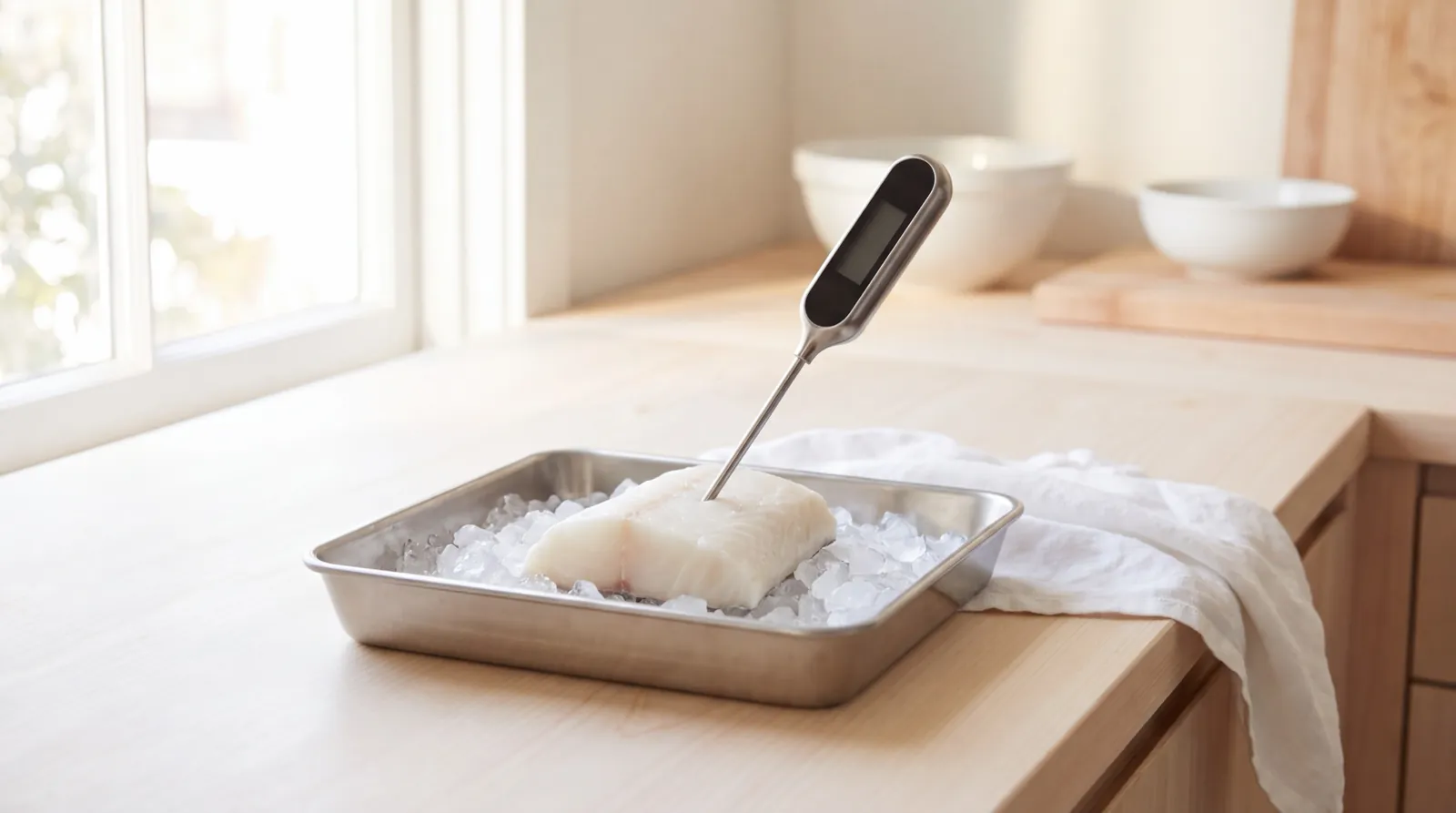
Even if the refrigerator display reads 3°C, the fish inside is not necessarily at 3°C. Refrigerator air temperature is the temperature of the air inside the refrigerator. Food temperature is the temperature of the food itself. A plastic bottle of water that you just put in the refrigerator does not get cold right away. In the same way, the core of a fish you just put in can stay above 10°C for some time. This is because air does not carry heat well, and a fish is a mass of water that is slow to cool. What you must control is food temperature. Measure it with a probe thermometer, a thermometer that you insert into food to measure the temperature inside.
Using the refrigerator
Commercial refrigerators cool by circulating cold air with a fan. If you pack them too full, you block the airflow and create spots that do not get cold. Do not put anything in front of the air vents, and fill the refrigerator to no more than about 70%. Every time you open the door, cold air flows out toward the floor. Decide what you will take before you open the door, and close it right away.
If you put hot food in as it is, the temperature of the whole refrigerator rises, and so does the food temperature of the fish next to it. But leaving food “at room temperature until it cools” means keeping it in the danger zone for a long time. The correct method is rapid cooling. Spread the food thinly in a shallow tray and set it over ice water, for example, so that it cools in a short time. The MHLW's Hygiene Management Manual for Large-Scale Cooking Facilities gives a guideline for cooling cooked food. Bring the core temperature down to about 20°C within 30 minutes, or to about 10°C within 60 minutes.
Why food temperature lags behind
Heat flows from the warmer side to the cooler side. The bigger the temperature difference, the faster it flows. If you take a 4°C saku out into a 25°C kitchen, its food temperature starts rising at that moment. The thinner the slice of neta (topping), the faster it warms, because it has more surface area for its weight. You can assume that the surface of a slice cut for 1 piece will rise above 10°C within a few minutes on a cutting board at room temperature. And the surface is exactly where the bacteria are.
Cooling, on the other hand, lags behind. Air is poor at carrying heat. Fish is a mass of water, so a lot of heat must move in or out before its temperature changes. That is why you cannot know the food temperature just by looking at the refrigerator display.
5.3 Take Out Small Amounts, and Do Not Slice Ahead
Fish starts to warm up the moment you set it on a cutting board at room temperature. That is why the basic rule of prep is to work in small batches. Take out of the refrigerator only what you are about to work on. Return each item as soon as you finish prepping it. If something must stay on the work counter for a long time, put it in a tray stacked on top of a tray of ice, and keep its food temperature at 10°C or below. However, do not let ice touch the flesh directly, and do not let the flesh sit in meltwater. Flesh that absorbs fresh water turns white and watery, and its umami washes out (Chapter 13).
When prep is finished, put things in the refrigerator right away. Someone thinks, “I'll use it again soon,” and leaves it at the edge of the counter for an hour. This is a typical cause of accidents. The same goes for cooked food. Spore-forming bacteria (Chapter 2) survive heating and multiply while the food is cooling down. Never leave simmered anago (conger eel) or tsume (sweet reduced sauce) in the pot at room temperature overnight.
Slicing ahead is the most dangerous practice
During service, the most dangerous thing you can do in the tsukeba (the chef's work area behind the counter) is to slice dozens of pieces' worth of toppings in advance and line them up on the cutting board to prepare for the rush. From the moment they are cut, the toppings are exposed to room air and lighting. They warm up, they dry out, and bacteria start to multiply. You throw away both hygiene and flavor at once. The rule is cut only after the order comes in, one piece at a time. Prepare for busy times by readying your saku in advance and by how you arrange the topping case.
A refrigerated topping case is a refrigerated glass case that sits on the counter. It is not perfect either. Even when it is set to around 5°C, the temperature tends to rise near the glass, near the lights, and on the side that is opened often. Put in only what will be served within a few hours. When service ends, empty it and return everything to the refrigerator.
How bacteria multiply, and what tempering really means
Prepped ingredients are high in moisture and nutrients, and their surfaces are covered with cut faces. Their food temperature is approaching room temperature. For bacteria, conditions could not be better. In the danger zone, bacteria double, and double again, as time passes. Growth that looks slight in the first hour becomes explosive in the second and third hours. In cooked food, spores wake up and start to multiply while the food cools from 60°C to 10°C. If you leave simmered anago or tsume at room temperature overnight, you give toxin-producing bacteria plenty of time.
Toppings that have been sliced ahead lose moisture and umami from their many cut surfaces, and their color changes. In the topping case, keep raw fish separate from cooked items. Do not set items directly on the bottom, and use plastic wrap or bamboo leaves to keep them from drying out.
Tempering (letting cold fish warm slightly) is a technique for slightly warming toppings that are too cold, just before serving (Chapter 23). It does not mean “leaving it at room temperature.” It is the work of bringing the surface up by 1 to 2°C on the cutting board after slicing, over a few tens of seconds, or a few minutes at most. Leaving saku out in the name of tempering is the same as slicing ahead.
5.4 First In, First Out: Older Items in Front, Newer Items in Back
Among the basics of refrigerator use, the one the Japan Sushi Association considers especially important is first in, first out (FIFO). It means using first whatever went in first.
When people open a refrigerator, they take what is in front first. If you put newly delivered fish in front, the older items in back stay there unused. By the time you notice, they are past their date and spoiled. So there is only one way to arrange things: older items in front, newer items in back. In the milk section of a supermarket, the cartons with the oldest dates are lined up in front, and new stock is added from the back. The refrigerator works the same way.
- Move to the front Each time a delivery arrives or you finish prep, first bring forward whatever is left in the back.
- New items go in back Place anything new behind the older items. Never put it in front of them.
- Write the date Write the “item name, date, and person in charge” on every container. Writing on masking tape and sticking it on is enough. Without a date, you cannot tell whether something is new or old.
- Use from the front When you use something, take it from the front. Throw away anything past its date without hesitation.
First in, first out is not just a rule for the fish you buy. Apply it in the same way to prepped toppings and to house-made seasonings. Prepped toppings means items such as cured kohada (gizzard shad), zuke (marinated in soy sauce), and boiled shrimp. House-made seasonings means items such as tsume, nikiri (simmered soy glaze), gari (pickled ginger), and sushi vinegar (awasezu). The idea that “it has vinegar or soy sauce in it, so it won't spoil” is wrong. Tsume is high in sugar and gelatin, so mold and yeast can grow in it. Nikiri has been heated, but bacteria get in from the brush or chopsticks every time it is used. Mold grows on gari too. And without a date, no one can tell how many months old the awasezu is.
Upper shelf and lower shelf
The other rule is about height. Put raw seafood on the lower shelf, and cooked or ready-to-eat food on the upper shelf. The juices that come out of raw fish, called drip, can contain bacteria. And juices fall downward. Use containers with lids, and if there is no lid, cover with plastic wrap. Figure 5-2 shows how to arrange a refrigerator, seen from the side. Simmered anago is on the upper shelf and saku is on the lower shelf. On both shelves, the items with older dates are lined up in front.
Using ice, and what plastic wrap does
When ice melts, it becomes fresh water at 0°C. Vibrio parahaemolyticus is weak against fresh water, so rinsing with fresh water is in itself good for hygiene (Chapter 3). But if flesh soaks in fresh water, the difference in salt concentration drives water into the cells, and the flesh becomes watery and white. So keep a barrier between the ice and the flesh. Use one of these methods. Set a perforated tray on top of the tray of ice so the water drains away. Put the ice in a bag. Or wrap the flesh in plastic wrap before setting it on the ice. A whole fish protected by its skin and scales may be placed directly on ice. Make fresh ice every day.
Plastic wrap does more than prevent drying. It is also a film that stops drip and debris falling from above.
5.5 Use-By Dates and Best-Before Dates
Food labels in Japan show two kinds of dates. The use-by date is the date “until which the food can be eaten safely.” It appears on perishable foods such as boxed lunches, sashimi, sushi, and raw meat. The best-before date is the date “until which the food tastes good.” It appears on foods that keep well, such as seasonings, canned foods, dried foods, and frozen foods. A food does not become inedible the moment this date passes.
Throw away anything past its use-by date without using it. This is true even if it is only 1 day past. “It'll be fine if I cook it” and “It doesn't smell any different” are not acceptable reasons. Some toxins, such as the toxin of Staphylococcus aureus, are not destroyed by heating (Chapter 3). There is also a stage when bacteria have multiplied but the smell has not changed. The best-before date is a guide to quality, so there is no rule that you must throw food away as soon as it passes. Still, keep only as much as you can use up before that date. Both dates apply to unopened food stored as the label directs. Once you open something, write the date you opened it.
For house-made items such as tsume, nikiri, and cured fish, no one will write a date for you. The restaurant must set the date, write it down, and stick to it. Items with strong acid or salt, items that have been heated, and items that can be sealed tightly keep longer. Unheated raw items, such as sliced toppings or zuke, are close to “same day only.” When in doubt, make the period shorter.
The basis for setting shelf lives for house-made items
There are eight factors on which to base a shelf life. They are the storage temperature, whether the item was heated, acidity, salt content, sugar content, moisture, how well the container seals, and how often bacteria can get in from outside each time the item is used. Write the shelf life you decide on in your hygiene management plan, put it on the labels, and follow it.
Table 5-1 gives guidelines for refrigeration at 4°C or below in sealed containers. Awasezu keeps for about 1 month. Gari keeps for 2 to 4 weeks. Nikiri and tsume keep for 1 to 2 weeks. Shime-saba (cured mackerel) keeps from the day it is made until the next day. Cured kohada keeps from the next day until day 3 (Chapter 16). Zuke and sliced toppings are for the same day only. These are general guidelines. A restaurant may shorten them to fit its own conditions, but it should never lengthen them.
| Item | What preserves it | Guideline |
|---|---|---|
| Awasezu | Acid (around pH 3), salt, and sugar | About 1 month |
| Gari | Acid, sugar, and blanching | 2–4 weeks. If mold appears, throw out the whole batch |
| Nikiri | Salt and heating | 1–2 weeks. Wash the brush every day |
| Tsume | Sugar and heating | 1–2 weeks. Longer if you reheat it each time you use it |
| Cured kohada and mackerel | Salt, acid, and drawing out moisture | Shime-saba: same day to next day. Kohada: next day to day 3. 3 days at most |
| Zuke and sliced toppings | Salt only, or nothing | Same day only |
5.6 Deliveries and Cardboard Boxes
Food hygiene starts outside the restaurant's door. Check deliveries on the spot, the moment you receive them. Check four things: temperature, freshness, packaging, and foreign objects.
- Temperature For refrigerated items, measure the food temperature and confirm that it is 10°C or below. As a house standard, 5°C or below is preferable. Frozen items must be at −15°C or below. If drip has frozen solid inside the bag, the item may have thawed once along the way and then refrozen. Do not accept anything that falls outside the standard.
- Freshness Look at the eyes, the gills, the firmness of the body, the firmness of the belly, and the smell (Chapter 11). For saku, look at the color of the cut surface and the amount of drip.
- Packaging Check for tears and leaks, and check whether there is ice.
- Foreign objects Check inside the box and on the surface of the food for insects, debris, and fragments.
Also, never bring cardboard boxes into the kitchen. There are two reasons. The first is insects. The corrugated gaps in cardboard are hiding places for cockroach eggs and adult cockroaches. They are carried from warehouses and trucks into the restaurant, insects and all. The second is dirt. The bottom of a cardboard box has sat on truck beds, market floors, and the ground outside the restaurant. If you lift a box from the floor onto a prep counter, you move bacteria from the floor to the counter. Open cardboard boxes at the delivery entrance, and move the contents into the restaurant's clean containers. Then dispose of the boxes without bringing them into the kitchen.
Do not place food directly on the floor either. Raise it with a slatted rack or shelving. A slatted rack is a low platform that keeps goods off the floor. The U.S. standard requires storage at least 15 cm above the floor. The MHLW's Hygiene Management Manual for Large-Scale Cooking Facilities requires food to be handled at a height of at least 60 cm above the floor.
Delivery routes, and the receiving side's attitude
Floors carry coliform bacteria and other germs from drains, shoe soles, and garbage. Set a fixed delivery route: from outside to the delivery entrance, and then to the refrigerator. Make sure cardboard boxes never cross the areas where food is prepared. When inspection is done, move the food into the restaurant's containers and put it in the refrigerator right away. Measure and record temperatures, and return anything that falls outside the standard. A restaurant that accepts anything will be sent anything.
5.7 Takeout
Once takeout sushi is in the guest's hands, temperature control is out of the restaurant's hands. So do everything you can before you hand it over.
- Keep it at 10°C or below Add ice packs and use an insulated bag. Place the ice packs on top. Cold air sinks, so ice packs on top cool everything inside. Ice packs on the bottom cool only the bottom. Ice packs are tools for keeping cold food cold. Chill the toppings and the containers before packing.
- Write the time and say it Write the time the sushi was made and a note asking the guest to eat it within a set number of hours, and also tell the guest out loud. Whether the law requires a label depends on how the food is sold. Even when it is not required, write it and hand it over.
- Change the time limit by season In the United States, there is a general guideline. The limit is 2 hours for food that cannot be kept refrigerated, or 1 hour if the air temperature is above 32°C. In summer, or when the guest has a long way to go, reduce the raw items. Also decide in advance when you will turn down an order.
Labeling rules, and when to say no
Takeout that is packed into containers on the spot after the order is placed is considered exempt from the labeling requirements of Japan's Food Labeling Standards. Even so, write the information and hand it over. The storage standard for fresh seafood for raw consumption is 10°C or below. So the fish in a takeout box should be protected at the same temperature.
Here are some examples of when to say no. In summer, do not accept takeout that will be more than 2 hours without cooling. On days above 30°C, or when the guest has a long way to go, always use insulated bags, and recommend a selection centered on cooked toppings. In hot countries, set the limit at 1 hour from preparation. For delivery, check the temperature inside the vehicle and the time until arrival, and use cooler boxes. Some restaurants also decide to deliver only by their own means, with their own cooler boxes.
5.8 Records and HACCP
HACCP (Hazard Analysis and Critical Control Point) is the world standard for food hygiene. It is a method in which you identify the hazards that could cause food poisoning at each step of the process, choose the most important steps and control them, and keep records. In Japan, too, since June 2021, in principle all food business operators have been required to practice hygiene management based on HACCP principles. Small independent sushi restaurants are no exception.
That said, small restaurants are not required to write thick plan documents. They follow guidance manuals made by industry associations, under the approach called “hygiene management incorporating the HACCP approach.” There are three things to do: make a plan, carry it out, and keep records. In a sushi restaurant, records worth keeping include the following.
- Temperatures of refrigerators, freezers, and topping cases (at set times, such as before opening and after closing)
- The food temperature at delivery, and the results of inspection
- The time the shari was cooked, the time the vinegar was mixed in, and the time it was discarded (Chapter 9)
- Prep dates and shelf lives of prepped items and house-made seasonings, and staff health and handwashing
Records serve two purposes. One is evidence. If an accident or a suspected case occurs, records help you find the cause. They can also show that the restaurant was managing hygiene properly. The other purpose is noticing changes. When you write down temperatures every day, you notice changes such as “the temperature after closing is 1°C higher than usual.” You can find a refrigerator breakdown before it causes an accident. Every chef's skills are different, but hygiene can be decided and written down so that everyone can do it the same way.
How the system developed, and standardization
Hygiene management based on HACCP principles became a legal requirement through the June 2018 amendment of the Food Sanitation Act. The amendment took effect in June 2020. After a 1-year grace period, it was fully enforced in June 2021. The guidance manuals used by small restaurants were made by industry associations and confirmed by the MHLW.
The plan has two parts. One is prerequisite hygiene programs: handwashing, cleaning, disinfection, health management, and pest control. The other is control of critical control points (CCPs), which in a sushi restaurant means controlling temperature and time. This critical control is exactly what this chapter is about. Records should also include the core temperature of foods you cook and the time it took to cool them.
Do not rely on one person's attentiveness for hygiene. You need standardization: deciding temperatures, times, and the order of work, and writing them down. Standardization means putting procedures and standards in writing so that everyone does things the same way. A chef's skill cannot be standardized, but hygiene can. And it must be.
If you open a restaurant outside Japan, health inspectors will visit without notice. What inspectors look at is not the chef's career but the records. Are the temperature records filled in up to today? Do the containers have dates? Are there records of the pH of the vinegared rice (Chapter 6)? Outside Japan, inspectors judge that “if it isn't written down, it wasn't done.” Do not make excuses to the inspector. Open your records and show them.
Chapter summary
- By law, seafood for raw consumption must be kept at 10°C or below (frozen products at −15°C or below). The ideal for raw fish is 0 to 4°C. The temperature danger zone is 10 to 60°C. What you control is food temperature, not refrigerator air temperature.
- Cool hot food rapidly before putting it in the refrigerator. Prep in small batches, and return items right away when you finish. Do not slice ahead in the tsukeba.
- First in, first out: older items in front, newer items in back. Write the item name, date, and person in charge on every container, and apply the same rule to prepped items and house-made seasonings. Raw seafood goes on the lower shelf, cooked food on the upper shelf.
- The use-by date is a safety limit, and food past it must be thrown away. The best-before date is a guide to flavor. Both dates apply to unopened food, so write the opening date once you open something.
- At delivery, check temperature, freshness, packaging, and foreign objects. Do not bring cardboard boxes into the kitchen, and do not put food on the floor.
- For takeout, place ice packs on top to keep the food at 10°C or below, and tell the guest the time it was made and how many hours it should be eaten within. Record temperatures and other data, and manage hygiene using the HACCP approach.
- Tempering is work of seconds to minutes that brings the surface up by 1 to 2°C. It is not leaving food at room temperature. Each restaurant sets the shelf lives of its house-made items on a sound basis, and standardizes and records its hygiene practices (Grade 1).
Review questions
Q1 Which is the correct way to arrange the refrigerator when you put in new saku?
a Put the new saku in front, and push the older ones to the back
b First bring the remaining older items to the front, then put the new saku in back. Write the item name, date, and person in charge on the container
c You can tell which is older by looking, so there is no need to write dates
d House-made seasonings made with vinegar or soy sauce do not spoil, so store them in back without dates
e Put the most frequently used items in front, and do not worry about which is newer or older
Answer: b
People take things from the front first, so put older items in front and newer items in back (first in, first out). In a, the direction is reversed, so the older items in back stay there indefinitely. In c, without dates you cannot tell new from old. In d, mold and bacteria can grow even in tsume and nikiri, so date them and manage them under the same rule. In e, older items stay in the refrigerator indefinitely.
Q2 The refrigerator display reads 3°C, but when you insert a probe thermometer into a saku that you just put in, it reads 9°C. Which is the most appropriate way to think about this?
a It is within the legal limit of 10°C or below, so there is no problem
b The display shows the air temperature inside, and the food temperature follows behind it. Manage by food temperature, and review how items are arranged and how the door is opened and closed
c Fish gives off heat from inside, so it will never drop below 9°C
d The probe thermometer is broken, so trust the refrigerator display
e A refrigerator cools better when it is packed full, so fill it with other ingredients
Answer: b
Refrigerator air temperature is the temperature of the air, and food temperature is the temperature of the food itself. The two are not the same. What you must protect is food temperature. Choice a mistakes the legal minimum of 10°C for the restaurant's target. The ideal for raw fish is 0 to 4°C. Choices c and d are wrong. In e, the airflow is blocked, and some spots do not get cold.
Q3 Which statement about “tempering” toppings is the most appropriate?
a Taking saku out to room temperature before service and letting it warm up slowly
b Bringing the surface up by 1 to 2°C on the cutting board after slicing, over a few tens of seconds or a few minutes at most
c Raising the topping case setting to 15°C
d Cutting dozens of pieces in advance, lining them up, and letting them adjust to room temperature
e Soaking saku in lukewarm water to warm it to the core
Answer: b
Tempering is work of seconds to minutes. Just before serving, you slightly warm the surface of toppings that are too cold. Leaving toppings at room temperature in the name of tempering, as in a and d, is the same as slicing ahead. It lets bacteria multiply in the danger zone. In c, the topping case would be inside the danger zone. In e, the flesh absorbs fresh water and becomes watery, and it also stays in the danger zone for a long time.