
Part I Food Safety
Chapter 3
Food Poisoning in Sushi Restaurants
This chapter applies what you learned in Chapter 2 to the hazards that actually harm people in sushi restaurants. For each one, you will learn where it comes from and how to prevent it, with the numbers and the reasons.
In this chapter you will learn
- To explain the steps that prevent Anisakis, and why vinegar and salt do not kill it
- To explain where norovirus and Vibrio parahaemolyticus come from, and what they are weak against
- To explain how to prevent toxins that cooking does not remove, and histamine
- To name the 9 specified allergenic ingredients, and to serve guests with allergies safely
- To explain other bacteria, natural toxins, and the first response when food poisoning is suspected (Grade 1)
3.1 The Main Culprits and How to Tell Them Apart
Three causes stand out among the food poisoning cases in sushi restaurants: Anisakis, norovirus, and Vibrio parahaemolyticus. The Association calls them the Big 3 of sushi-restaurant food poisoning. One is a parasite, one is a virus, and one is a bacterium. Because they are different kinds, different measures work against them. In this chapter, we add Staphylococcus aureus, histamine, and food allergies, and study six causes in all.
The time from eating to the first symptoms is called the incubation period. It is a clue to the cause. The six causes are summed up in a table. Three of them cannot be prevented by cooking: the toxin of Staphylococcus aureus, histamine, and food allergies.
| Cause | Type | Incubation period | Prevented by cooking? |
|---|---|---|---|
| Anisakis | Parasite | A few hours (usually within 12 hours) | Yes (70°C or higher, or 60°C for 1 minute) |
| Norovirus | Virus | 24–48 hours | Yes (core 85–90°C for 90 seconds or more) |
| Vibrio parahaemolyticus | Bacterium | 8–24 hours | Yes (core 75°C for 1 minute or more) |
| Staphylococcus aureus | Bacterium (makes a toxin) | 1–6 hours | No (the toxin survives even 100°C for 30 minutes) |
| Histamine | Substance made by bacteria | A few minutes to 1 hour | No (neither cooking nor freezing destroys it) |
| Food allergy | The body's reaction | Usually soon after eating | No |
The three types of food poisoning and their incubation periods
Food poisoning is harm to health caused by food or drink that contains harmful microorganisms, parasites, toxins, or chemicals. There are three types. In the infection type, a living organism enters the body. In the toxin type, you eat a toxin that has already formed in the food (Chapter 2). The third group is counted separately in the statistics: natural toxins (pufferfish toxin and shellfish toxins) and chemicals (histamine and mercury). In the toxin type, people get sick even if the bacteria are killed, as long as the toxin remains. Incubation periods are tens of minutes to a few hours when the toxin itself is eaten. They are half a day to a few days for infection-type bacteria, 2 to 8 days for Campylobacter and O157, and several weeks for Listeria.
3.2 Anisakis: Vinegar and Salt Do Not Kill It
Anisakis is a parasite in the group called nematodes, or roundworms. The problem is the larva. It is about 2 to 3 cm long and 0.5 to 1 mm wide, and it looks like a white, translucent thread. It lies coiled in a spiral on the surface of a fish's internal organs or in the belly meat.
The adults live in the stomachs of whales and dolphins. Their eggs leave the body with the feces and enter the sea. The larvae are eaten by krill. They then collect in the bellies of fish and squid that eat the krill. When a whale eats those fish, the larvae become adults. Humans are outside this cycle. We are only accidental hosts. Inside the human body the larvae cannot become adults, and they die within a few weeks. Before that, however, they push their heads into the wall of the stomach or intestine and cause severe pain.
Anisakis is common in mackerel, Pacific saury, sardines, horse mackerel, skipjack tuna, salmon, and Japanese flying squid. These are migratory fish that eat krill, and the fish that eat them. Farmed fish raised on formulated feed almost never carry it. They do not eat live krill or wild small fish, so they are outside the cycle. However, larvae have been found in farmed fish raised from juveniles caught at sea, or raised on raw feed.
Symptoms usually start within 12 hours of eating. They are severe pain in the pit of the stomach, nausea, and vomiting. Fever and diarrhea are not prominent. This "intense pain that does not seem like food poisoning" is typical. In recent years, Anisakis has been one of the most common causes of food poisoning incidents (Chapter 1).
How to prevent it
- Keep them out Choose fresh fish, and gut whole fish right away. Most larvae are in the internal organs. As time passes after the fish dies, more of them move into the flesh. Do not serve the organs raw. Some larvae are in the flesh from the start, so the risk never drops to zero.
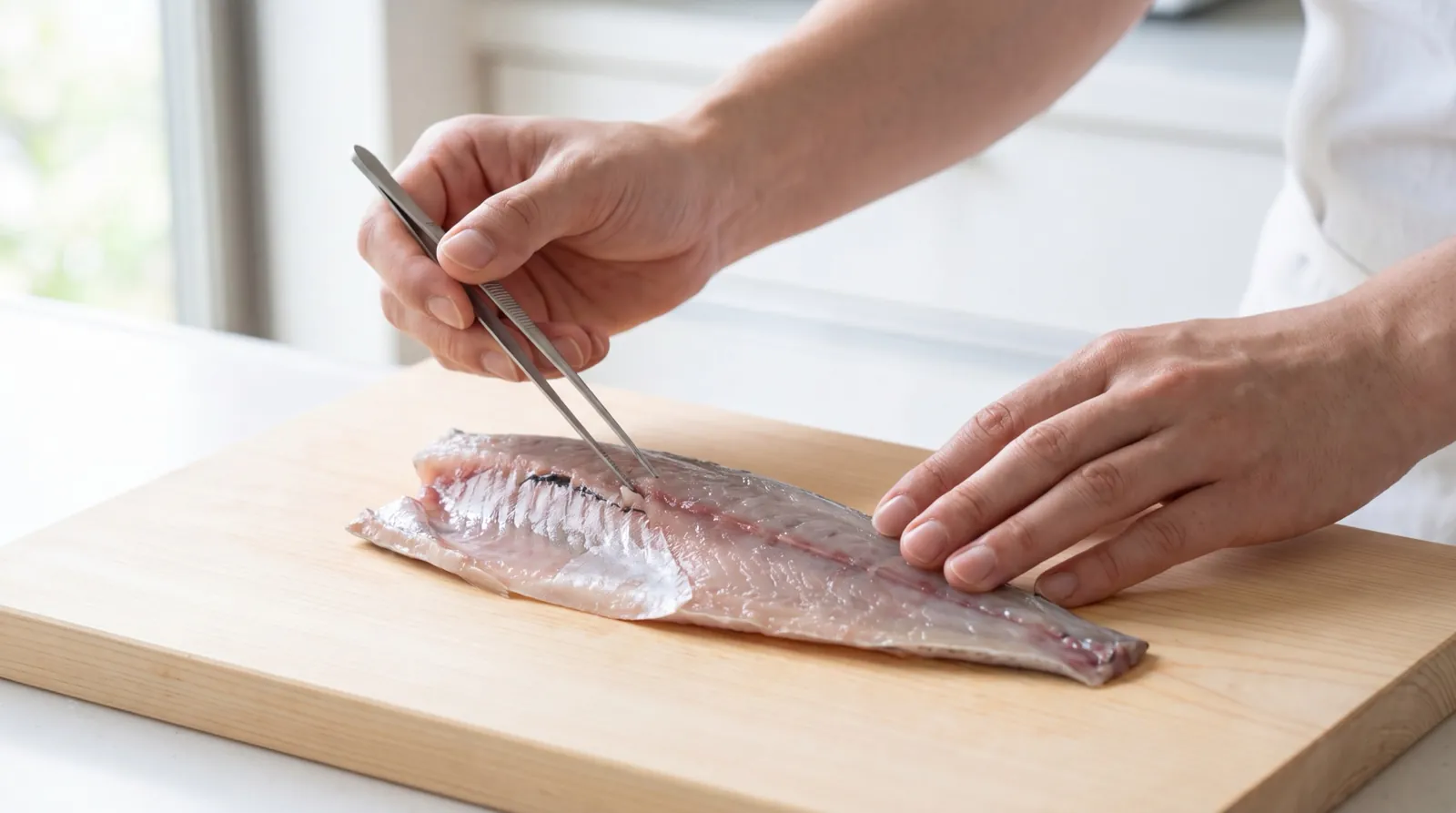
- Find and remove them Look closely at both sides of the fillet, especially the belly side, and pull larvae out with bone tweezers. In a dark place, shine a black light (UV light) on the fish, and the larvae glow bluish white. However, you can see only down to about 0.5 mm below the surface. Finding none does not prove that there are none.
- Kill them If you serve fish raw, freeze it at −20°C for 24 hours or more. This is a recommendation from Japan's Ministry of Health, Labour and Welfare (MHLW), not a legal requirement. To be sure, start counting when the center of the fish reaches −20°C. Many home freezers run at around −18°C and may not reach −20°C. If you cook the fish, heat it to 70°C or higher, or 60°C for 1 minute (freezing procedures are covered in Chapter 12).
Vinegar, salt, wasabi, and soy sauce do not kill them. The larvae normally live in the stomachs of whales, and they can withstand strong stomach acid. That is why people get anisakiasis from shime-saba (vinegar-cured mackerel) every year. Chewing well and cutting the fish thin do not count as measures either. Even 1 undamaged larva is enough to make a person sick.
Two forms of anisakiasis, and differences by region of origin
Most cases are gastric anisakiasis. The pain is thought to come not only from the larva piercing the wall, but also from an allergic reaction to the larva. Once the larva is removed with an endoscope, the pain stops almost at once. Intestinal anisakiasis begins with pain in the lower abdomen, from a dozen or so hours to a few days after eating. It can progress to bowel obstruction.
Larvae are also found in cod, Japanese amberjack (buri, yellowtail), and olive flounder (hirame). In Japan, the type common in mackerel on the Pacific side is reported to move into the flesh more easily than the type common on the Sea of Japan side. A black light uses ultraviolet light with a wavelength of about 365 nm. It does not reach deep into the flesh. Live larvae also glow more faintly than larvae that have been frozen.
The larvae have a thick outer skin and live in stomach acid at pH 1 to 2. Vinegar at about pH 3, or 3% salt water close to seawater, cannot possibly kill them. Also, a guest who says "I get hives from blue-backed fish" may be allergic to Anisakis rather than to mackerel. Such a guest should avoid mackerel, squid, Pacific saury, and similar fish.
Freezing standards outside Japan
In Europe, Spanish anchovies pickled in vinegar are a typical source. Freezing standards differ by country. In the EU, freezing is a legal requirement, for example −20°C or below in all parts of the product for 24 hours or more. The U.S. standard of "−20°C for 7 days" is longer because it measures the freezer temperature and includes the time the fish takes to freeze.
| Country or region | Freezing conditions | Notes |
|---|---|---|
| Japan (MHLW) | −20°C for 24 hours or more (a recommendation, not a legal requirement) | If cooking, 60°C for 1 minute or more, or 70°C or higher |
| EU (Regulation 853/2004) | −20°C or below in all parts of the product for 24 hours or more, or −35°C or below for 15 hours or more | Exception for farmed fish raised on parasite-free feed |
| United States (FDA Food Code) | −20°C or below in the freezer for a total of 7 days, or frozen at −35°C or below and then held at −35°C for 15 hours or at −20°C or below for 24 hours | Does not apply to some large tuna species, farmed fish raised on formulated feed, or bivalves |
Farmed salmon from Norway or Chile can be served raw because it is raised on formulated feed and stays outside the cycle. Outside Japan, "we serve it raw in Japan" is no excuse. Follow the rules of that country, and record the freezing temperature, the times, and the type of fish.
3.3 Norovirus: From Human Hands and Bivalves
Norovirus is a virus that multiplies only in the human intestine. One way in is through bivalves. Oysters and Manila clams (asari) filter large amounts of seawater to feed, so viruses washed into the sea build up inside them. The shellfish do not get sick, and they look and smell normal. The other way in is through people. The virus passes from the stool or vomit of an infected person, through the hands, to food. In Japan, norovirus causes more food poisoning patients than any other cause, and most of these cases pass through the hands of the people who prepare food. If a chef is infected, sushi finished by hand can make dozens of people sick at once.
A very small amount, about 10 to 100 virus particles, is thought to be enough to infect a person. Some infected people have no symptoms. Even after recovery, the virus keeps coming out in the stool for a week, or for as long as a month. It is resistant to freezing, and alcohol does not work well against it. Between 24 and 48 hours after eating, sudden violent vomiting, diarrhea, abdominal pain, and a mild fever appear. Most cases settle in 1 to 2 days.
How to prevent it
- Manage people Every morning, check staff for vomiting, diarrhea, and fever. Anyone with symptoms does not prepare food. Ask staff to report illness in their families too. A person diagnosed with norovirus must not touch food directly, even after recovery, until a stool test confirms that the virus is gone.
- Wash it away Handwashing with soap and running water does not kill the virus; it washes it away. Do not rely on alcohol. Use double handwashing (Chapter 4).
- Destroy it with heat and chlorine If you cook bivalves before serving, heat them to a core temperature of 85 to 90°C for 90 seconds or more. For utensils and work surfaces, use sodium hypochlorite (the main ingredient of chlorine bleach). Dilute it to 200 ppm for utensils and to 1,000 ppm for vomit (Chapter 4).
The label "for raw consumption" on oysters means they were harvested in designated clean sea areas, or purified in sterilized seawater or a similar way, and that they meet bacterial standards. These are standards for bacteria. They are not a guarantee that there is no norovirus. Never serve oysters labeled "for cooking" raw (Chapter 18).
The nature of norovirus, and finer points of control in the restaurant
Norovirus is 30 to 40 nm across. A patient's stool often holds more than 100 million particles in 1 g, so invisible traces left on hands can make guests sick. Alcohol does not work well because the virus has no fatty envelope for alcohol to destroy. People can also be infected when dried vomit turns to dust and floats in the air. Norovirus is most common in winter, but it occurs all year.
An oyster filters 10 to 20 liters or more of seawater in 1 hour, and the virus collects in its digestive gland (midgut gland). Heat disinfection means 85°C or higher for 1 minute or more. Chlorine at 200 ppm is 0.02%, and 1,000 ppm is 0.1%. Stool tests are done at least once a month, and in the winter months, from October to March, a norovirus test is added. Oysters labeled "for cooking" often come from near river mouths. They are large and rich in flavor. But serving them raw "because they taste better" is the least excusable kind of accident.
Outside Japan, keep the shellfish harvest certificates (harvest tags), buy only from approved suppliers, and do not serve shellfish raw if it comes from coasts with poor sewage treatment. The U.S. Food Code requires that employees with vomiting or diarrhea be kept out of the kitchen.
3.4 Vibrio parahaemolyticus: A Sea Bacterium Weak Against Fresh Water and Cold
Vibrio parahaemolyticus lives in seawater. It is one of the halophilic bacteria, which cannot survive without salt. From early summer to fall, it multiplies along coasts and gets on the surface, gills, and internal organs of fish and shellfish. What makes it dangerous is its speed. Under good conditions, it doubles in about 10 minutes. It also often causes secondary contamination, spreading from utensils or hands to other foods. Between 8 and 24 hours after eating, severe abdominal pain and watery diarrhea begin.
It has three weak points. It is weak against fresh water. It is weak against heat (it dies at a core temperature of 75°C for 1 minute or more). It does not multiply at low temperatures (at 10°C or below its growth slows greatly, and at 4°C or below it almost stops; but chilling does not remove the bacteria).
- Wash in fresh water After removing the scales, gills, and organs, wash the surface and the belly cavity under running drinkable water. Halophilic bacteria die in fresh water, and the flow also washes them off. Wash only up to the point of filleting (Chapter 13 explains why).
- Chill right away Put washed fish back in the refrigerator at once. Bring out onto the cutting board only what you are about to use (Chapter 5).
- Separate utensils Do not take the cutting board, knife, or cleaning cloth used for scaling and gutting (mizu-arai) and use it as it is for cutting saku blocks or for vegetables (Chapter 4).
In Japan, cases were frequent in the 1990s. In 2001, standards were set, such as storing seafood for raw consumption at 10°C or below, and cases then dropped sharply. The bacterium did not disappear. Measures aimed at its weak points were simply carried out thoroughly.
Numbers for Vibrio parahaemolyticus, and precautions outside Japan
Vibrio parahaemolyticus grows best at about 3% salt and 30 to 37°C. It multiplies when the sea temperature rises above 15 to 20°C. It is said to multiply faster than any other food poisoning bacterium. Fish left for 3 hours in a summer kitchen can carry enough bacteria to make people sick (Chapter 2). It dies at 60°C in 10 minutes. It is also weak against acid and hardly grows at the pH of vinegared rice.
The incubation period is usually around 12 hours. People recover in 2 to 3 days, but older people can become seriously ill from dehydration. In 1998, it was the leading cause of food poisoning, with more than 12,000 patients. The 2001 standards set storage at 10°C or below, washing with water fit for drinking, and limits on bacterial counts. The ideal refrigeration temperature is 4°C or below. Put fish back in the refrigerator at each break in the work. There have been cases from cucumbers cut on the same cutting board as fish, and from plates wiped with the same cloth. With salt carried over from the fish, the bacteria can multiply even on vegetables.
In markets in hot countries, check fish with a noncontact thermometer. If the surface is above 10°C, do not use the fish raw. A relative of this bacterium, Vibrio vulnificus, infects people through raw oysters, or through wounds exposed to seawater. In people with liver disease or diabetes, the death rate is high. In the United States, raw oysters in summer come with a warning notice.
3.5 Toxins That Cooking Does Not Remove: Staphylococcus aureus and Histamine
"Cooking makes it safe" does not apply to these two. The only way to prevent them is to keep them from forming.
Staphylococcus aureus: from the chef's hands
About 3 in 10 healthy people carry Staphylococcus aureus in their noses. It is also common on skin and hair and in infected wounds. It passes to food from cuts and hangnails on the hands, and from fingers that have rubbed the nose. As it multiplies, it makes a toxin called enterotoxin. This toxin is not destroyed even by heating at 100°C for 30 minutes. The bacterium can multiply even at about 15% salt, so it grows in salty rice balls and sushi too. A typical cause is nigiri or boxed meals that were made and then left at room temperature for hours. Between 1 and 6 hours after eating, severe nausea and vomiting begin.
Prevention has two pillars. First, keep the bacteria off food with handwashing and wound care. If you have a cut on your hand, cover it with a waterproof bandage and wear a glove. Otherwise, do not touch neta (topping) or shari (sushi rice) directly until it heals. If you touch your nose, hair, or face, wash your hands again. Second, keep food at 10°C or below so the bacteria do not multiply. The toxin is made as the bacteria multiply, and below 10°C it is hard for them to make it. But once the toxin has formed, chilling does not remove it.
Histamine: temperature control for red-fleshed and blue-backed fish
Histamine forms when bacteria act on histidine, a substance abundant in the flesh of red-fleshed and blue-backed fish. It occurs in tuna, skipjack tuna, mackerel, sardines, Pacific saury, Japanese amberjack, and similar fish, and hardly ever in white-fleshed fish. It forms rapidly when the fish rises above 10°C, and slowly even in the refrigerator, so it also builds up in red-fleshed fish kept for a long time. Once formed, it is not destroyed by cooking or freezing. It may be present even when the fish does not smell spoiled.
Within a few minutes to 1 hour after eating, symptoms appear: a flushed face, hives, headache, and a pounding heart. The tongue and lips may also tingle. It looks like an allergy. The difference is that several people who ate the same fish get sick at the same time. Prevention comes down to controlling temperature and time. Buy fish that was kept cold in transport. Thaw it in the refrigerator or in ice water (Chapter 12). Do not leave thawed tuna saku sitting out.
Detailed numbers for the toxin and histamine
In a 2000 incident involving a dairy product in Japan, toxin that formed at the raw-material stage survived heat sterilization, and more than 10,000 people became ill. The average incubation period for Staphylococcus aureus is 3 hours, and most people recover within 24 hours.
Histamine poisoning also occurs with mahi-mahi. The bacteria that make histamine live on the surface and gills of fish. Accidents also occur with canned fish and dried fish. The U.S. FDA uses 50 mg per 1 kg of fish as its regulatory guideline, and the EU sets an upper limit of 100 to 200 mg. Once histamine has formed, washing, curing in vinegar, or simmering does not reduce it.
3.6 Other Bacteria You Should Know
Salmonella
Salmonella comes from chicken eggs, chicken meat, and other meat. The incubation period is 6 to 72 hours, with fever, abdominal pain, and diarrhea. In a sushi restaurant, the eggs for tamagoyaki (Japanese omelet) are the way in. Do not use cracked eggs. Do not make egg mixture in advance. Cook tamagoyaki to a core temperature of 70°C for 1 minute or more (the general guideline is 75°C for 1 minute or more). Do not move on to the next task with the hands that cracked the eggs. Outside Japan, assume that eggshells carry Salmonella. Japanese habits with raw eggs do not apply.
Campylobacter
Campylobacter is found on a high share of chicken meat, and a few hundred bacteria are enough to infect. The incubation period is long, 2 to 5 days. It causes diarrhea, abdominal pain, and fever. In rare cases, it leaves paralysis of the arms and legs (Guillain-Barré syndrome). To prevent secondary contamination from utensils and hands that handled chicken, set aside utensils and an area only for chicken.
Enterohemorrhagic E. coli O157
This is a member of the E. coli family that lives in the intestines of cattle. It produces Shiga toxin (verotoxin), and as few as about 100 bacteria can infect. The incubation period is 3 to 8 days, with severe abdominal pain and bloody stools. In children and older people, it can progress to hemolytic uremic syndrome (HUS), which damages the kidneys, and some die. It is resistant to acid, and outbreaks have come from lightly pickled vegetables, so "it's vinegared rice" is no defense. Heating at 75°C for 1 minute kills it. The keys are keeping beef separate, washing vegetables, and keeping infected people from bringing it in.
Listeria
Listeria (Listeria monocytogenes) is widespread in soil and water. It is one of the few food poisoning bacteria that keep multiplying even at refrigerator temperatures of 0 to 4°C. It multiplies even at 10% salt. Sources include smoked salmon, prosciutto, natural cheese, and ready-to-eat foods kept refrigerated for a long time. In pregnant women it causes miscarriage and stillbirth. In older people it causes meningitis and sepsis. In severe cases, the death rate is high. The incubation period is several days to several weeks, and up to 70 days. The days spent aging (jukusei) fish in the refrigerator (Chapter 10) are also days for Listeria to grow. Prevent it with clean utensils, careful date control, and extra care for pregnant guests.
Clostridium perfringens
This bacterium dislikes oxygen and forms heat-resistant spores. When a big pot of simmered food cools slowly at room temperature, the spores wake up. At the oxygen-poor bottom of the pot, the bacteria then multiply explosively, mainly at 43 to 47°C. The incubation period is 6 to 18 hours, with diarrhea and abdominal pain. The greatest danger is the habit of leaving pots at room temperature until the next day. This includes anago (conger eel) simmering liquid, simmered kanpyo (dried gourd strips) and shiitake, dashi (soup stock), and pots of tsume (sweet reduced sauce). Divide food into small portions and cool it quickly (Chapter 5). When you reheat, stir well and bring it to a boil all the way to the center. Spores survive even 100°C, so "we heat it every day" is no guarantee.
Bacillus cereus
This bacterium is found as spores on rice and grains. When cooked rice is left at room temperature, it multiplies and makes a vomiting toxin that is extremely heat-resistant. The incubation period is 30 minutes to 6 hours, with violent vomiting. The dangers are cooking rice ahead and leaving it out, keeping it warm at a low temperature in a rice warmer, and carrying rice over to the next day. Vinegared rice has a low pH, so the bacteria grow poorly in it. But plain rice before the vinegar is mixed in is not safe (Chapters 6 and 9).
3.7 Natural Toxins and Chemicals
Pufferfish toxin (tetrodotoxin)
Tetrodotoxin is a poison that blocks nerve signals. It is concentrated in the liver, ovaries, skin, and intestines of pufferfish (fugu). The amount varies by species, by individual fish, and by season. Heat does not destroy it, and there is no antidote. Within 20 minutes to 3 hours after eating, the lips and tongue go numb. Paralysis spreads to the arms and legs, and then the breathing muscles are paralyzed, leading to death. The lethal dose is estimated at about 1 to 2 mg. In Japan, only people with a license approved by the prefecture may process pufferfish. Serving a pufferfish someone caught, or giving in to a guest who asks for the liver, is an act that costs a chef the right to work as a chef.
Ciguatera
Ciguatera occurs when a toxin made by tiny algae-like organisms on tropical and subtropical coral reefs builds up in large predatory fish. The fish involved include the two-spot red snapper, the yellow-edged lyretail, the great barracuda, moray eels, and large groupers. The toxin is not destroyed by heat. Within 1 to 8 hours after eating, diarrhea and vomiting occur. A temperature-sensation reversal, in which touching something cold feels like an electric shock, can last for weeks to months. Whether a fish is toxic differs from one fish to the next, and you cannot tell by looking. In Japan, a national notice bans eating the great barracuda, and the prefectures advise people not to eat other toxic fish. In the Caribbean, the Pacific islands, and the Indian Ocean, treat ciguatera as seriously as Anisakis is treated in Japan. Do not use fish that local fishers "don't eat."
Shellfish toxins
These are toxins that bivalves accumulate from toxic plankton. Paralytic shellfish toxin (PSP) makes the mouth go numb about 30 minutes after eating, and in severe cases it paralyzes breathing. Diarrhetic shellfish toxin (DSP) causes diarrhea and vomiting, and people recover in a few days. Neither toxin is destroyed by heat. They are most common from spring to early summer, in scallops, blue mussels, oysters, and Manila clams. Shellfish sold through normal channels are protected by testing and shipping restrictions in the producing areas. But shellfish gathered at the beach or by individuals fall outside that safety net. Even if a guest asks, "Please make nigiri with the clams I gathered," say no.
Mercury
Methylmercury builds up in large predatory fish through the food chain. It affects the development of the nervous system of unborn babies. Japan's MHLW advises pregnant women to limit Pacific bluefin tuna, bigeye tuna, swordfish, and splendid alfonsino (kinmedai) to about once a week, at 80 g per serving. This amount is not a problem for healthy adults. Still, take care not to keep serving toro (fatty tuna) or large fish to pregnant guests.
3.8 Food Allergies: A Tiny Amount Can Be Life-Threatening
A food allergy happens when the body's defense system (the immune system) overreacts to the proteins in a particular food. A severe reaction is called anaphylaxis. Soon after eating, hives, swelling of the lips and throat, difficulty breathing, and a drop in blood pressure progress rapidly. If treatment is late, the person can die. Even shrimp juice left on a cutting board, a shared knife, or shared frying oil can cause a reaction.
Under Japan's Food Labeling Act, the specified allergenic ingredients that must be labeled are 9 items: shrimp, crab, walnuts, wheat, buckwheat, eggs, milk, peanuts, and cashew nuts. Walnuts were added in 2023, and cashew nuts in April 2026. The items recommended for labeling also include many sushi toppings, such as squid, ikura (salmon roe), salmon, mackerel, and abalone. The labeling requirement applies to packaged foods, not to restaurant dishes. Even so, it is unacceptable not to be able to answer correctly when a guest asks.
Sushi restaurants have hidden allergens (substances that cause allergies) that are easy to miss. Soy sauce and nikiri (simmered soy glaze) contain wheat. Imitation crab sticks (kanikama) contain egg white, wheat, and crab extract. Some restaurants mix shrimp or white fish paste into tamagoyaki. Keep a list of what goes into every item. People with an Anisakis allergy react even if the larvae have been killed by freezing or cooking. Freezing keeps the larvae from piercing the stomach, but it does not prevent the allergy.
- Ask Always ask when the guest makes a reservation and again when the guest sits down. Confirm the items and how severe the allergy is. Ask whether the guest has had anaphylaxis and whether they carry a self-injectable medicine (Chapter 26).
- Use dedicated, clean utensils Do not use shared cutting boards or knives, even if they have been washed. Bring out utensils and plates that have been washed and sanitized just for this order. Wash your hands again and finish the order without doing any other task in between.
- Keep seasonings and liquids separate Do not use shared soy sauce dishes, the nikiri brush, shared frying oil, or shared cooking water.
- Tell the guest When you serve, confirm out loud with the guest what you have done. If you cannot meet the request, say so clearly. "It's probably fine" is the most dangerous answer.
Detailed labeling rules and hidden allergens
For cashew nuts, there is a transition period until the end of March 2028. The items recommended for labeling also include soybeans, sesame, and gelatin, and the EU's 14 items also include soybeans and sesame. Watch out for tempura batter, rolls sprinkled with sesame, and dishes set with gelatin. Most reactions begin a few minutes to 30 minutes after eating, and even a few milligrams of liquid can trigger one. If possible, prepare allergy orders before other orders.
3.9 First Response When Food Poisoning Is Suspected
If a guest contacts you about feeling ill, do not deny it, and do not make a careless apology. Record when and what they ate, when the symptoms began and what they are, how the others at the table are, and whether they have seen a doctor. Estimate the cause from the incubation period. Keep that day's records of purchasing, preparation, and staff health, and keep any food samples set aside for testing. If several guests have symptoms, consult the public health center (hokenjo) before you continue serving. Reporting is mandatory. The more you hide, the greater the harm and the penalty. You will learn about disinfecting the restaurant in Chapter 4 and about dealing with guests in Chapter 26.
Chapter summary
- The Big 3 of sushi-restaurant food poisoning are Anisakis (a parasite), norovirus (a virus), and Vibrio parahaemolyticus (a bacterium). Because they are different kinds, different measures work against them.
- For Anisakis, gut fish early, search with your eyes and a black light, and if serving raw, freeze at −20°C for 24 hours or more (to be sure, count from when the core reaches that temperature). If cooking, use 70°C or higher, or 60°C for 1 minute. Vinegar, salt, wasabi, and soy sauce do not kill it.
- Norovirus comes from human hands and bivalves. Prevent it with health checks, handwashing, cooking to a core temperature of 85 to 90°C for 90 seconds or more, and sodium hypochlorite. "For raw consumption" is not a guarantee that there is no norovirus. Vibrio parahaemolyticus doubles in about 10 minutes and is weak against fresh water, heat, and cold.
- The toxin of Staphylococcus aureus and histamine are not destroyed by cooking. Keep the toxin from forming with handwashing, wound care, and holding food at 10°C or below. Keep histamine from forming by controlling temperature and time.
- There are 9 specified allergenic ingredients (shrimp, crab, walnuts, wheat, buckwheat, eggs, milk, peanuts, and cashew nuts). Ask, use dedicated utensils, and confirm out loud. If symptoms appear, call an ambulance immediately.
- Listeria multiplies even in the refrigerator, O157 is resistant to acid, and the spores of Clostridium perfringens and Bacillus cereus survive 100°C (Grade 1).
- Pufferfish toxin, ciguatera, and shellfish toxins are not destroyed by heat. If food poisoning is suspected, keep records, preserve the evidence, and consult the public health center (Grade 1).
Review questions
Q1 Which statement about Anisakis is correct?
a If you cure mackerel firmly in vinegar, as for shime-saba, the larvae die
b As time passes after a fish dies, larvae can move from the organs into the flesh, so whole fish should be gutted early
c A black light lets you find every larva, even those deep in the flesh
d Leaving fish overnight in a home freezer is sure to kill them
e Farmed fish raised on formulated feed carry more of them than wild fish
Answer: b
In a living fish, most larvae are in the internal organs. As time passes after death, more of them move into the flesh, so gutting early is a form of prevention. a is wrong: vinegar, salt, wasabi, and soy sauce do not kill them. c is wrong: the larvae that glow and can be seen are only those within about 0.5 mm of the surface. d is wrong: the standard is −20°C for 24 hours or more, and home freezers may not reach −20°C. e is the opposite: farmed fish raised on formulated feed almost never carry them.
Q2 Which is the most appropriate way to prevent food poisoning from Staphylococcus aureus?
a Heat destroys the toxin, so if you are worried, lightly sear the neta before shaping the nigiri
b The two pillars are keeping the bacteria off food with handwashing and wound care, and keeping food at 10°C or below so they do not multiply
c The acid in vinegared rice breaks down the toxin, so hands that touch shari do not need washing
d Freezing makes the toxin disappear, so freeze anything made in advance
e Even with a cut on your hand, you may touch neta with bare hands if you sanitize with alcohol
Answer: b
The toxin of Staphylococcus aureus is not destroyed by heat, so you prevent it by keeping the bacteria off food and not letting them multiply. a is wrong: the toxin is not destroyed even by heating at 100°C for 30 minutes. c is wrong: vinegar does not break down the toxin. d is wrong: once the toxin has formed, chilling does not remove it. e is wrong: a wound is a home for the bacteria. Cover it with a waterproof bandage and wear a glove, or do not touch neta or shari directly until it heals.
Q3 Which is the most appropriate way to prevent Clostridium perfringens food poisoning during preparation in a sushi restaurant?
a Pots of anago simmering liquid or tsume may be left at room temperature until the next day, as long as they are heated every day
b Let a big pot of simmered food cool slowly at room temperature with the lid on
c Divide simmered food into small portions and cool it quickly, and when reheating, stir well and bring it to a boil all the way to the center
d Clostridium perfringens likes oxygen, so you only need to watch the surface of the pot
e Clostridium perfringens grows best at refrigerator temperatures, so do not refrigerate simmered food
Answer: c
Clostridium perfringens forms heat-resistant spores that survive cooking. If food cools slowly, the bacteria multiply explosively at the oxygen-poor bottom of the pot, mainly at 43 to 47°C. That is why you divide food into small portions, cool it quickly, and reheat it to a boil all the way to the center. a is wrong: spores survive even 100°C, so heating every day is no guarantee. b cools the food slowly, so it is the most dangerous. d is the opposite: Clostridium perfringens dislikes oxygen. e is wrong: it multiplies most readily at around 43 to 47°C.