
Part I Food Safety
Chapter 1
Sushi Around the World and the Reality of Hygiene
Sushi is a dish that brings raw fish to the guest's mouth without cooking it. So a chef's small lapse goes straight into the guest's body. Sushi has become a world cuisine, but the conditions for eating it raw safely did not spread along with its form. In this chapter, you will learn what is happening around the world, why sushi in Japan could be eaten raw, the rules outside Japan, and the chef's responsibility. This lays the foundation for Part I.
In this chapter you will learn
- To explain what is happening with sushi as it has spread around the world, and how hygiene breaks down in hot countries and at street stalls
- To name the four conditions that have made sushi in Japan a safe way to eat raw fish
- To explain who is most likely to die from food poisoning, and the chef's responsibility summed up as "when in doubt, throw it out"
- To state the freezing standards in the United States, Europe, and Japan for fish served raw, including the temperature, the time, and where the temperature is measured (Grade 1)
- To explain the U.S. ban on bare-hand contact and the procedure for an exception, and the ideas behind controlling vinegared rice by pH and by time (Grade 1)
1.1 Sushi Has Spread Worldwide: Who Makes It, and Where
Sushi came to be widely eaten outside Japan from the 1970s onward. Japan's Ministry of Agriculture, Forestry and Fisheries estimates that there are about 181,000 Japanese restaurants outside Japan (2025).
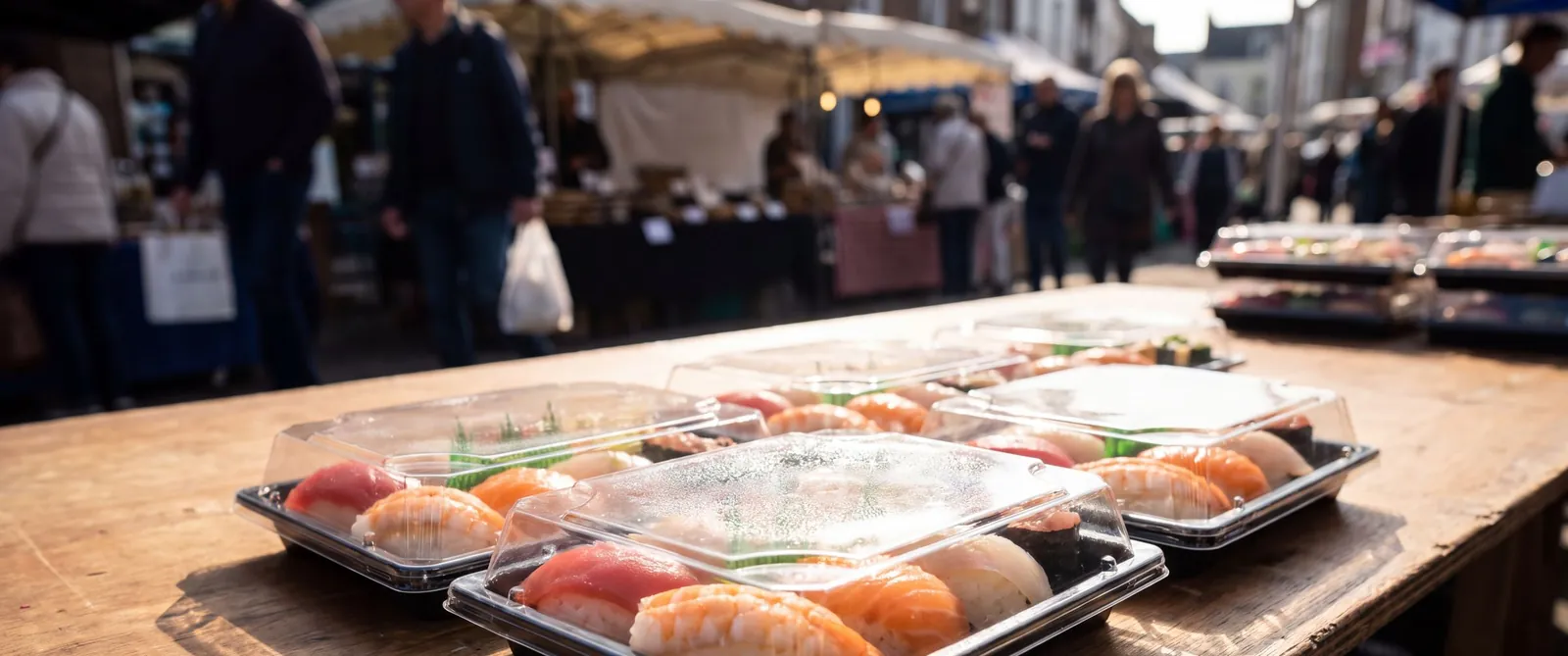
As sushi spread, the people making it and the ways of selling it changed. Chefs who trained in Japan are only a tiny fraction. Most are local cooks, people who moved over from other cuisines, or people who opened a shop after only a short course. Sushi is not sold only at specialty restaurants, either. It is sold in packs at supermarkets, at street stalls, and through delivery that can take more than 1 hour to arrive. Sushi changed from a dish that is "eaten right after it is shaped" into a dish that is "eaten some time after it is made."
The Association does not reject this spread. The problem lies elsewhere. The form of "raw fish on vinegared rice" is easy to copy. But the conditions that kept that form safe did not travel with it. You will learn what those conditions are in 1.3.
The Numbers Behind the Spread
Sushi spread first in North America. In the 1990s it spread to Europe, and from the 2000s onward to Asia, the Middle East, Latin America, and Africa. Japan's Ministry of Agriculture, Forestry and Fisheries estimates that Japanese restaurants outside Japan grew from about 24,000 in 2006 to about 187,000 in 2023. In 2025 there were about 181,000. That means the number became more than 7 times larger in less than 20 years. When the number of people making sushi rises quickly, the number of people making it without training rises too.
1.2 What Happens in Hot Countries, at Street Stalls, and Where Refrigeration Falls Short
What Is Happening at Street Stalls and Night Markets
At street stalls and night markets in hot countries, scenes like these are not unusual. In 35°C heat, raw fish sits on half-melted ice. Vinegared rice mixed in the morning is still being sold in the evening. Fish that has never been frozen is served raw, without any check for parasites. The stalls have no steady electricity, so the fish sits either on half-melted ice or out in the open air.
In places where tap water is not safe to drink, fish is sometimes chilled with ice made from that water. Ice is only as clean as the water it was made from. Ice made from dirty water itself carries bacteria and viruses. You think you are cooling the fish, but you are actually smearing contamination onto it.
How Many People Fall Ill Around the World
The World Health Organization (WHO) published an estimate in 2026. In the single year of 2021, about 866 million people worldwide became ill from diseases caused by food. About 1.52 million people died. There are no statistics for sushi alone. But at street stalls in hot countries, or with takeout sushi, mistakes in controlling temperature and time cause food poisoning. They can even lead to accidents that put lives at risk.
Japan Was Not Always Safe, Either
In Japan in the 1990s, there were many outbreaks of food poisoning from Vibrio parahaemolyticus, caused by seafood such as sashimi and sushi. Vibrio parahaemolyticus is a food poisoning bacterium that lives in seawater (Chapters 2 and 3). In 1998, outbreaks of Vibrio parahaemolyticus food poisoning reached 839.
In 2001, Japan set standards for seafood eaten raw, such as "store at 10°C or below." After that, the number of outbreaks fell sharply. Today it is standard practice to keep fish for raw consumption at 10°C or below. It is also standard to keep takeout sushi at 10°C or below with ice packs and to tell guests by what time to eat it. These rules came out of that experience (Chapter 5). Today, many regions outside Japan are walking the same road that Japan walked in the 1990s.
What Happens When the Temperature Chain Breaks
In Japan, fish is buried in ice on the fishing boat. At the market and at the intermediate wholesaler (nakaoroshi), it moves on ice and through cold storage, and then goes into the restaurant's refrigerator. In regions where this chain is broken, even fish "caught this morning" spends hours in the back of a truck under the blazing sun. The fish's temperature can rise above 30°C before it even reaches the restaurant.
Making vinegared rice in advance also carries a scientific risk. The acid in vinegar slows the growth of bacteria, but it does not stop it (Chapters 2 and 6). And rice carries bacteria that form spores, which survive heating. A spore is a bacterium in a dormant state, wrapped in a heat-resistant shell. It survives cooking, then wakes up in lukewarm rice, multiplies, and produces toxins (Chapter 3).
The Warmer the Sea, the More Dangerous Bacteria There Are
Vibrio parahaemolyticus becomes easier to find on the surface of fish and shellfish once the sea temperature rises above about 15°C. In summer, when the water rises above 20°C, it increases sharply. This is why Vibrio parahaemolyticus food poisoning in Japan is concentrated in summer. On tropical coasts, it is "Japanese summer" all year round (Chapter 3).
The Background to the Numbers
According to WHO estimates, children under 5 bear about 30% (29%) of the total health burden from food. About 143,000 children under 5 died.
Some bacteria cause serious illness. Enterohemorrhagic E. coli O157 can cause a serious kidney disease in young children called hemolytic uremic syndrome (HUS). Listeria can cause miscarriage or stillbirth in pregnant women (Chapter 3). Because of illnesses like these, we set the standard by the most vulnerable person.
In 1990s Japan, Vibrio parahaemolyticus competed with Salmonella for first place in the number of bacterial food poisoning outbreaks. The ranking changed from year to year. The peak year was 1998, with 839 outbreaks.
1.3 Why Sushi in Japan Could Be Eaten Raw
Few cultures in the world eat raw fish as an everyday food. It is no accident that this has worked in Japan. It has worked because at least four conditions came together (Figure 1-1). The four are a low-temperature supply chain, a short serving time, the acid and salt in the vinegared rice, and the chef's training.
- A low-temperature supply chain On the fishing boat, fish is buried in ice. Sometimes it is killed by ikejime (killing the fish instantly and bleeding it) and chilled in seawater ice. After that, it moves through the market, the intermediate wholesaler, refrigerated trucks, and the restaurant's refrigerator. Almost the whole way it stays at 10°C or below, and in many stages at 0 to 5°C. The fish travels at temperatures where bacteria do not grow. This flow is called the cold chain. It is a supply system that never lets the temperature rise, from the moment the fish is caught until it is served.
- A short serving time In Edomae (Edo-style) sushi, the neta (topping) prepared that day is shaped into sushi that same day. A finished piece reaches the guest's mouth within tens of seconds. Bacteria need time to multiply (Chapter 2). The counter is also a system for making the time between making and eating as short as possible. Sushi is a dish that sells not only the freshness of the toppings, but also time.
- The acid and salt in the vinegared rice The acid in the sushi vinegar makes it hard for bacteria to grow in the vinegared rice. Salt and sugar also slightly reduce the water that bacteria can use. Wasabi, gari (pickled ginger), and tea only play a supporting role (Chapter 6).
- The chef's training Chefs have an eye for freshness and a routine for removing the guts quickly. They have the habit of using separate cutting boards and knives for dirty work and clean work. They take only what they need from the refrigerated topping case. They rinse the cutting board and cleanse their hands with vinegar.
The chef's training has been engraved in the body as apprentices worked beside their master. It was handed down without the reasons ever being put into words. Because it was never put into words, it did not reach the world outside Japan. That is why this book writes down the "why."
Even in Japan, Safety Is Not Automatic
Even when all four conditions are in place, sushi in Japan is not perfectly safe. According to statistics from Japan's Ministry of Health, Labour and Welfare, the parasite Anisakis was the number one cause of food poisoning outbreaks every year from 2018 to 2024. In 2025, it was number two, after norovirus (Chapters 2 and 3). "It's fresh, so it's fine" is no guarantee of safety.
If even one of the four conditions is missing, the safety of eating raw fish breaks down. Outside Japan, two or even three are often missing. So the rule for chefs making sushi outside Japan is not "the same as in Japan." It is "stricter than in Japan."
Stacking Weak Defenses: The Hurdle Concept
The set of defenses built around the acid in the vinegared rice has a name. It is the hurdle concept. It is the idea of holding back bacteria by combining many defenses that are each weak on their own. In a track hurdle race, even low hurdles slow a runner down if there are many of them in a row. It is the same for bacteria.
Sushi vinegar lowers the pH of the vinegared rice. pH is a number that shows how strong an acid is. 7 is neutral, and the lower the number, the more acidic. Allyl isothiocyanate, the compound that gives wasabi its heat, has been reported to hold back bacteria in the laboratory. Wasabi is placed between the topping and the shari (sushi rice). There is also the vinegar in gari, hot tea, and tezu (vinegared hand water) for cleansing the hands. However, wasabi and tea only help make it harder for bacteria to grow. Each is weak on its own. Stacked around the acid in the vinegared rice, they hold back bacterial growth from many directions. Foods protected by acid exist all over the world, such as nare-zushi (fermented sushi), pickles, and sourdough bread, and they work on the same principle (Chapter 6).
Anisakis and the Mistake of "Fresh Means Safe"
There are several species of Anisakis in the seas around Japan. Research points out that the species common on the Pacific side tends to move from the guts into the flesh after the fish dies. The species common on the Sea of Japan side is said to tend to stay in the guts. In fish from any sea, the parasites can be in the flesh. Removing the guts early is important, but it is not enough. You need freezing or cooking, and you also need to look for the parasites and remove them (Chapters 3 and 12).
1.4 Rules Outside Japan: Three Rules That Differ from Japan
The first thing chefs making sushi outside Japan run into is rules that do not exist in Japan. We will look at three typical ones: freezing fish served raw, the ban on bare-hand contact, and the control of vinegared rice.
Fish Served Raw Must Be Frozen
The United States has a model code called the FDA Food Code. It is a hygiene code for restaurants issued by the U.S. Food and Drug Administration (FDA). States and counties adopt it and turn it into local ordinances. This code requires freezing to kill parasites in fish served raw or nearly raw. There are three options.
- At −20°C or below for 7 days Hold it for 168 hours. The 7 days is the total time, including the time it takes the fish to freeze.
- At −35°C or below for 15 hours Freeze it at −35°C or below, and hold it at −35°C or below for 15 hours.
- Freeze at −35°C, then hold at −20°C for 24 hours Freeze it at −35°C or below, and hold it at −20°C or below for 24 hours.
The FDA temperatures are based on the air temperature inside the freezer. Records must be kept for 90 days after the fish is served. Bivalve shellfish, some species of tuna, and farmed fish raised only on parasite-free formulated feed are among those exempt from this requirement.
European Union (EU) Regulation 853/2004 also requires freezing for fishery products eaten raw. The conditions are −20°C or below in every part of the product for 24 hours or more, or −35°C or below for 15 hours or more.
As a measure against Anisakis, Japan's Ministry of Health, Labour and Welfare recommends freezing at −20°C for 24 hours or more. For cooking, it is 70°C or above, or 1 minute at 60°C. The ministry also asks you to choose fresh fish, remove the guts early, and look for the parasites and remove them. However, in Japan this freezing is a recommendation, not a legal requirement. You can serve unfrozen fish raw. This is the biggest difference between Japan and Europe and the United States.
Table 1-1 sets the three standards side by side. The United States requires, for example, 7 days based on the air temperature inside the freezer. The EU requires, for example, −20°C or below in every part of the product for 24 hours or more. Japan recommends −20°C for 24 hours or more.
| Standard | Temperature and time | Conditions and exceptions |
|---|---|---|
| U.S. FDA Food Code | −20°C or below for 7 days (168 hours); or frozen at −35°C or below and held at −35°C or below for 15 hours; or frozen at −35°C or below and held at −20°C or below for 24 hours | Required. The temperature is the air temperature inside the freezer (the 7 days is the total time, including freezing). Records kept for 90 days after serving. Exemptions include bivalve shellfish, some tuna species, and farmed fish raised only on formulated feed |
| EU Regulation 853/2004 | −20°C or below for 24 hours or more; or −35°C or below for 15 hours or more | Required. "In every part of the product." Exception for farmed fish with no parasite concern |
| Japan, Ministry of Health, Labour and Welfare | −20°C for 24 hours or more (or cooking at 70°C or above, or 1 minute at 60°C) | A recommendation, not a legal requirement. No rule on where to measure the temperature. Combined with looking for and removing parasites, and removing the guts early |
Do Not Touch Ready-to-Eat Food with Bare Hands
The FDA Food Code prohibits touching ready-to-eat food with bare hands. This means food that will be eaten without any further cooking. Instead, you use tongs, paper, disposable gloves, or similar tools. In nigiri sushi, both the vinegared rice and the topping fall into this category. This rule is why many chefs in the United States wear gloves to make nigiri.
However, there is a procedure for an exception. If you apply to the health authority in advance and receive approval, bare-hand preparation is allowed. Approval requires written procedures describing several control measures. These include records of handwashing training, double handwashing or the use of nail brushes, hand sanitizing after washing, and a policy of not letting sick staff work. In other words, the U.S. system does not say, "Bare hands are unsanitary, so they are banned." It says, "If you keep food safe with bare hands, prove it." You will learn why sushi can be shaped with bare hands in Chapter 6.
Control Vinegared Rice by pH or by Time
In sushi restaurants in Japan, chefs keep the vinegared rice at body temperature, about 35 to 37°C, while shaping nigiri. But under U.S. rules, cooked rice is a TCS food (time/temperature control for safety). This is a food that needs control of time and temperature to keep bacteria from growing. TCS food must be held at 5°C or below, or at 57°C or above. Leaving vinegared rice at body temperature is, as a rule, a violation.
There are two ways to resolve this conflict. The first is acidification. You use sushi vinegar to bring the pH of the vinegared rice below a set value, and you get special approval from the health authority. The vinegared rice then no longer counts as a TCS food and can be held at room temperature. The set value differs by region. The 2022 edition of the FDA Food Code gives a pH below 4.2 as an example of a control limit. Some health authorities require 4.2 or below, while other regions set it at 4.6 or below. The restaurant submits a control plan, measures the pH with a pH meter every time it cooks rice, and records it. The second way is time control. You write down the time the rice came out of the refrigerator, or the time it was cooked and mixed. After 4 hours, you throw out what is left and record the time and the discarding.
Why 4.6 or 4.2? A pH of 4.6 is considered the lower limit at which Clostridium botulinum can grow. Clostridium botulinum forms heat-resistant spores and produces a deadly toxin. But Bacillus cereus, which lives on rice, can grow down to about pH 4.3. Salmonella and Staphylococcus aureus can sometimes grow at an even lower pH. That is why some regions require around 4.2 for vinegared rice (Chapters 2 and 9).
What the rules in Europe and the United States have in common is planning and record-keeping based on HACCP. HACCP is a hygiene management method. You identify the points where hazards arise, decide on the critical control points, monitor them, and keep records. In Japan too, since June 2021, hygiene management based on HACCP principles has been required, in principle, of all food business operators. What an inspector looks at is not the chef's skill, but the records (Chapter 5).
1.5 The Chef's Responsibility: When in Doubt, Throw It Out
Food poisoning happens by "probability." You may serve fish that sat in the temperature danger zone for 2 hours, and very often no one gets sick. This experience of "it's always been fine" is the most dangerous teacher. On a day when the conditions line up, the same routine hurts people. Safety does not mean that no accident has happened. It means that a system to prevent accidents is working every day.
Food poisoning prevention in Japan has three principles: keep bacteria off, keep them from growing, and kill them. Keep bacteria off the food (Chapter 4). Keep any bacteria that got on from growing (Chapters 2 and 5). Kill whatever remains (Chapters 3 and 12). Then in Chapter 6, you will learn how shaping sushi with bare hands, the core skill of sushi, fits with these three principles. Each chapter in Part I applies these three principles to the work of a sushi restaurant.
From purchasing until the sushi reaches the guest's mouth, only the chef touches every stage. The chef is the last line of defense. A hazard the chef fails to stop there can no longer be stopped by anyone. There is only one rule for judgment: when in doubt, throw it out. The cost of the ingredients you throw away is far less than the price of one guest going to the hospital. It does not even compare with the price of losing your restaurant's trust.
Chapter summary
- Sushi spread around the world from the 1970s onward, and there are about 181,000 Japanese restaurants outside Japan (2025). Both the people making it and the ways of selling it changed, and it became a dish "eaten some time after it is made."
- In hot countries and at street stalls, half-melted ice, ice made from dirty water, and vinegared rice made in advance cause food poisoning. According to WHO estimates (published in 2026, for 2021), about 1.52 million people a year die from diseases caused by food.
- Japan also had many Vibrio parahaemolyticus outbreaks in the 1990s. They fell sharply after the 2001 standards, such as "store seafood for raw consumption at 10°C or below."
- The safety of sushi in Japan has rested on four things: a low-temperature supply chain, a short serving time, the acid and salt in the vinegared rice, and the chef's training. Wasabi and tea only help. Outside Japan, be "stricter than in Japan."
- Set the hygiene standard by "the most vulnerable person." Food poisoning happens by probability, and the chef is the last line of defense. When in doubt, throw it out.
- Freezing standards: the FDA requires, for example, −20°C or below for 7 days based on the air temperature inside the freezer. The EU requires, for example, −20°C or below in every part of the product for 24 hours or more. Japan recommends −20°C for 24 hours or more (a recommendation; this book applies it to the core temperature). (Grade 1)
- The FDA prohibits bare-hand contact, but an exception is allowed with approved written procedures. Vinegared rice is handled either by acidification (pH 4.6 or below, or 4.2 or below, depending on the region) or by 4-hour time control. (Grade 1)
Review questions
Q1 Which is the most appropriate reason why sushi with raw fish has worked as a safe food culture in Japan?
a Because fish in the seas around Japan have no parasites
b Because bacteria do not get on fresh fish
c Because several conditions came together: a low-temperature supply chain, a short serving time, the acid and salt in the vinegared rice, and the chef's training
d Because the salt in soy sauce kills all food poisoning bacteria
e Because Japan's climate is cool all year, so bacteria have a hard time growing
Answer: c
The safety of eating raw fish has rested on four conditions coming together. a is wrong: Anisakis was the number one cause of food poisoning outbreaks from 2018 to 2024. b is also wrong: even fresh fish carries bacteria on its skin, gills, and intestines. d is wrong: the level of salt in soy sauce does not kill bacteria. e is also wrong: in a Japanese kitchen in summer, the temperature is one at which bacteria grow well.
Q2 Regarding sushi hygiene, which is the correct way for a chef to think?
a A procedure that has never caused food poisoning will stay safe in the future
b The hygiene standard is decided by whether a healthy adult can eat the food safely
c Even outside Japan, it is enough to follow the same methods as in Japan
d Set the hygiene standard at a level that is fine even for the most vulnerable person who eats it, and when in doubt, throw it out
e If fish is placed on ice, it is safe even after the ice has fully melted
Answer: d
The people most likely to die from food poisoning are infants and young children, older adults, pregnant women, and people with lowered resistance. A chef cannot know a guest's health, so the standard is set by the most vulnerable person. a is wrong: food poisoning happens by probability, on a day when the conditions line up. b sets the standard far too loosely. c is wrong: outside Japan, conditions are often missing, so the rule is "stricter than in Japan." e is also wrong: fish whose ice has fully melted is starting to enter the temperature danger zone.
Q3 Which is a correct freezing condition set by the U.S. FDA Food Code against parasites in fish served raw?
a Hold at −18°C or below for 24 hours
b Hold at −20°C or below for 7 days (168 hours)
c Hold at −10°C or below for 7 days
d Soak in vinegar for 30 minutes or more, then hold at −20°C for 1 hour
e Hold at −35°C or below for 15 minutes
Answer: b
The FDA Food Code gives three options: −20°C or below for 7 days; freezing at −35°C or below and holding at −35°C or below for 15 hours; or freezing at −35°C or below and holding at −20°C or below for 24 hours. In every case, the temperature is the air temperature inside the freezer. a is about the temperature of a home freezer: it does not reach −20°C, and the time is too short. c is too warm. d is wrong because vinegar does not kill parasites, and the time is too short. e is wrong because the rule is 15 "hours," not 15 minutes.